GENEVA: The number of humanitarian aid convoys entering Gaza daily must at least double to meet some of the population’s most basic needs, the World Food Programme (WFP) said on Wednesday.
The United Nations has warned that widespread famine in the Gaza Strip is “almost inevitable” without action. Aid organizations have blamed military operations, insecurity and extensive restrictions to the delivery of essential supplies for the shortage of food in the enclave, which has been devastated by an Israeli offensive against Hamas.
The five-month war has already killed over 30,000 people in the Strip, according to health officials in Gaza.
“I would say that we need to double the level we have now. We are now at around 150 trucks. We need a minimum of 300 trucks a day coming in,” Carl Skau, Deputy Executive Director and Chief Operating Officer at the World Food Programme, told Reuters.
“But of course, that also in the longer run needs to be supplemented with commercial (supplies).”
Before the conflict began in October, Gaza relied on 500 trucks entering daily. Aid can currently be delivered into southern Gaza via the Rafah crossing from Egypt and Kerem Shalom crossing from Israel.
A breakdown of law and order inside Gaza has been a major impediment to aid delivery, as five months of war have destroyed many of the institutions that underpinned social order in the Palestinian enclave.
“The breakdown of civil order is an increasing challenge for us,” Skau said. “There are armed gangs that are roaming, filling that vacuum of security.”
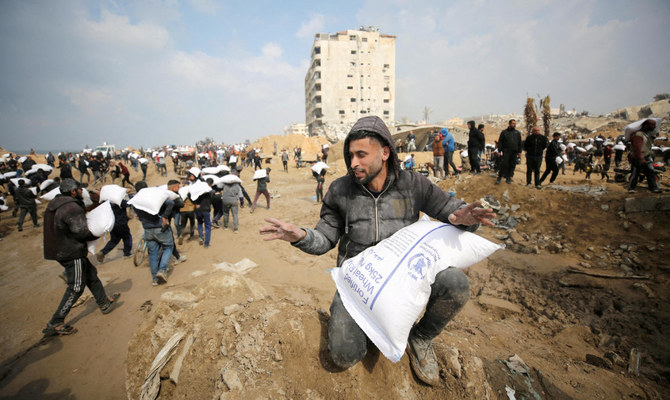
Some convoys have been seized by people seeking food, and any convoys moving into northern Gaza require Israeli coordination for safe passage through checkpoints and areas with fighting.
On Tuesday, WFP’s first mission to northern Gaza since Feb. 20 — a 14-truck food convoy — was turned back by the Israeli Defense Force after a three-hour wait at the Wadi Gaza checkpoint, it said.
Skau said Israeli authorities did not provide a reason for the convoy being turned away.
The WFP said that after the trucks were turned away, they were rerouted and later stopped by a large crowd of desperate people who looted the food, taking around 200 tons.
Skau said he could not predict when the WFP would make a new attempt to deliver supplies to northern Gaza but said the organization was “determined to get there as soon as we can.”
“We have built up the commodities to be able to serve the entire population for three months, and this can be scaled up tomorrow, should the situation allow,” Skau said.
“We will go as soon as we feel that the conditions are acceptable.”


![]()

Aid trucks entering Gaza must double to meet basic needs, WFP says
Short Url
https://arab.news/cxeah
Aid trucks entering Gaza must double to meet basic needs, WFP says
- The five-month war has already killed over 30,000 people in the Strip, according to health officials in Gaza


Latest updates


© 2026 SAUDI RESEARCH & PUBLISHING COMPANY, All Rights Reserved And subject to Terms of Use Agreement.