

Pakistani court issues notices to information ministry, telecom authority over X ban

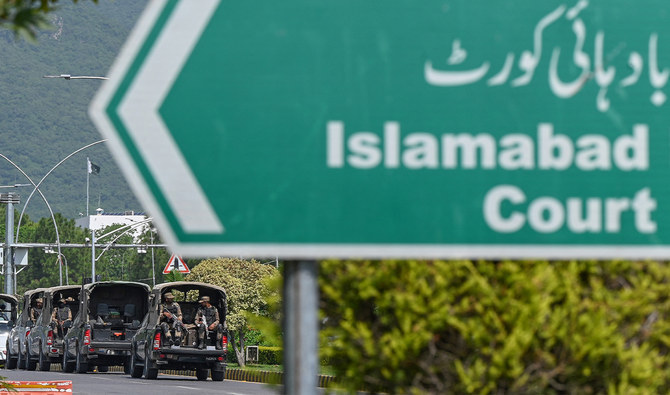
A convoy of Pakistani army passes the Islamabad High Court building in Islamabad on August 29, 2023. (AFP/File)
Short Url
Updated 05 March 2024
Follow

Pakistani court issues notices to information ministry, telecom authority over X ban

  • X first went down on Feb. 17 when a government official confessed to manipulating votes in last month’s election
  • The unannounced ban has raised widespread concerns about the state of democratic freedoms in the country

ISLAMABAD: A Pakistani high court on Tuesday issued notices to the country’s information ministry and its telecommunication authority on a plea challenging the ban on social media platform X, local media widely reported. 

X first went down on Feb. 17 when a government official confessed to manipulating votes in Pakistan’s Feb. 8 general election. The admission came as former prime minister Imran Khan’s Pakistan Tehreek-e-Insaf (PTI) and other political parties staged protests countrywide, alleging the Election Commission of Pakistan (ECP) had rigged elections, which it denies. 

Pakistani authorities remain tight-lipped about the ban, with Caretaker Information Minister Murtaza Solangi saying last week the government did not impose any ban on the platform. 

X’s disruption has raised widespread concerns about the state of democratic freedoms in the country, with the United States and several international organizations urging Pakistan to provide unhindered Internet access and leading digital rights activists calling the blockade a “blatant violation” of civil liberties. 

Islamabad High Court (IHC) Chief Justice Aamer Farooq took up a plea challenging X’s restriction, Pakistani English language newspaper Dawn reported. Lawyers Sardar Masroof and Amna Ali appeared before the court on behalf of the petitioner, an Islamabad resident named Ehtisham Abbasi. The judge asked if X was accessible for Pakistani users to which Masroof responded that it has been banned since Feb. 17. 

“Subsequently, the IHC issued notices to the respondents, including the information ministry and the Pakistan Telecommunication Authority (PTA), and adjourned the hearing till next week,” Dawn said. Other Pakistani media also widely reported on the development. 

The ban continues to remain in force despite a Sindh High Court (SHC) order on Feb. 21, in which the court ordered the PTA to restore X and other social media platforms in the country. The SHC is holding a contempt of court hearing against the PTA for allegedly violating the high court’s orders on restoring X. 

Before the latest blockade, Pakistan experienced multiple Internet disruptions in recent weeks that made social media platforms such as Facebook, YouTube, X and Instagram inaccessible. Recent occurrences were on Jan. 20, Jan. 7, and Dec. 17, when Khan’s PTI party was holding virtual events. The government had blamed those disruptions on “technical glitches.”

Such shutdowns have previously had a devastating impact on Pakistan’s economy. The day after Khan’s arrest in May last year, Reuters reported that point-of-sale transactions routed through Pakistan’s main digital payment systems fell by around 50 percent according to the region’s two largest payments system operators, 1LINK and Habib Bank Limited.

According to the Internet Society’s monitor Pulse, it is becoming an increasingly common tactic for governments to shut down the Internet on a national or sub-national level to either control civil unrest, stem the flow of misinformation, sway the results of general elections or to gain strategic advantages in territories with ongoing wars.


Imran Khan’s party shutdown draws mixed response; government calls it ‘ineffective’

Updated 08 February 2026
Follow

Imran Khan’s party shutdown draws mixed response; government calls it ‘ineffective’

  • Ex-PM Khan’s PTI party had called for a ‘shutter-down strike’ to protest Feb. 8, 2024 general election results
  • While businesses reportedly remained closed in Khyber Pakhtunkhwa, they continued as normal elsewhere

ISLAMABAD: A nationwide “shutter-down strike” called by former prime minister Imran Khan’s party drew a mixed response in Pakistan on Sunday, underscoring political polarization in the country two years after a controversial general election.

Khan’s Pakistan Tehreek-e-Insaf (PIT) opposition party had urged the masses to shut businesses across the country to protest alleged rigging on the second anniversary of the Feb. 8, 2024 general election.

Local media reported a majority of businesses remained closed in the Khyber Pakhtunkhwa (KP) province, governed by the PTI, while business continued as normal in other provinces as several trade associations distanced themselves from the strike call.

Arab News visited major markets in Islamabad’s G-6, G-9, I-8 and F-6 sectors, as well as commercial hubs in Rawalpindi, which largely remained operational on Sunday, a public holiday when shops, restaurants and malls typically remain open in Pakistan.

“Pakistan’s constitution says people will elect their representatives. But on 8th February 2024, people were barred from exercising their voting right freely,” Allama Raja Nasir Abbas Jafri, the PTI opposition leader in the Senate, said at a protest march near Islamabad’s iconic Faisal Mosque.

Millions of Pakistanis voted for national and provincial candidates during the Feb. 8, 2024 election, which was marred by a nationwide shutdown of cellphone networks and delayed results, leading to widespread allegations of election manipulation by the PTI and other opposition parties. The caretaker government at the time and the Election Commission of Pakistan (ECP) both rejected the allegations.

Khan’s PTI candidates contested the Feb. 8 elections as independents after the party was barred from the polls. They won the most seats but fell short of the majority needed to form a government, which was made by a smattering of rival political parties led by Prime Minister Shehbaz Sharif. The government insists the polling was conducted transparently and that Khan’s party was not denied a fair chance.

Authorities in the Pakistani capital deployed a heavy police contingent on the main road leading to the Faisal Mosque on Sunday. Despite police presence and the reported arrest of some PTI workers, Jafri led local PTI members and dozens of supporters who chanted slogans against the government at the march.

“We promise we will never forget 8th February,” Jafri said.

The PTI said its strike call was “successful” and shared videos on official social media accounts showing closed shops and markets in various parts of the country.

The government, however, dismissed the protest as “ineffective.”

“The public is fed up with protest politics and has strongly rejected PTI’s call,” Pakistan’s Information Minister Attaullah Tarar said on X.

“It’s Sunday, yet there is still hustle and bustle.”

Ajmal Baloch, All Pakistan Traders Association president, said they neither support such protest calls, nor prevent individuals from closing shops based on personal political affiliation.

“It’s a call from a political party and we do not close businesses on calls of any political party,” Baloch told Arab News.

“We only give calls of strike on issues related to traders.”

Khan was ousted from power in April 2022 after what is widely believed to be a falling out with the country’s powerful generals. The army denies it interferes in politics. Khan has been in prison since August 2023 and faces a slew of legal challenges that ruled him out of the Feb. 8 general elections and which he says are politically motivated to keep him and his party away from power.

In Jan. 2025, an accountability court convicted Khan and his wife in the £190 million Al-Qadir Trust land corruption case, sentencing him to 14 years and her to seven years after finding that the trust was used to acquire land and funds in exchange for alleged favors. The couple denies any wrongdoing.