
CAIRO/RAFAH: Hamas said on Monday it was pressing on with talks on securing a ceasefire in Gaza despite Israel’s decision not to attend, while Washington appeared to take a tougher line in demanding its ally Israel ease the plight of suffering civilians.
The ceasefire talks, which began on Sunday in Cairo, are billed as a final hurdle to establish the first extended ceasefire of the five-month-old war, in time for the Ramadan Muslim fasting month which is expected to begin on Sunday.
Israel has declined public comment on the Cairo talks or its decision not to attend. A source had earlier told Reuters Israel would stay away because Hamas had refused its request for a list of names of all hostages it is holding that are still alive, information the militants say they will provide only once terms are agreed.
“Talks in Cairo continue for the second day regardless of whether the occupation’s delegation is present in Egypt,” a Hamas official told Reuters on Monday.
Washington, which is both Israel’s closest ally and a sponsor of the talks, says a deal remains close, with an agreement already effectively agreed by Israel and only awaiting approval from Hamas.
“Hamas claims it wants a ceasefire. Well, there is a deal on the table. And as we have said, Hamas needs to agree to that deal,” Vice President Kamala Harris said on Sunday. “Let’s get a ceasefire. Let’s reunite the hostages with their families. And let’s provide immediate relief to the people of Gaza.”
In a speech signalling an apparent change of tone from the administration of President Joe Biden toward its ally, Harris also used unusually forceful language to call for Israel to do more to alleviate the humanitarian plight of the Gaza Strip.
“People in Gaza are starving. The conditions are inhumane and our common humanity compels us to act,” she said. “The Israeli government must do more to significantly increase the flow of aid. No excuses.”
A Palestinian official close to the talks disputed the US contention that Israel had agreed to the ceasefire deal and Hamas was holding it up, saying the position appeared aimed at deflecting blame away from Israel should the talks collapse.
“The Palestinian resistance, led by Hamas, has shown the flexibility needed, but at the same time they are determined to defend their people and achieve a deal that is acceptable to the Palestinian people,” the official said.
The proposal being discussed is for a ceasefire of around 40 days, during which militants would release around 40 of the more than 100 hostages they are still holding in return for around 400 detainees held in Israeli jails.
Israeli troops would pull back from some areas, more humanitarian aid would be allowed into Gaza, and residents would be permitted to return to abandoned homes.
But the deal does not appear to address directly a Hamas demand for a clear path to permanently ending the war. Nor does it resolve the fate of more than half of the remaining hostages — Israeli men excluded from both this and earlier agreements covering women, children, the elderly and the wounded.
Israel says it will not end the war until Hamas is eradicated. Hamas says it will not free all its hostages without a deal that ends the war. Mediators have indicated they hope to overcome the standoff with promises to resolve further issues in later phases.
Rafah strike kills family
The Gaza war erupted after Hamas fighters who control the enclave burst into Israel on Oct. 7, killing 1,200 people and abducting 253 hostages, according to Israeli tallies.
Since then, Israel has sealed off the coastal strip, stormed nearly all of its towns and pounded it from the sky. Palestinian authorities say more than 30,000 people have been confirmed killed, with thousands of other bodies unrecovered. Most of the population has been made homeless, and the United Nations says hundreds of thousands of people face famine.
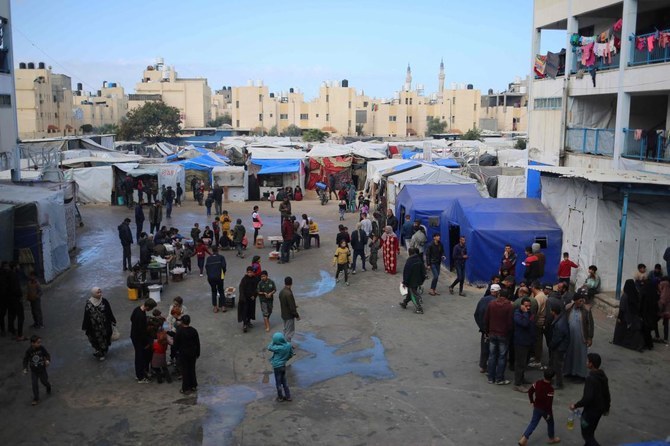
An agreement to halt fighting by Ramadan would effectively head off a threatened Israeli assault on Rafah, the last town on the southern edge of Gaza, where more than half of the enclave’s population are now sheltering, mostly in makeshift tents.
The final days leading up to that deadline have been particularly bloody. Residents have described heavy fighting since Saturday just north of Rafah in Khan Younis, the main southern city, where Israeli forces have released video showing buildings obliterated in airstrikes.
In Rafah itself, airstrikes on homes have been killing families nightly as they sleep. At least 14 corpses of a family killed overnight were laid out at a hospital morgue in Rafah on Monday morning. One of the body bags was partially unzipped so weeping relatives could stroke the hair of a dead child.
Israel’s Channel 14 News reported on Monday that several officers in the Israel Defense Forces (IDF) spokesperson’s unit were leaving their jobs, including chief international spokesperson Lt. Col. Richard Hecht. It said the large number leaving at once at a time of war was unusual.
The military denied media reports that chief spokesperson Rear-Admiral Daniel Hagari had resigned, but did not directly comment on reports of other officers leaving the unit. “The IDF Spokesperson’s Unit continues to fulfil its mission of sharing the truth with transparency and accuracy, while countering misinformation — including baseless claims such as these,” it said in a statement.