The US and South Korea begin large military drills to boost readiness against North’s threats

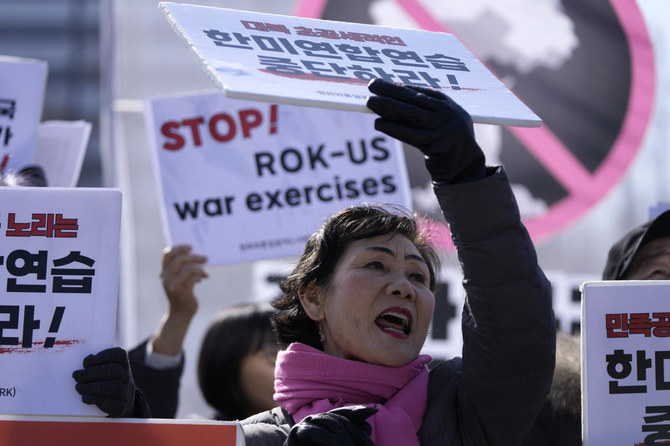
Protesters shout slogans during a rally demanding to stop the joint military exercises between the US and South Korea, in Seoul. (AP)
Short Url
Updated 04 March 2024
Follow

The US and South Korea begin large military drills to boost readiness against North’s threats

  • North Korea had no immediate response to the major annual drills it regards as a rehearsal for invasion

SEOUL, South Korea: South Korea and the United States began large annual military exercises Monday to bolster their readiness against North Korean nuclear threats after the North raised animosities with an extension of missile tests and belligerent rhetoric earlier this year.
The South Korean and US forces began a computer-simulated command post training called the Freedom Shield exercise and a variety of field exercises for an 11-day run, the South Korean Defense Ministry said.
North Korea had no immediate response to the major annual drills it regards as a rehearsal for invasion. The North has staged provocative weapons tests in the past in reaction to its adversaries’ joint drills.
South Korea’s military said last week that it would conduct 48 field exercises with the US forces this spring, twice the number conducted last year, and that they would involve live-firing, bombing, air assault and missile interception drills.
Since early 2022, North Korea has conducted more than 100 rounds of missile tests to modernize its arsenal as talks with the United States and South Korea have been stalled for an extended period. In response, the United States and South Korea have expanded their training exercises and increased the deployment of powerful USmilitary assets such as aircraft carriers and long-range nuclear-capable bombers.
This year, North Korea carried out six rounds of missile tests and barrage of artillery firing drills. Its leader Kim Jong Un also said North Korea would scrap its long-standing goal of peaceful unification with South Korea and take a more aggressive military posture along the disputed sea boundary with South Korea. He also vowed to “annihilate” South Korea and the United States if provoked, a threat that he had previously issued.
The North Korean steps raised worries that it might make provocations along the tense Korean sea and land borders. But experts say the prospect for a full-blown attack by North Korea is dim as the North knows its military is outmatched by US and South Korean forces.
North Korea’s moves to raise tensions are likely related to upcoming elections planned by its rivals: the US presidential election in November and South Korea’s parliament election in April. North Korea believes an advanced nuclear arsenal will increase its leverage in future diplomacy and it can win concessions like the easing of international sanctions, experts say.


Congo-Brazzaville president set to extend decades-long rule

Updated 2 sec ago
Follow

Congo-Brazzaville president set to extend decades-long rule

BRAZZAVILLE: At the age of 82 and after more than 40 years in power, Denis Sassou Nguesso is the clear favorite to win Sunday’s presidential election in Congo-Brazzaville.
With the opposition divided, sidelined and largely absent, observers say voter turnout could slump to a record low in the oil-rich but impoverished central African country.
Sassou Nguesso ranks as one of Africa’s longest-serving leaders, along with Equatorial Guinea’s Teodoro Obiang Nguema and Cameroonian President Paul Biya.
“Honestly, I don’t see the point of voting on March 15. Whether I vote or not, we’ll have the same winner,” said Cyril Massamba, who lives in the capital Brazzaville.
Sassou Nguesso, a career military officer, first led Congo under a one-party system from 1979 to 1992 before losing the first multi-party elections to former prime minister Pascal Lissouba, whom Sassou Nguesso then overthrew in a civil war in 1997.
He has maintained a firm grip over the former French colony, which gained independence in 1960 and has traditionally maintained close ties with both France and Russia.
Six candidates are bidding to unseat him but few have the resources to compete with the ruling Congolese Labour Party (PCT).
The party’s red Soviet-style flags and giant Sassou Nguesso portraits have filled city streets since the campaign began.
Lacking broad support, opposition candidates have been unable to rally behind a single challenger.
The two main opposition parties have chosen not to stand, one of them arguing that conditions for a free and transparent election have not been met, and urging supporters to vote “according to their conscience.”
“Denis Sassou Nguesso controls the entire electoral process,” said Clement Mierassa, an opposition figure, former minister and previous presidential candidate.
He argued that all those running against the president were just placeholders.
Two prominent candidates who challenged Sassou Nguesso in the disputed 2016 election remain in prison, serving 20-year sentences for “endangering state security.”

- Turnout fears, unemployment -

“I’ll go to a polling station the day my own child is a candidate,” joked shopkeeper Monique Ouollo.
Sassou Nguesso has urged his supporters to turn out and vote in Sunday’s first round, telling a rally in Pointe?Noire: “No abstention!” No date has yet been given for a second round of voting.
But many young people in the port city voiced frustration over chronic unemployment and the lack of economic prospects in a country rich in oil and gas.
Despite GDP growth of 2.9 percent in 2025, about half the population of six million lives below the poverty line, according to the World Bank.
Congo-Brazzaville depends heavily on hydrocarbons, which account for more than three-quarters of export earnings.
Authorities say proven oil reserves will last another 25 years at current production rates and aim to reach 500,000 barrels a day by 2030.
Gas production reached three million tons of LNG last year.
Although it has 10 million hectares of arable land, only about four percent is farmed, mostly for low-yield subsistence crops.
The country imports much of its food, leaving households exposed to swings in global prices, shipping costs and exchange rates.
Officials hope Congo’s location — between the Congo Basin and the Atlantic Ocean — will help turn it into a regional trading hub, tapping existing rail and road networks to boost links with neighbors.

- Diplomatic balancing act -

At Sassou Nguesso’s first campaign rally last month, foreign paramilitaries were spotted on rooftops nearby, including a sniper.
Their presence fueled speculation about Russian mercenaries providing security, mirroring arrangements in the Central African Republic.
A ruling party official confirmed to AFP that the men were Russian personnel, without detailing their mission.
Seen as a relatively stable hub in a volatile region, Congo-Brazzaville retains close ties with Paris, its largest development aid donor, and is home to around a hundred French companies.
But Russia is also a longstanding partner: Congo was allied with the Soviet bloc from 1968 to the early 1990s.
Though Sassou Nguesso maintains tight control over the security apparatus, some of his allies acknowledge that fears of a power grab remain.
The president told AFP in an interview in early March that he does not intend to “remain in power forever.”