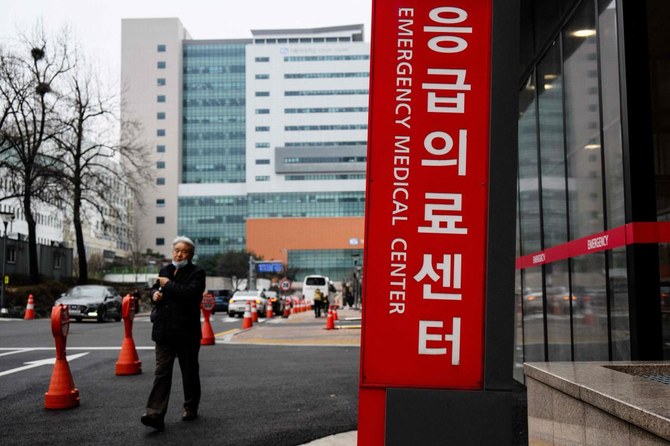
SEOUL: South Korea said Thursday it was seeking its first talks with striking junior doctors, warning them to return to hospitals ahead of a looming deadline or risk legal action over work stoppages that have plunged hospitals into chaos.
Nearly 10,000 junior doctors — about 80 percent of the trainee workforce — handed in their notice and walked off the job last week to protest government plans to sharply increase medical school admissions to cope with shortages and an aging society.
Doctors say the plan would hurt the quality of service, and the Korean Medical Association (KMA) has slammed the government’s “intimidation tactics.”
Under South Korean law, doctors are prohibited from striking, and the government has threatened to arrest and suspend the medical licenses of medics who do not return to work by Thursday.
Second Vice Health Minister Park Min-soo said he had contacted doctors involved in the strike seeking talks and hoped to meet them later Thursday, adding he was unsure “how many people will attend.”
Doctors had begun trickling back to work in hospitals, Park said. “We have confirmed a downgrade in the walkouts for two days in a row,” he told a press briefing.
But Health Minister Cho Kyoo-hong told local media on Thursday that “a full-scale return has not yet materialized.”
“As today is the last day (to) return, I implore them to do so for the patients,” he said, adding medics who returned to work before the deadline expired would not be punished.
Cho said the government was committed to its reform plan, which would increase medical school admissions by 65 percent, citing shortages of health professionals and a looming demographic crisis.
The KMA has not commented on possible talks, but a social media account run by young doctors shared a screenshot of a text message from the government and said: “You must be joking.”
Analysts say the government’s hard-line stance may play well for them ahead of legislative elections set for April 10.
“If the government were to back down now, they would perceive it as a major setback ahead of the upcoming general elections,” Kim Jae-heon, the secretary general of an NGO advocating free medical care, said.
But doctors “believe that stepping back at this point would result in their own disadvantage. It seems the current standoff will continue for a while.”
Proponents of the reform say doctors are mainly concerned the changes could erode their salaries and social status. The government says South Korea has one of the lowest doctor-to-patient ratios among developed countries.
Polling shows up to 75 percent of the public support the reforms, and President Yoon Suk Yeol, who has taken a hard line on the striking doctors, has seen his approval ratings tick up.
Kim Sung-ju, head of the Korean Cancer Patients Rights Council, said that patients’ lives were being held “hostage.”
“If the entire system comes to a halt simply because (junior doctors) have left, it truly highlights the shortage of doctors,” he said.
“It is astonishing that they are... using patients’ lives as leverage to further their own interests.”
The mass work stoppage has resulted in cancelations and postponements of surgeries for cancer patients and C-sections for pregnant women, with the government raising its public health alert to the highest level.
Kim Tae-hyeon, the head of the Korean ALS Association, said the striking doctors were “worse than organized criminals.”
“In hospice wards and intensive care units, (patients) are struggling to stay alive,” he added.


![]()

South Korea seeks talks with striking medics as return to work deadline looms
Short Url
https://arab.news/6wh6k
South Korea seeks talks with striking medics as return to work deadline looms
- Nearly 10,000 junior doctors – about 80 percent of the trainee workforce – handed in their notice and walked off the job last week


Latest updates


Recommended


© 2026 SAUDI RESEARCH & PUBLISHING COMPANY, All Rights Reserved And subject to Terms of Use Agreement.