



DUBAI: “It’s the biggest thing I’ve ever done in my life,” says London-based Palestinian artist Malak Mattar. The statement refers to her rectangular black-and-white painting, “Last Breath,” completed in February, and it is true both literally and metaphorically.
“Last Breath” portrays hellish scenes unfolding in Mattar’s native city of Gaza, the target of Israeli military aggression since October last year. “I feel it summarizes a lot of things I want to say,” she tells Arab News.
When the current war began, Mattar says she had no creative urge whatsoever. “It was like artistic paralysis: I couldn’t hold a piece of paper, or paint, or look at paintings. For me, nothing had meaning to be honest,” she explains.
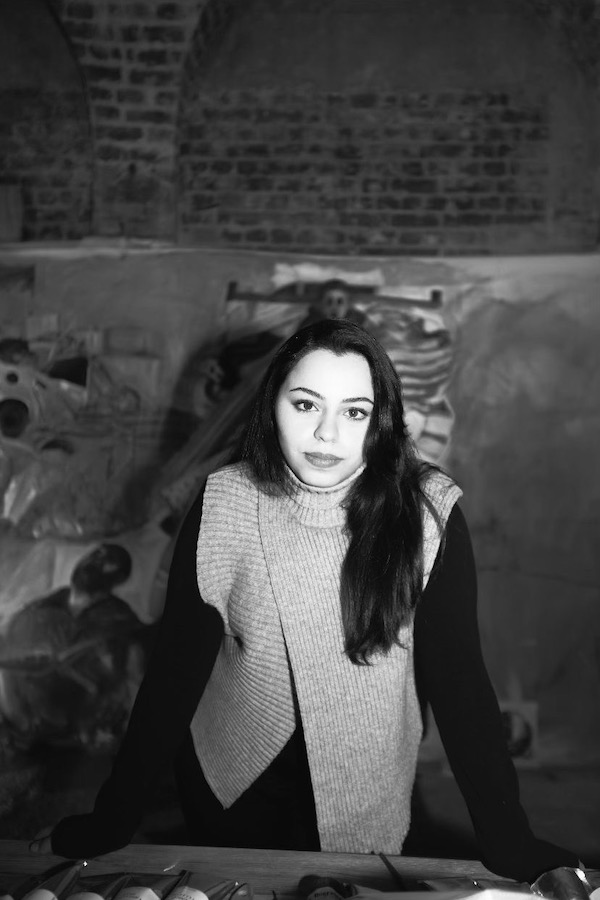
Malak Mattar is a London-based Palestinian artist. (Supplied)
But things started shifting when she spent December making more than 100 sketches, based on graphic photographs, on brown paper. They mostly portrayed victims of the Israeli bombardment, which began just days after Mattar returned to the UK from a visit to her hometown.
Mattar spent a month creating “Last Breath,” using a ladder at times to work on the canvas, which is more than two meters high. During that month, there were two weeks when she didn’t hear from her family in Gaza.
“It was a complete blackout — there were no messages, no calls, no news,” she recalls. “But that didn’t stop me. To keep painting a work like this, you have to pressure yourself. For a while, I blocked my feelings; the urgency and commitment that I had was bigger than any personal feelings I had.”
The result is confrontational and compelling. Mattar has created an unflinching and disturbing scene of terrified faces, broken buildings and poignant graffiti that is hard to swallow. At the center of it all is a horse. It pulls a cart laden with household belongings — a mattress, a chair, blankets — as well as a dead body wrapped in white cloth. But there is also a young boy, alive, perched on the front of the cart.
“The horse has a symbolism and a place in the current time of war,” Mattar explains. “Its role has changed from carrying fruits and vegetables to being an ambulance. There’s a strength and hardness to a horse, which is how I also see Gaza; I don’t see it as a weak place. In my memory, I think of it as a place that loves life. It always gets back on its feet after every war.”
Mattar says the hardest section for her to paint was the image’s left side, which includes large, black birds picking at corpses.
“The most shocking thing was how birds were eating martyrs’ bodies. Even the animals couldn’t find food,” says Mattar.
The painting also notes the loss of cultural heritage, portraying how important landmarks, such as the Great Omari Mosque, the Greek Orthodox Saint Porphyrius Church and the Rashad Shawa Cultural Center have been severely damaged.
And then there are the glimpses of children’s toys, indicating the loss of youth and innocence.
“Inside every child there is an adult. When a child starts speaking as an adult, it’s dangerous,” says Mattar. “A whole generation hasn’t lived its childhood and adolescence.”
“Last Breath” is difficult, uncomfortable viewing. Deliberately so. “It’s a very dark time and this painting is not about hope — not even an ounce of it,” Mattar says. “It’s not something we will ever recover from.”
Some have said that the painting resembles Picasso’s masterpiece “Guernica,” created during the Spanish Civil War, and also a response to the bombing of a city. Mattar was particularly flattered when a commentator called it “Guernica Al-Jadida” (the New Guernica).
“Last Breath” is currently being stored in the vault of London’s National Gallery. It will be on display at a solo exhibition between Mar. 6 and 10 at Cromwell Place in the British capital. Mattar hopes the work will become a permanent part of a museum’s or public institution’s collection, but not a private one.
“The goal for this work is for it to be seen,” she says. “It’s not for sale, because it’s impossible to put a price on it. For the first time, I feel like (my work) belongs to something bigger than me; it belongs to a bigger cause.”


