RAFAH, Gaza Strip: Aid convoys carrying food reached northern Gaza this week, Israeli officials said Wednesday, the first major delivery in a month to the devastated, isolated area, where the UN has warned of worsening starvation among hundreds of thousands of Palestinians amid Israel’s offensive.
The increasing alarm over hunger across Gaza has fueled international calls for a ceasefire as the US, Egypt and Qatar work to secure a deal between Israel and Hamas for a pause in fighting and the release of some of the hostages seized by Hamas in its Oct. 7 attack.
Mediators hope to reach an agreement before the Muslim holy month of Ramadan starts around March 10. But so far, Israel and Hamas have remained far apart in public on their demands.
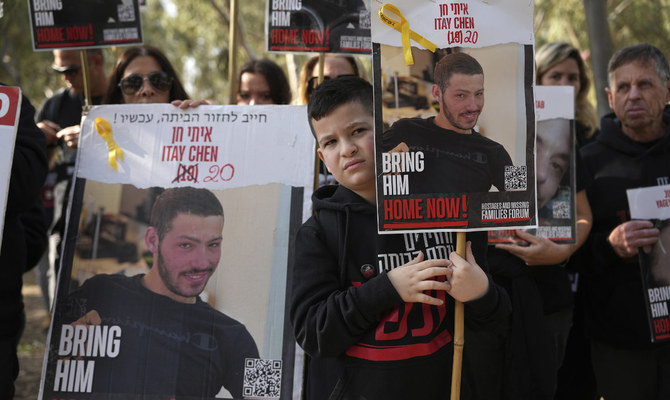
Increasing the pressure on Israeli Prime Minister Benjamin Netanyahu to reach a deal, families of hostages on Wednesday launched a four-day march from southern Israel to Jerusalem to demand their loved ones be set free. Some of the around 100 hostages freed during a ceasefire in late November are joining the march, which is to end near Netanyahu’s official residence.
The plight of the hostages has deeply shaken Israelis, who see in them an enduring symbol of the state’s failure to protect its citizens from Hamas’ assault. In its Oct. 7 attack, the Palestinian militant group abducted roughly 250 people, according to Israeli authorities, including men, women, children and older adults. After the November releases, some 130 hostages remain, and Israel says about a quarter of them are dead.
Israel’s assault on Gaza, which it says aims at destroying Hamas after its attack, has killed more than 29,900 Palestinians. UN officials warn of further mass casualties if it follows through on vows to attack the southernmost city of Rafah, where more than half of Gaza’s population of 2.3 million has taken refuge. They also say a Rafah offensive could collapse the aid operation that has already been crippled in the fighting.
Across Gaza, more than 576,000 people – a quarter of the population – are a step away from famine, the UN says. But northern Gaza in particular has been gutted by hunger. The north has largely been cut off and much of it has been leveled since Israeli ground troops invaded in late October. Several hundred thousand Palestinians are believed to remain there, and many have been reduced to eating animal fodder to survive. The UN says one in 6 children under 2 in the north suffer from acute malnutrition and wasting.
A convoy of 31 trucks carrying food entered northern Gaza on Wednesday, the Israeli military office that oversees Palestinian civilian affairs said. The office, known by the acronym COGAT, said nearly 20 other trucks entered the north on Monday and Tuesday. Associated Press footage showed people carrying sacks of flour from the distribution site.
It was not immediately clear who carried out the deliveries. The UN was not involved, said a spokesperson for the UN’s humanitarian coordination office, Eri Keneko.
As of Sunday, the UN had been unable to deliver food to northern Gaza since Jan. 23, according to Philippe Lazzarini, the head of UNRWA, the UN agency for Palestinian refugees that has led the aid effort during the war. On Feb. 18, the World Food Program attempted a delivery to the north for the first time in three weeks, but much of the convoy’s cargo was taken en route by desperate Palestinians, and it was only able to distribute a small amount in the north. Two days later, the WFP announced it was pausing deliveries to the north because of the chaos.
Since launching its assault on Gaza following Hamas’ Oct. 7 attack, Israel has barred entry of food, water, medicine and other supplies except for a trickle of aid entering the south from Egypt at the Rafah crossing and Israel’s Kerem Shalom crossing. Despite international calls to allow in more aid, the number of supply trucks entering has dropped dramatically in recent weeks.
COGAT said Wednesday that Israel does not impose limits on the amount of aid entering. Israel has blamed UN agencies for the bottleneck, saying hundreds of trucks are waiting on the Palestinian side of Kerem Shalom for aid workers to collect them.
UN spokesman Stephane Dujarric on Wednesday countered saying large trucks entering Gaza have to be unloaded and reloaded onto smaller Palestinian trucks, but there aren’t enough of them and there’s a lack of security to distribute aid in Gaza. Police in Gaza stopped protecting convoys after Israeli strikes on them near the crossing. There is also “insufficient coordination” from Israel on security and deconfliction, which puts the lives of UN staff and other humanitarian workers at risk.
“That’s why we’ve repeatedly asked for a humanitarian ceasefire,” he said. The UN has called for Israel to open crossings in the north to aid deliveries and guarantee safe corridors for convoys.
The director of Kamal Adwan Hospital in northern Gaza said the number of children who have died in recent days from severe malnutrition and dehydration had risen to four.
Dr. Hussam Abu Safiya said that operations at the hospital will shut off starting Wednesday due to fuel shortages. “Dialysis, intensive care, childcare, and surgeries will stop. Therefore, we will witness more deaths in the coming days,” he said.
But the pain from the lack of supplies extends across Gaza. Project Hope, a humanitarian group that runs a clinic in the central town of Deir Al-Balah, said 21 percent of the pregnant women and 11 percent of the children under 5 it has treated in the last three weeks are suffering from malnutrition.
The Gaza Health Ministry said the death toll from Israel’s offensive had risen to 29,954 people, with 70,325 wounded. The ministry doesn’t differentiate between civilians and combatants, but it says two-thirds of the dead were children and women.
In its attack on southern Israel on Oct. 7, Hamas and other Palestinian militants killed some 1,200 people, mainly civilians.


![]()

Food aid reaches north Gaza for first time in weeks. Israeli hostages’ families push for release
Short Url
https://arab.news/6kxvv
Food aid reaches north Gaza for first time in weeks. Israeli hostages’ families push for release
- The plight of the hostages has deeply shaken Israelis, who see in them an enduring symbol of the state’s failure to protect its citizens from Hamas’ assault


Latest updates





Recommended


© 2026 SAUDI RESEARCH & PUBLISHING COMPANY, All Rights Reserved And subject to Terms of Use Agreement.