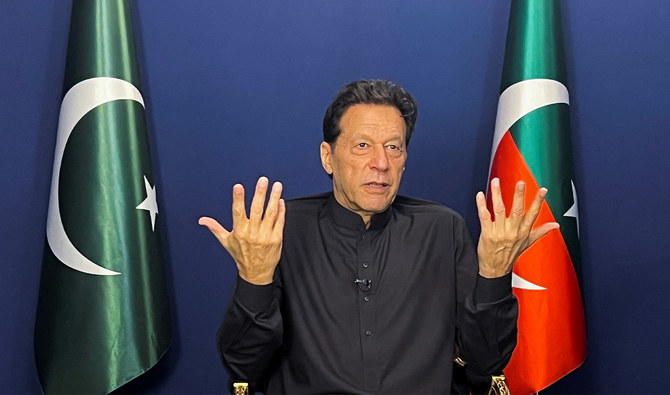
ISLAMABAD: Former prime minister Imran Khan’s spokesperson on Wednesday wrote to the International Monetary Fund’s managing director (IMF), urging the lender to link the grant of another financial facility to Pakistan with “good governance” and an audit of at least 30 national and provincial assembly seats, following controversial polls held earlier this month that have triggered countrywide protests and accusations of vote-rigging.
Last week, the jailed former premier’s lawyer revealed Khan would write to the IMF to urge the lender to call for an independent audit of the country’s controversial Feb. 8 national elections before it commences talks with Islamabad for a new program. The IMF had responded by saying it would not comment on “ongoing political developments” in the country.
Pakistan averted default last summer thanks to a short-term International Monetary Fund bailout, but the program expires next month and a new government will have to negotiate a long-term arrangement to keep the $350 billion economy stable.
Khan’s party has been leading protests in many parts of the country since Feb. 8, accusing the Election Commission of Pakistan (ECP) of manipulating the results of the national polls. The election regulator and authorities deny Khan’s accusations, and have called on protesting parties to seek redressal from relevant forums. In a letter addressed to the IMF’s Managing Director Kristalina Georgieva, Khan’s spokesperson Raoof Hasan said calls for an independent audit of the election by several Pakistani political parties and independent observers have gone “unheeded.”
“We, therefore, call upon the IMF to give effect to the guidelines adopted by it with respect to good governance as well as conditionalities that must be satisfied prior to the grant of a finance facility that is to burden the people of Pakistan with further debt,” a copy of the letter seen by Arab News reads.
“An audit of at least thirty percent of the national and provincial assemblies’ seats should be ensured, which can be accomplished in merely two weeks.”
Hasan clarified that an audit can be accomplished within two weeks, clarifying that the party was not demanding the IMF adopt the role of an investigative agency. He pointed out that two organizations in the country, the Free and Fair Election Network (FAFEN) and PATTAN-Coalition38 have proposed “comprehensive” methodologies to conduct an audit of the polls.
“Such a role by the IMF would be a great service to Pakistan and its people, and could become the harbinger of enduring prosperity, growth, and macroeconomic stability in the country,” the letter concluded.
Khan, ousted in April 2022 in a parliament vote of confidence, was accused by opposition parties of scuttling an IMF deal days before leaving his office, a charge he denies. Khan and his party hold ex-PM Sharif, who was elected after him by the parliament, responsible for Pakistan’s economic woes.


![]()

Ex-PM Khan’s party urges IMF to ensure election audit before bailout discussions
Short Url
https://arab.news/526e8
Ex-PM Khan’s party urges IMF to ensure election audit before bailout discussions
- In letter to IMF managing director, Khan’s spokesperson urges IMF to ensure audit of at least 30 percent of national, provincial seats
- A new Pakistani government will have to negotiate a long-term arrangement to keep Pakistan’s fragile $350 billion economy stable
Latest updates


© 2026 SAUDI RESEARCH & PUBLISHING COMPANY, All Rights Reserved And subject to Terms of Use Agreement.