More opportunities for women awaiting in the petrochemical industry: SABIC official

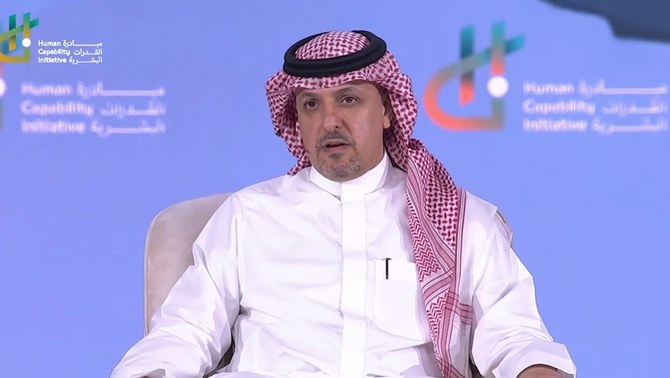
Faisal Al-Suwailem, executive vice president of corporate human resources at Saudi Basic Industries Corp., speaking at the Human Capability Initiative in Riyadh. Shutterstock
Short Url
Updated 28 February 2024
Follow

More opportunities for women awaiting in the petrochemical industry: SABIC official

  • Only 25 percent of the sector’s workforce are female

RIYADH: Saudi women should explore more opportunities in the petrochemical industry, as only 25 percent of the sector’s workforce are female, said a top official. 

Speaking at the Human Capability Initiative in Riyadh on Feb. 28, Faisal Al-Suwailem, executive vice president of corporate human resources at Saudi Basic Industries Corp., said that the industrial sector in the Kingdom has been witnessing a sharp rise in female employment over the past three years. 

“If we take a look at the petrochemical industry, in the last 20 years, I have seen a great increase in the participation of females in the petrochemical industry. However, if you look at the number of women in the petrochemical industry, it is still about 25 percent. So, I believe we still have room to grow,” said Al-Suwailem. 

He added: “In the industrial sector, the hiring of females has increased 93 percent over the last three years. We have right now over 63,000 females working in plants around the Kingdom.” 

Al-Suwailem further pointed out that Saudi Arabia has surpassed the female workforce target outlined in the Kingdom’s Vision 2030. 

“Let us first look at Vision 2030, and under the thriving economy for female participation in the labor market, the baseline target was set at 22.8 percent, and now we are at 34.5 percent,” said Al-Suwailem. 

He added that SABIC stands out as one of the companies offering structured training programs aimed at nurturing and enhancing the skills of young individuals.

Al-Suwailem also underscored that SABIC offers scholarship programs that provide equal opportunities for both men and women. 

“SABIC is a national champion for sure in petrochemicals, but it also has a proven record of being a national champion for development, job creation, learning and contribution to the gross domestic product,” said Al-Suwailem. 

He added: “SABIC’s scholarship program, which is meant for Saudi bright young talents, is right now equally split between men and women.” 

For her part, during the same panel discussion, Cabinet Secretary and Minister of Labor and Social Protection of Kenya Florence Bore said that the country is preparing its youth to adapt themselves to procure jobs in the international market. 

“Our focus currently is on labor migration, and even as you focus on labor migration, it is one of the areas where we get foreign remittances,” said Bore. 

She added: “Kenya has been undergoing lots of changes in the workplace. We have both the informal and formal jobs. The informal sector is really growing at a faster rate than the formal jobs. And because of that, you will find most of our Kenyans are now venturing out for jobs in the international market.”


Oman special zones investment rises 6.8% to $3.6bn

Updated 14 sec ago
Follow

Oman special zones investment rises 6.8% to $3.6bn

JEDDAH: Investment in Oman’s special economic zones, free zones and industrial cities rose 6.8 percent in 2025, reaching 1.4 billion Omani rials ($3.64 billion), official data showed. 

The figure raises the total committed investment under the supervision of the Public Authority for Special Economic Zones and Free Zones, known as OPAZ, to 22.4 billion rials, the Oman News Agency reported. 

This increase underscores the central role of the zones in Oman’s Vision 2040 strategy to diversify the economy, drive growth, create jobs and expand the private sector. 

The authority said 325 investment agreements were signed across sectors during the year, with additional land allocated for industrial projects in several zones. 

“Development is ongoing in the Al-Dhahira Special Economic Zone, the Al-Rawdah Economic Zone, and the Muscat International Airport Free Zone, alongside four new industrial cities in Al-Mudhaibi, Al Suwaiq, Thumrait and Madha to accommodate diverse industrial activities, enhance local manufacturing, and create additional job opportunities for Omani youth,” the ONA report stated. 

Qais bin Mohammed Al-Yousuf, chairman of OPAZ, emphasized the authority’s commitment to fostering a competitive and attractive investment environment that supports economic diversification and financial sustainability. 

He said the authority’s strategy focuses on positioning special economic zones, free zones and industrial cities as preferred investment destinations through business-friendly regulations, targeted incentives and maximizing value added by projects. 

Al Yousuf added that these zones have established themselves as integrated economic platforms that support diversification, enhance investment attractiveness and maximize the benefits of free trade agreements and comprehensive economic partnerships. 

OPAZ expanded its international outreach in 2025 by joining the World Free Zones Organization, a move aimed at aligning local zones with global standards and attracting cross-border investment. 

The authority is developing specialized clusters including an integrated cold chain hub in Duqm, an aluminum cluster in Sohar Industrial City and a mining cluster in Shaleem, as well as a proposed silica and mining complex in the Duqm Special Economic Zone. 

Ahmed bin Hassan Al-Theeb, deputy chairman of OPAZ, said that 2025 witnessed numerous achievements across the authority’s key focus areas, including planning and development; regulation and supervision; facilitation and aftercare services; marketing and investment attraction; operations and business acceleration; and institutional excellence. 

He further said that the authority increased foreign investment outreach, contacting over 500 companies in sectors such as pharmaceuticals, food, and sustainable construction, as well as services, logistics, storage, and renewable energy technologies. 

A new digital project-tracking system registered 294 investments across sectors including renewables, petrochemicals, fisheries and minerals by year-end, he added. 

The zones created 4,467 jobs for Omanis in 2025, exceeding the 2,500 target and raising total national employment in the network to 30,780 out of about 85,000 workers. Omanization reached 36 percent, with 4,774 small and medium enterprises operating across the zones.