Pakistan inaugurates ‘pivotal’ polio campaign to immunize over 45.8 million children

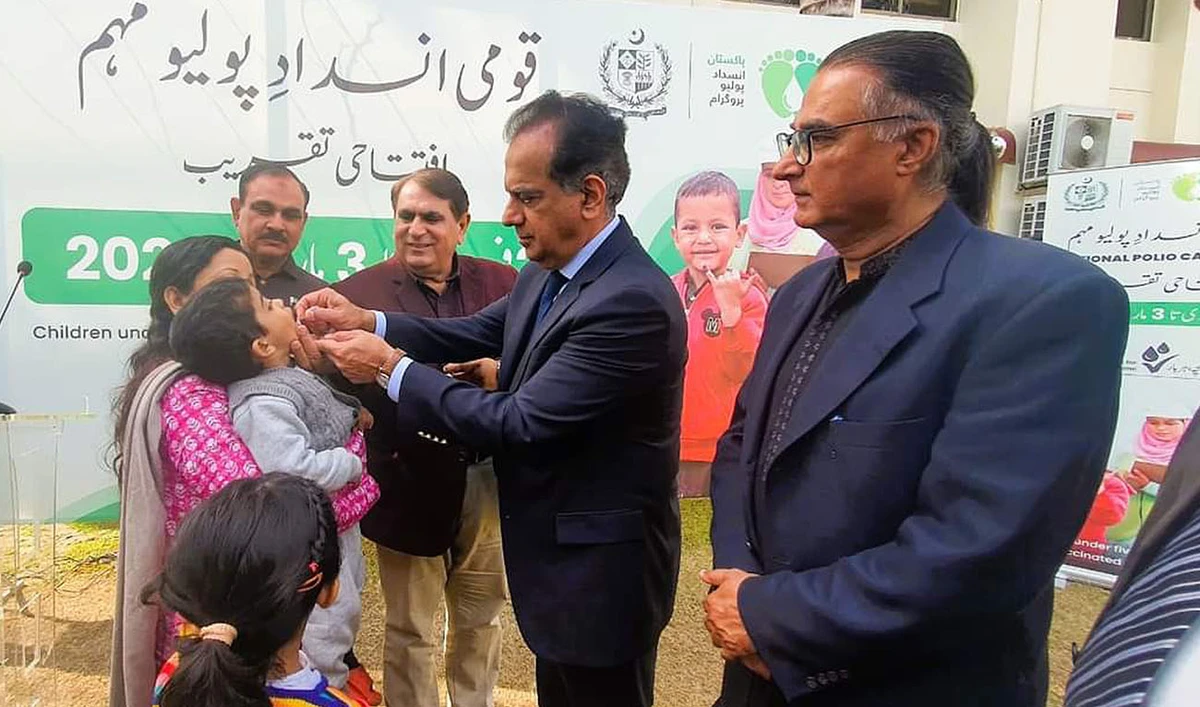
Pakistan’s federal health secretary Iftikhar Shallwani (center) inaugurates nationwide campaign against polio by administering polio drops to children on February 25, 2024. (Photo courtesy: Ministry of National Health Services)
Short Url
Updated 25 February 2024
Follow

Pakistan inaugurates ‘pivotal’ polio campaign to immunize over 45.8 million children

  • Polio volunteers to immunize children under five years old from Feb. 26 to March 3, says national health ministry 
  • Many believe in the conspiracy theory that polio vaccines are part of a Western ploy to sterilize Pakistan’s population

ISLAMABAD: Pakistan’s federal health secretary Iftikhar Shallwani on Sunday inaugurated a nationwide campaign against polio that aims to immunize over 45.8 million children against the disease, the national health ministry said. 

Pakistan is one of only two countries in the world where polio is endemic. The disease affects the nervous system of children and ultimately leads to paralysis.

The South Asian country’s efforts to contain polio have often been met with opposition, especially in the country’s northwestern Khyber Pakhtunkhwa province, where militants have carried out attacks against vaccinators and the security teams guarding them. 

Many believe in the conspiracy theory that polio vaccines are part of a plot by Western outsiders to sterilize Pakistan’s population. 

Shallwani inaugurated the campaign, which is set to launch nationwide on Monday, by administering polio drops to children. 

“This pivotal campaign, scheduled from Feb 26 to Mar 3, aims to immunize over 45.8 million children under the age of 5 across the country,” the Ministry of National Health Services wrote on X platform. 

Shallwani said polio is a “terrible” disease that can cause paralysis in children.

“Unfortunately, it continues to be a threat to our children because some people refuse to vaccinate children based on misconceptions and false information about the vaccine,” he said. 

He said volunteers will deliver the vaccine to people’s doorsteps from next week, requesting parents to cooperate with them. 

“I implore you to recognize the threat posed by the poliovirus to your children and ensure that you open your doors to facilitate their vaccination,” the health official said. 

Pakistani masses’ doubts regarding polio campaigns were exacerbated in 2011 when the US Central Intelligence Agency set up a fake hepatitis vaccination program to gather intelligence on former Al-Qaeda chief Osama bin Laden. 

Pakistan offers Kyrgyzstan Arabian Sea access as two states sign 15 cooperation accords

Updated 05 December 2025
Follow

Pakistan offers Kyrgyzstan Arabian Sea access as two states sign 15 cooperation accords

  • Pakistan and Kyrgyzstan sign MOUs spanning trade, energy, agriculture, ports, education, security cooperation
  • Kyrgyz president is on first visit to Pakistan in 20 years as both sides push connectivity and CASA-1000 power links

ISLAMABAD: Pakistan on Thursday offered Kyrgyzstan the shortest and most economical route to the Arabian Sea as the two countries signed 15 agreements and memoranda of understanding aimed at boosting cooperation across trade, energy, agriculture, education, customs data-sharing and port logistics.

The accords were signed during a visit to Islamabad by President Sadyr Zhaparov, the first by a Kyrgyz head of state to Pakistan in two decades, and part of Islamabad’s renewed push to link South Asia with landlocked Central Asian economies through ports, power corridors and transport routes.

For Pakistan, Kyrgyzstan offers access to hydropower through CASA-1000, a $1.2 billion regional electricity transmission project designed to carry surplus summer electricity from Kyrgyzstan and Tajikistan through Afghanistan into Pakistan. For Bishkek, Pakistan provides overland access to warm-water ports on the Arabian Sea, creating a shorter commercial route to global markets.

“President Asif Ali Zardari has reiterated Pakistan’s readiness to offer Kyrgyzstan the shortest and most economical route to the Arabian Sea,” Radio Pakistan reported after Zhaparov met the Pakistani president. 

The two leaders also discussed expanding direct flights to deepen business, tourism and people-to-people ties.

Zardari welcomed Kyrgyzstan’s completion of its segment of the CASA-1000 project and “reaffirmed Pakistan’s commitment to completing its part of the project, which is now at an advanced stage,” the state broadcaster said. 

Zhaparov thanked Islamabad for supporting Bishkek’s candidacy for a non-permanent UN Security Council seat and invited Zardari to visit Kyrgyzstan at a time of his convenience. Both sides expressed satisfaction with progress under the Quadrilateral Traffic in Transit Agreement, designed to facilitate road movement between Pakistan, Kyrgyzstan, Kazakhstan and China.

Earlier, both governments exchanged 15 sectoral cooperation documents covering commerce, mining, geosciences, power, agriculture, youth programs, the exchange of convicted persons, customs electronic data systems and a sister-city linkage between Islamabad and Bishkek.

According to APP, the MOUs were signed by ministers representing foreign affairs, commerce, economy, energy, power, railways, interior, culture, health and tourism. Agreements also covered cooperation between Pakistan’s Foreign Service Academy and the Diplomatic Academy of Kyrgyzstan, as well as collaboration between universities, youth ministries and cultural institutions.

“Our present mutual trade, comprising of about $15–16 million will be enhanced to $200 million in the next two years,” Prime Minister Shehbaz Sharif said after the agreements were signed, calling them “a framework for structured, result-oriented engagement and closer institutional linkages.”

Sharif said Pakistan was ready to serve as a maritime outlet for the landlocked Central Asian republic, offering access to Karachi, Port Qasim and Gwadar to help Kyrgyz goods reach regional and global markets.