

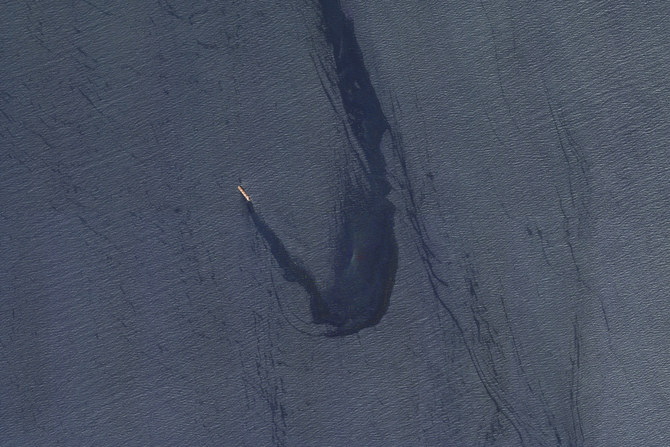


WASHINGTON: A cargo ship abandoned in the Gulf of Aden after an attack by Yemeni rebels is taking on water and has left a huge oil slick, in an environmental disaster that US Central Command said Friday could get worse.
Rubymar, a Belize-flagged, British-registered and Lebanese-operated cargo ship carrying combustible fertilizer, was damaged in a Sunday missile strike claimed by the Iran-backed Houthi rebels.
Its crew was evacuated to Djibouti after one missile hit the side of the ship, causing water to enter the engine room and its stern to sag, said its operator, the Blue Fleet Group.
A second missile hit the vessel’s deck without causing major damage, Blue Fleet CEO Roy Khoury told AFP.
CENTCOM said the ship is anchored but slowly taking on water and has left an 18 mile oil slick.
“The M/V Rubymar was transporting over 41,000 tons of fertilizer when it was attacked, which could spill into the Red Sea and worsen this environmental disaster,” it said in a post on X, formerly Twitter.
The ship’s operator said Thursday the ship could be towed to Djibouti this week.
Khoury said the ship was still afloat and shared an image captured on Wednesday that showed its stern low in the water.
When asked about the possibility of it sinking, Khoury had said there was “no risk for now, but always a possibility.”
The attack on the Rubymar represents the most significant damage yet to be inflicted on a commercial ship since the Houthis started firing on vessels in November — a campaign they say is in solidarity with Palestinians in Gaza during the Israel-Hamas war.
The Houthi attacks have prompted some shipping companies to detour around southern Africa to avoid the Red Sea, which normally carries about 12 percent of global maritime trade.
The UN Conference on Trade and Development warned late last month that the volume of commercial traffic passing through the Suez Canal had fallen more than 40 percent in the previous two months.


