

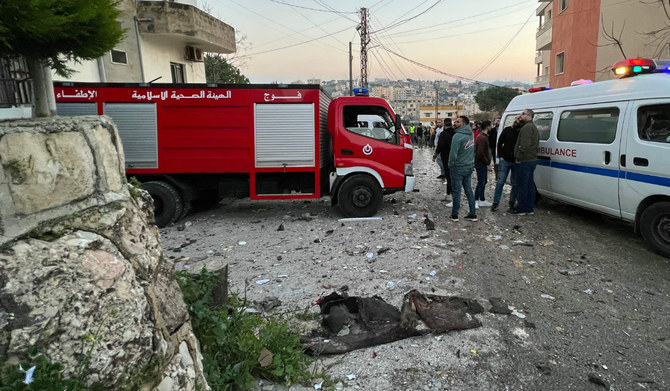

BEIRUT: Israel killed a top Hezbollah official and three paramedics affiliated with the group in airstrikes on Thursday.
Hassan Mahmoud Saleh, a missile unit commander, was killed in the town of Kafr Rumman. The paramedics, from the Hezbollah-affiliated Islamic Health Authority, were killed in the town of Blida.
The assassination of Saleh was Israel’s third high-profile strike on top officials belonging to the Axis of Resistance in Lebanon. It follows the killing of Hamas leader Sheikh Saleh Al-Arouri and seven others in Beirut in January, and the killing of Ali Al-Debs, along with civilians, a week ago in Nabatiyeh.
The airstrike targeted the top floor of a building in a residential neighborhood on the Kafr Rumman-Marjayoun Highway, killing Saleh and one other person, and wounding three people.
The Israeli airstrike on the Civil Defense Center of the Islamic Health Authority in Blida on Thursday night led to the destruction of the building, with debris removal continuing until Friday morning.
Hezbollah mourned the three paramedics killed in the strike: Hussein Mohammed Khalil from the town of Baraachit, and Mohammed Yaacoub Ismail and Mohammed Hassan from Blida.
Social media videos showing the funeral processions revealed the extent of material devastation to local neighborhoods as a result of Israeli bombardment.
The funeral procession was attended by a crowd of Hezbollah supporters.
A security source monitoring field developments in southern Lebanon said: “Both Hezbollah and the Israeli army possess a dangerous information bank, with advanced tracking technology for the Israeli side.
“Hezbollah cadre Wissam Al-Tawil was targeted by a drone over a month ago in his town of Kherbet Selem immediately upon his return, and in return, Hezbollah targeted Israeli military positions.”
Hezbollah said: “In response to the attack on the civil defense center in Blida, it targeted, through an aerial attack with two drones, the headquarters of the Regional Council in Kiryat Shmona and accurately hit them.”
The southern Lebanese border area came under Israeli attack on Friday morning. The town of Wazzani was targeted by gunfire and artillery, leading to the wounding of a Lebanese soldier and damage to homes and livestock farms.
While Blida mourned the three dead paramedics, the Israeli army opened fire on the town’s cemeteries, where residents were digging graves.
Israeli artillery hit the outskirts of Halta Farm, the forests of Kfarchouba, Kfarhamam and Jabal Al-Labouneh, as well as the outskirts of Naqoura on the coast.
Meanwhile, the Israeli Army announced “the conclusion of intensive training for warships equipped with missiles at sea in the north of the country.”
Israeli Foreign Minister Israel Katz informed the UN Security Council presidency that his country “will enforce security on its northern borders militarily if the Lebanese government does not implement Resolution 1701 and prevent attacks from its borders on Israel.”
Katz’s statement also included unprecedented details about Iran’s transfer of weapons to Hezbollah via Syria, an apparent violation of Resolution 1701.
His comments appeared to signal the possibility of Israel launching a full-scale war on Lebanon.
Katz called on the Security Council to “demand that the government of Lebanon fully implement Resolution 1701 and ensure that the area up to the Litani River is free from military presence, assets or weapons.”


