

Tech does what we tell it, Dell founder tells Future Investment Initiative Priority summit in Miami

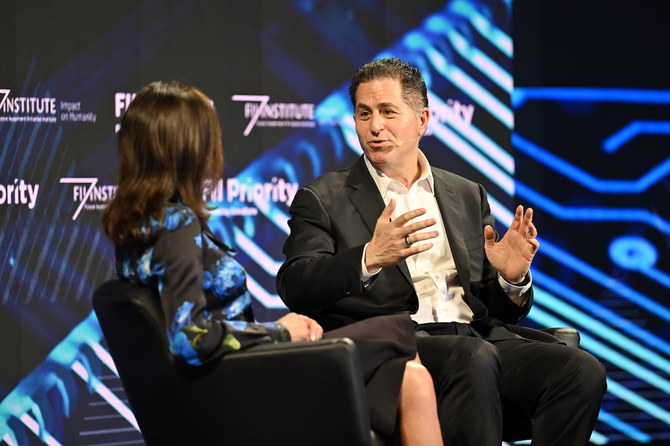
Tech should reflect our humanity, values and beliefs, founder and CEO of Dell told the Future Investment Initiative Priority summit. (Supplied)
Short Url
Updated 23 February 2024
Follow

Tech does what we tell it, Dell founder tells Future Investment Initiative Priority summit in Miami

  • Michael Dell says the potential benefits of AI are too great to ignore but we must ‘have it reflect our humanity, values and beliefs’
  • ‘We have to make sure that the bad people don’t get hold of (the technology) too much, and to the extent they do, we have ways to stop them and to control that,’ he adds.

MIAMI: “Technology doesn’t wake up in the morning and say, ‘I’m going to be good or bad today’… it does what we tell it to do,” Michael Dell, the founder and CEO of tech company Dell told the Future Investment Initiative Priority summit in Miami on Thursday. “And so we have to have it reflect our humanity, values and beliefs.”

Dell, who has been interested in technology since he was 13 years old, talked about the beginnings of his company and its future, especially with artificial intelligence poised to transform the sector.

When he was a teenager, he said, he upgraded computer systems as a hobby and “eventually, in my dorm room 40 years ago, started what became Dell Technologies.”

In the tech industry “all of the successive waves of technology are built on top of the previous ones,” he said, and right now there is “an enormous amount of data.” This evolution has resulted in better connectivity and advancements in computing power, memory, bandwidth and networking. Researchers and developers therefore are now looking at ways to use all this information to go beyond mere computation and calculation, and into the realms of cognition and creativity.

“The game hasn’t even started but it’s clearly a huge opportunity for efficiency and productivity, but also sort of reimagining organizations,” said Dell.

He sees “a tremendous amount of conviction and excitement around building a great future” in Saudi Arabia.

“It’s probably the most exciting region in the world in terms of growth and opportunity, and certainly, when I look at the scale, the ambition and the vision, it’s inspiring and we obviously want to want to be a big part of that,” he added.

That’s why his company is planning expansions in the Kingdom he said will be announced next month.

“Technology has always been about making us safer and healthier and more successful in all human endeavors, and AI is just turbocharging that at an unprecedented scale,” said Dell.

He acknowledged the risks posed by the technology but said it would be almost irresponsible not to utilize it, given its massive benefits.

“We have to make sure that the bad people don’t get hold of (the technology) too much, and to the extent they do, we have ways to stop them and to control that,” he said.

But in the end “it’s software, after all,” Dell added.

“I do think there will be mistakes, problems and challenges. But ultimately, it is going to expand human potential, creativity and capability dramatically.”


UAE uses AI to guide oil production decisions, transform factories, ports

Updated 22 January 2026
Follow

UAE uses AI to guide oil production decisions, transform factories, ports

  • Move marks major step, says minister for foreign trade

DUBAI: The UAE is now using artificial intelligence to guide production decisions in its oil and gas sector, replacing traditional simulation-based methods, a senior official said during the World Economic Forum in Davos on Thursday.

Speaking during the Factories That Think panel, the UAE’s Minister for Foreign Trade Thani Ahmed Al-Zeyoudi said the move marked a major step in the country’s adoption of AI, robotics and digital technologies across manufacturing, logistics, and energy sectors.

“Now we are applying AI. The AI tells us where to produce. We don’t need simulation engineers anymore to tell us where,” Al-Zeyoudi explained.

He said digitalization was also transforming the entire value chain, adding: “Digitalization and digital twinning are not only happening in factories, they are now across the entire value chain, from extraction and manufacturing to logistics, distribution and customs clearance.”

Al-Zeyoudi highlighted the UAE’s global logistics network, and said: “We have historically invested heavily in logistics, and today we are connected to around 250 ports around the world.

“The majority of consignments are now cleared before they arrive. What used to take a few days now takes just a matter of minutes.”

The minister also discussed the country’s shift away from labor-intensive models, and said: “This is no longer about wages; it’s about digitalization and improving efficiency in how we run operations.”

Robotics are being deployed at industrial sites to reduce downtime, and Al-Zeyoudi said: “Sites that used to shut down for three to six months can now be monitored by robotics during operation, reducing downtime to just a couple of days.”