Ukraine leader downplays loss of Avdiivka, seeks faster support

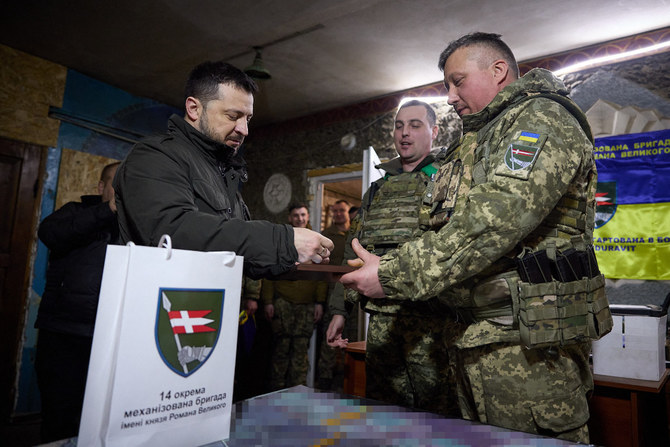
Ukrainian President Volodymyr Zelensky (L) visits the frontline positions of Ukrainian troops in the Kupyansk sector on Feb. 19, 2024, amid the Russian invasion of Ukraine. (Ukrainian Presidential Press Service / Handout via AFP)
Short Url
Updated 22 February 2024
Follow

Ukraine leader downplays loss of Avdiivka, seeks faster support

  • Russian troops took control of Avdiivka last week in Moscow’s biggest battlefield gain since its forces captured Bakhmut last May
  • Zelensky pointed to earlier gains made by Ukraine forces, particularly in the northeastern Kharkiv region and destruction of Russian ships

KYIV: President Volodymyr Zelensky downplayed Ukraine’s loss of the eastern town of Avdiivka to Russian forces and called for faster support from allies as the war against Russia neared the two-year mark, in comments broadcast on Wednesday.

Russian troops took control of Avdiivka last week in Moscow’s biggest battlefield gain since its forces captured Bakhmut last May. Kremlin leader Vladimir Putin says Russia will press on with its drive through eastern Ukraine.
Zelensky, in excerpts from an interview with Fox News to be aired on Thursday, acknowledged that last year had been “complicated” for Ukraine, particularly as 2023 came to a close.
But, speaking in English, he pointed to earlier gains, particularly in the northeastern Kharkiv region, where the Fox interview took place.
“During these two years we got (back) part of the Kharkiv region. Now we are in this region ... and we unblocked the Black Sea. There are grain routes and we destroyed a lot of their ships of the Russian fleet,” Zelensky said.
“That is what we did over two years. And what they could do? Only this one place. But what for?“
Avdiivka lies 15 km (nine miles) northwest of the Russian-held main town of Donetsk region, also named Donetsk.
Russian analysts say its capture will keep Donetsk safe from Ukrainian shelling as Moscow considers how to pursue its drive to capture all of Donetsk and Luhansk regions.
In his comments, Zelensky expressed new discontent with the slowdown in Western aid for Ukraine’s war effort, without singling out the United States.
US President Joe Biden’s request to extend a big aid package has been held up by wrangling in the US Congress.
“We have to be more quick. That means to lose all the bureaucracy. Otherwise we will not have any chance,” he said.
The president acknowledged that finding an alternative to US support would not be easy.
“Of course, we will find. We will not stay in the same place. We have to survive. We have to find some parallel steps,” he said in the interview, conducted in part on a hospital ward.
“You understand that this help is crucial. So without it, sorry, we will have more and more such heroic guys who will be in the hospitals. If you don’t have a real defending shield and similar powerful artillery with rounds, of course you will lose people.”
The US Senate has passed a $95 billion aid package that includes funds for Ukraine, but House of Representatives Speaker Mike Johnson has declined to bring it up for a vote on the floor of the House.


Nestle acknowledges delay before baby milk recall

Updated 5 sec ago
Follow

Nestle acknowledges delay before baby milk recall

  • The company in December recalled batches of its infant formula in 16 European countries
  • Nestle said routine checks at its Dutch plant at the end of November 2025 had detected “very low levels” of cereulide

GENEVA: Swiss food giant Nestle has acknowledged that it waited days for a health-risk analysis before alerting authorities after detecting a toxin in its baby milk at a Dutch factory.
But in an open letter to campaign group Foodwatch France Friday it denied accusations of negligence.
The company in December recalled batches of its infant formula in 16 European countries after detecting cereulide, a bacterial toxin that can cause diarrhea and vomiting.
French newspaper Le Monde reported Friday that traces of cereulide had been found in late November — 10 days before the first recalls of the product — because the company waited for a “health?risk analysis” before informing regulators.
Nestle said in a statement online that routine checks at its Dutch plant at the end of November 2025 had detected “very low levels” of cereulide after new equipment was installed in a factory.
It said there was no maximum limit for cereulide indicated by regulations.
The company halted production and launched further tests, which in early December confirmed minute quantities in products that had yet to leave the warehouse.
Nestle said it informed Dutch, European and other national authorities on December 10 and began a precautionary recall of all products made since the new equipment was installed — 25 batches across 16 European countries.

- Response to Foodwatch -

Friday’s open letter responded to claims by Foodwatch France, which a day earlier announced it was filing a legal complaint in the French courts against Nestle on behalf of several families whose babies had fallen ill.
Nestle denied Foodwatch’s suggestions that its product recall had been late without any reasonable excuse and that it had displayed “alarming negligence.”
They said they had acted in December and January as soon as they had identified there was an issue, said the company.
“We recognize the stress and worry that the recall has caused for parents and caregivers,” it said.
“To date, we have not received any medical reports confirming a link to illness associated with our products,” it added.
The company has said from the start of the affair that the recall stemmed from a “quality issue” and that it had seen no evidence linking its products to illness.
French authorities launched an investigation into the deaths in December and January of two babies who were thought to have drunk possibly contaminated powdered milk.
Nestle said in its statement that “nothing indicates any link between these tragic events in these two instances and the consumption of our products.”