
RIYADH: Saudi Arabia’s regulatory framework is progressing, with the Capital Markets Authority initiating a new public consultation allowing stockholders to offer more shares.
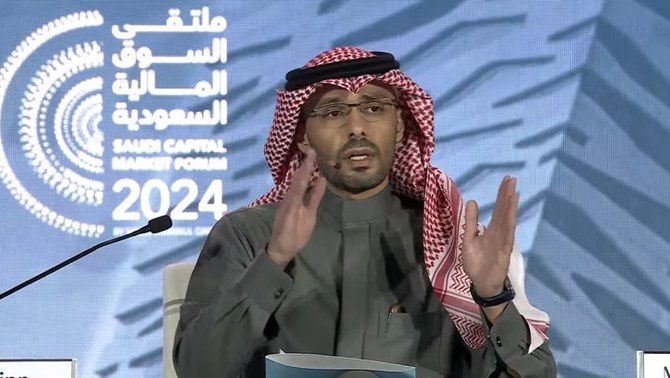
During a panel at the Saudi Capital Market Forum in Riyadh, Deputy of Financing and Investment Abdullah Binghannam revealed that the Kingdom has commenced its public consultation for the so-called “FMO” framework, aiming to enhance the market’s liquidity and accessibility.
“We recently published the public consultation for the FMO framework, which enables large shareholders to float additional shares in a process that is governed, which is a catalyst for an increase in free float,” he explained.
“We had stc two years ago, and since we had this practice in the market, we should regulate it because we are following a concept of trying to enable by regulations,” Binghannam added.
Free float refers to the number of company shares available for trading by the public, excluding locked-in claims held by company insiders, governments, or other restricted parties that are not readily available for trading on the stock market.
Binghannam elaborated on the authority’s efforts to collaborate with companies and shareholders to highlight the advantages of expanding the market’s free float.
He added that the authority is dedicated to enhancing the appeal of Saudi Arabia’s capital market to a broader spectrum of investors, particularly international ones, by employing dual strategies.
“Firstly, easing the access over the years. Second, keeping our government regulations up to standards. This resulted in bringing the total international investors holding in the Saudi capital market to SR400 billion ($106 billion),” Binghannam stated.
“Last year, the demand for subscription in IPOs (initial public offering) from international investors was an excess of SR70 billion, which is more than the offerings themselves,” he added.
Joining Binghannam’s panel session, Claire Suddens-Speirs, partner and co-head of Global Equity Capital Markets at Rothschild & Co., commended Saudi Arabia’s proactive and globally acknowledged initiatives in the capital markets sector.
“The world is watching and paying attention, and more importantly, the world is participating in what we are seeing now as real sustained growth in terms of the market in the region,” she said.
“There is a real excitement in terms of what is now happening in the Middle East, but specifically in the Saudi market, there is a lot of development that is happening and that has already happened,” she added.
Richard Cormack, co-head of Equity Capital Markets EMEA and co-head of UK Investment Banking at Goldman Sachs, also applauded the Kingdom’s liquidity status, stating: “The Saudi market from a liquidity perspective is up there with developed markets.”
The discussion highlighted the critical role of the debt capital market in Saudi Arabia, with Binghannam emphasizing its significance.
“Debt capital market is our number one priority. Today, it represents around 4 percent of the gross domestic product. The target is to take it to 18 percent, which is a ninefold expansion, taking into consideration the growth of the GDP. We are also growing the asset management industry, which is around 19 percent of the GDP. The target is to take it to more than 28 percent,” he explained.
The Ministry of Human Resources and Social Development and Saudi Exchange have signed a cooperation agreement to launch a Social Responsibility Index.