

‘Credible allegations’ of Palestinian women and girls being raped and executed by Israeli troops: UN experts

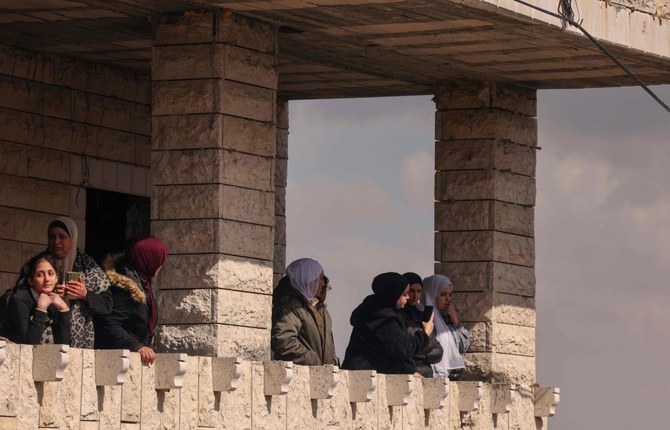
Palestinian women watch, from a balcony, the funeral of Nihil Ziad Breighith, 17, who died of wounds sustained during an Israeli raid, Beit Ummar, north of Hebron, West Bank, Feb. 15, 2024. (AFP)
Short Url
Updated 20 February 2024
Follow

‘Credible allegations’ of Palestinian women and girls being raped and executed by Israeli troops: UN experts

  • ‘We are shocked by reports of the deliberate targeting and extrajudicial killing of Palestinian women and children’
  • Photos of female detainees in ‘degrading circumstances’ reportedly uploaded online

NEW YORK: UN experts on Monday expressed alarm over “credible allegations of egregious human rights violations” against Palestinian women and girls in the Gaza Strip and West Bank.

They are being arbitrarily executed, arbitrarily detained, raped or threatened with sexual violence, the experts said, adding that these alleged acts may constitute “grave violations of international human rights and humanitarian law, and amount to serious crimes under international criminal law that could be prosecuted under the Rome Statute.”

They called for the perpetrators to be held accountable, and for victims’ families to receive “full redress and justice.”

The experts cited instances of Palestinian women and girls being reportedly arbitrarily executed in Gaza, often together with family members, including their children.

“We are shocked by reports of the deliberate targeting and extrajudicial killing of Palestinian women and children in places where they sought refuge, or while fleeing,” they said.

“Some of them were reportedly holding white pieces of cloth when they were killed by the Israeli army or affiliated forces.”

The independent experts include the working group on discrimination against women and girls, the special rapporteur on violence against women and girls, Reem Alsalem, and Francesca Albanese, special rapporteur on the situation of human rights in the Palestinian territories.

They expressed concern about the arbitrary detention of “hundreds of Palestinian women and girls, including human rights defenders, journalists and humanitarian workers, in Gaza and the West Bank since 7 October.”

They have reportedly been subjected to “inhuman and degrading treatment, denied menstruation pads, food and medicine, and severely beaten,” the experts said, adding that on at least one occasion, female detainees were put in a cage and left without food in the rain and cold.

The UN experts also expressed distress at reports of multiple forms of sexual assault against Palestinian female detainees, including being stripped naked and searched by male Israeli officers.

“At least two female Palestinian detainees were reportedly raped while others were reportedly threatened with rape and sexual violence,” the experts said, adding that that photos of female detainees in “degrading circumstances” were also reportedly taken by Israeli soldiers and uploaded online.

They also expressed concern that “an unknown number of Palestinian women and children, including girls,” have gone missing after contact with the Israeli army in Gaza.

“There are disturbing reports of at least one female infant forcibly transferred by the Israeli army into Israel, and of children being separated from their parents, whose whereabouts remain unknown,” they said.

“We remind the Government of Israel of its obligation to uphold the right to life, safety, health, and dignity of Palestinian women and girls and to ensure that no one is subjected to violence, torture, ill-treatment or degrading treatment, including sexual violence.”

The experts called for an independent, impartial, prompt, thorough and effective investigation into the allegations, and for Israel to cooperate.


Amnesty says Algeria unlawfully returned Tunisia asylum seeker

Updated 4 sec ago
Follow

Amnesty says Algeria unlawfully returned Tunisia asylum seeker

  • Amnesty International said Makhlouf was handed over to Tunisian police on January 18 without prior notice to him or his lawyers, in a move the group called “unlawful refoulement”

TUNIS: Global rights group Amnesty accused Algerian authorities on Monday of breaching international law by forcibly returning a political dissident to Tunisia, even though he was a registered asylum seeker.
Seifeddine Makhlouf, a former parliamentarian and critic of Tunisian President Kais Saied, was reportedly sentenced to prison for “plotting against state security” before his return to the North African country.
Makhlouf, who is the leader of the Al Karama party, sought asylum in Algeria in July 2024 after facing detention in Tunisia, and registered as an asylum seeker with the UN refugee agency UNHCR.
Amnesty International said Makhlouf was handed over to Tunisian police on January 18 without prior notice to him or his lawyers, in a move the group called “unlawful refoulement.”
“Makhlouf’s forced return is a violation of the principle of non-refoulement,” Amnesty’s MENA deputy chief Sara Hashash said in a statement published by the group.
“By handing him over to Tunisian authorities without allowing him any opportunity to contest the decision or assessing the risks he faces in Tunisia... Algeria has breached its obligations under international human rights law, including the Refugee Convention,” she added.
Saied froze parliament in July 2021 and seized far-reaching executive powers in what critics have called a “coup.”
Since then, local and international NGOs have denounced a regression of rights and freedoms in Tunisia.
Amnesty said Makhlouf was later imprisoned in Algeria for irregular entry and placed in administrative detention, during which he was denied access to the UN refugee agency.
The rights group said Makhlouf was arrested upon his arrival in Tunisia to serve sentences handed down in his absence.
Reports said a Tunisian court sentenced Makhlouf on January 13 to five years in prison for “plotting against state security.”
The Amnesty statement called for “verdicts rendered in absentia to be quashed and for a new and fair trial to be held before an independent and impartial court.”
Hashash warned that Makhlouf’s case reflects wider regional repression, calling his extradition “particularly alarming given the escalating crackdown on dissent in Tunisia, where the judiciary has been increasingly weaponized to silence political opposition.”
She said that Algeria’s actions “set a dangerous precedent,” adding that “bilateral cooperation now takes precedence over the most fundamental principles of international human rights and refugee law.”