


Gaza Strip: US President Joe Biden on Thursday again told Israel’s Prime Minister Benjamin Netanyahu that he should not proced with military action in Rafah without a credible and executable plan to protect Palestinian civilians, the White House said.
The call between the two leaders on Thursday was the second time in less than a week that Biden warned Netanyahu about moving into the southern part of the Gaza Strip without a plan to ensure the safety of some 1 million people sheltering there.
They also spoke about ongoing hostage negotiations and Biden pledged to continue to work around the clock to help free the hostages, who have spent 132 days in Hamas captivity, according to the White House read out of the call.
Earlier this month, Biden said Israel’s military response in the Gaza Strip had been “over the top“ and expressed grave concern over the rising civilian death toll in the Palestinian enclave.
The war began on Oct. 7 when Iran-backed Hamas sent fighters into Israel, killing 1,200 people, mostly civilians, and seizing 253 hostages according to Israeli tallies.
Israel’s air and ground offensive has since devastated tiny, crowded Gaza, killing 28,663 people, also mostly civilian, according to health authorities, and forcing nearly all its more than 2 million inhabitants from their homes.
Israel sends troops into 'besieged' Gaza hospital
Israel sent troops into a hospital in war-torn Gaza on Thursday where it said hostages may have been held, as medics warned the key medical facility was operating in “near impossible” conditions.
The raid came after days of intense fighting between troops and Hamas militants around the Nasser Hospital in Khan Yunis — one of the largest medical sites in southern Gaza, and one of the territory’s few hospitals that are still operational.
Israel, which has accused Hamas militants of using hospitals for military purposes, said it was carrying out a “precise and limited operation” at the facility with “no obligation” for patients or staff to evacuate.
Israeli army spokesman Daniel Hagari said there was “credible intelligence from a number of sources, including released hostages, indicating that Hamas held hostages at the Nasser Hospital in Khan Yunis and that there may be bodies of our hostages” there.
The health ministry in Hamas-ruled Gaza reported that thousands of people who had sought refuge in the complex, including patients, have been made to leave in recent days.
It has called the situation at Nasser “catastrophic,” with staff unable to move bodies to the morgue because of the risks involved.
Medical charity Doctors Without Borders (MSF) described a “chaotic situation” in the hospital after it was shelled early Thursday, killing and wounding multiple people.
“Our medical staff have had to flee the hospital, leaving patients behind,” MSF said, with one employee unaccounted for and another detained by Israeli forces.
The World Health Organization has described Nasser Hospital as a critical facility “for all of Gaza,” where only a minority of hospitals are even partly operational.
Netanyahu insist for a “powerful” operation into Rafah
Roughly 130 hostages are still believed to be in Gaza after the October 7 attack on Israel by Hamas militants, which resulted in the deaths of about 1,160 people, mostly civilians, according to an AFP tally based on official Israeli figures.
Dozens of the estimated 250 hostages seized during the attack were freed in exchange for Palestinian prisoners during a week-long truce in November. Israel says 30 of those still in Gaza are presumed dead.
At least 28,663 people, mostly women and children, have been killed in Israel’s assault on the Palestinian territory, according to the health ministry.
Israel launched more deadly strikes on southern Gaza on Thursday after Prime Minister Benjamin Netanyahu insisted it would push ahead with a “powerful” operation in the overcrowded city of Rafah for “complete victory.”
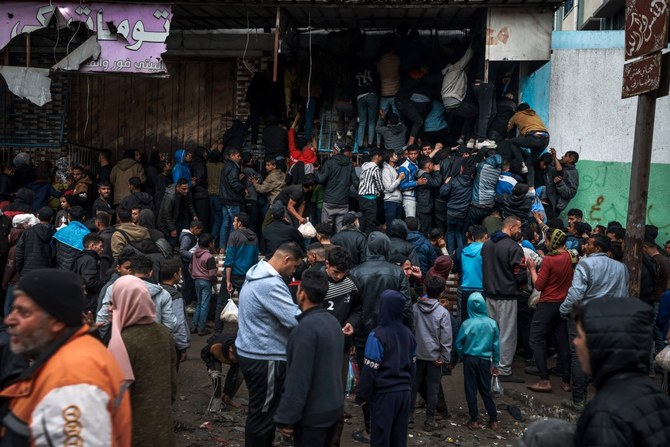
Hundreds of thousands of people have been driven into Rafah, seeking shelter in a sprawling makeshift encampment near the Egyptian border.
The city now hosts more than half of Gaza’s population, with displaced people “crammed” into less than 20 percent of the territory, according to UN humanitarian agency OCHA.
“We were displaced from Gaza City to the south,” said Ahlam Abu Assi. “(Then) they told us to go to Rafah, so we went to Rafah.
“We can’t keep going and coming,” she added. “There is no safe place for us.”
US President Joe Biden warned Netanyahu by phone on Thursday against launching an operation in Rafah without a plan to keep civilians safe, the White House said.
Britain, meanwhile, joined Australia, Canada and New Zealand in warning Israel not to launch a ground offensive in the city.
Prime Minister Rishi Sunak told Netanyahu in a telephone call that Britain was “deeply concerned about... the potentially devastating humanitarian impact of a military incursion into Rafah,” his office said.




