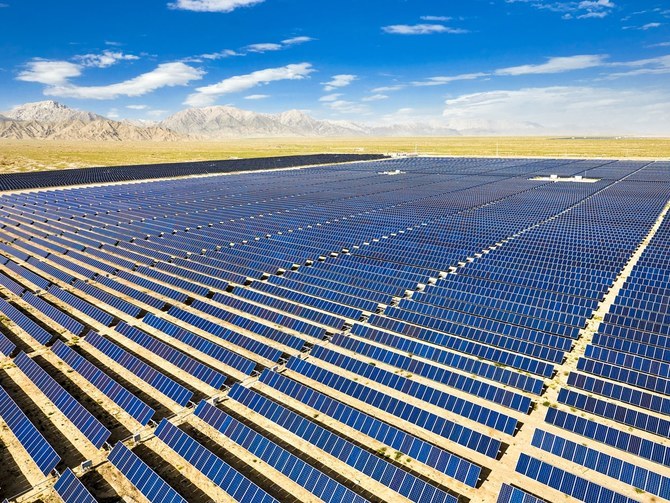
PIF-backed ACWA Power secures financing for $3.4bn solar plants 

The projects of Ar Raas 2, Saad 2 and Al-Kahfah have a production capacity of 4.55 gigawatts, powering approximately 750,000 households. They also have a capacity of approximately 2,000 megawatts, 1,125 MW and 1,425 MW of renewable power respectively,
Short Url
Updated 15 February 2024
Follow

PIF-backed ACWA Power secures financing for $3.4bn solar plants 

RIYADH: Utility firm ACWA Power, backed by Public Investment Fund, is a step closer to building solar energy plants worth $3.4 billion across Saudi Arabia after securing finance from a bank consortium.

The company, which owns a 50.1 percent stake in each of the three projects, secured a SR8.6 billion ($2.3 billon) credit facility from local, regional and international institutions, including Saudi Awwal Bank, Banque Saudi Fransi, and Mizuho Bank according to a statement to the Kingdom’s stock exchange.

Riyad Bank, Saudi National Bank, Standard Chartered Bank and HSBC are also part of the consortium. 

The projects of Ar Raas 2, Saad 2 and Al-Kahfah have a production capacity of 4.55 gigawatts, powering approximately 750,000 households. They also have a capacity of approximately 2,000 megawatts, 1,125 MW and 1,425 MW of renewable power respectively,

Of the total investment cost, SR8.6 billion was allocated to finance projects on a non-recourse basis.

The credit facility tenor will extend for 27.75 years, guaranteed by ACWA Power pro-rata share of an equity bridge loan, standby equity and reserve account.

The Public Investment Fund-owned Water and Electricity Holding Co. also known as Badeel, is a partner in the projects with a 49.9 percent equity stake in each of the three companies. SNB is one of the financing entities. Both are related parties, the statement added.

In May 2023, ACWA Power and Badeel signed power purchase agreements with the Saudi Power Procurement Co. to develop and operate the three large-scale plants.

The solar initiatives are part of the National Renewable Energy Program, a scheme overseen by the Ministry of Energy, with PIF assigned to establish 70 percent of NREP’s target capacity.

Aligned with the Kingdom’s Vision 2030 initiative, the Ministry of Energy aims to increase the share of renewables by 50 percent of the energy mix by 2030.

The wealth fund is currently developing a total of five projects, with a cumulative capacity of 8 GW and over $6 billion of investment from the fund and its partners.

The fund’s renewable projects, including Ar Raas 2, Saad 2, Al-Kahfah, Sudair, Shuaibah 2, aim to enable and support Saudi Arabia’s private sector through requirements for significant local content contribution and the procurement of equipment, supplies and services through local supply chains.

In 2023, an ACWA Power-led consortium secured financial closure for the Al-Shuaibah solar projects with an investment of $2.37 billion. The 2,061 MW projects of Al-Shuaibah 1 and Al-Shuaibah 2, are in Jeddah and expected to be operational by 2025.

Once completed, the solar project is expected to provide power to approximately 450,000 households.

The consortium includes ACWA Power Co., Badeel and the Saudi Arabian Oil Co., also known as Saudi Aramco.


Saudi Arabia’s industrial output rises 10.4% in November: GASTAT 

Updated 10 sec ago
Follow

Saudi Arabia’s industrial output rises 10.4% in November: GASTAT 

RIYADH: Saudi Arabia’s industrial output rose at its fastest rate in months, climbing 10.4 percent year on year in November, supported by stronger manufacturing activity and higher oil production, official data showed. 

The Industrial Production Index increased to 114.4, up from 103.6 a year earlier, according to the General Authority for Statistics, though the index slipped 0.7 percent from October.

The latest figures highlight continued momentum in the Kingdom’s industrial sector as Saudi Arabia pursues economic diversification under its Vision 2030 agenda.

In its latest report, GASTAT stated: “Preliminary results indicate an increase of 10.4 percent in the IPI in November 2025 compared to the same month of the previous year, supported by the rise in mining and quarrying activity, manufacturing activity and water supply, sewerage and waste management and remediation activities.”  

The sub-index of mining and quarrying activity increased by 12.6 percent year on year in November, supported by Saudi Arabia’s decision to raise oil production to 10.1 million barrels per day, compared to 8.9 million bpd a year earlier. 

Manufacturing activity rose by 8.1 percent compared to November 2024, driven by a 14.5 percent increase in the production of coke and refined petroleum products. The manufacture of chemical products also recorded a 10.9 percent annual rise.

In contrast, the sub-index of electricity, gas, steam, and air conditioning supply declined by 4.3 percent year on year, while water supply, sewerage and waste management and remediation activities rose by 10.2 percent. 

On a month-on-month basis, the overall IPI fell by 0.7 percent in November. 

Mining and quarrying activity rose by 0.5 percent from October, while manufacturing activity edged up by 0.3 percent.

However, electricity, gas, steam, and air conditioning supply recorded a sharp monthly decline of 28.6 percent. Water supply, sewerage and waste management and remediation activities fell by 3.1 percent over the same period. 

Overall, the index of oil activities advanced by 12.9 percent year on year in November, while non-oil activities increased by 4.4 percent. 

Compared to October, oil activities rose by 0.4 percent, while non-oil activities declined by 3.4 percent. 

The IPI measures changes in industrial output based on the International Standard Industrial Classification framework and covers mining, manufacturing, utilities, and waste management sectors.