Iran jails Mahsa Amini uncle for over five years

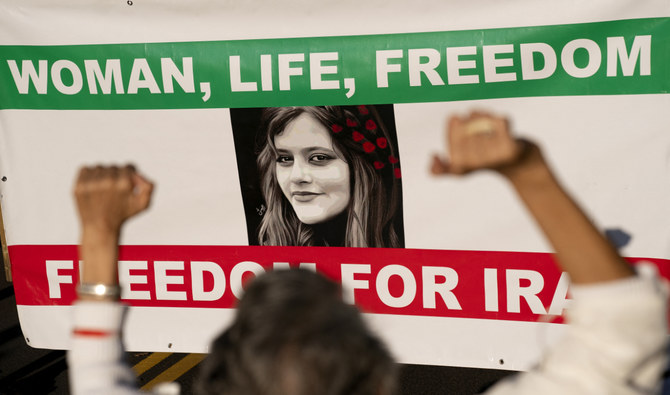
Demonstrators chant slogans while marching during the "March of Solidarity for Iran" in Washington, DC, on October 15, 2022. (AFP/File)
Short Url
Updated 13 February 2024
Follow

Iran jails Mahsa Amini uncle for over five years

PARIS: Iranian authorities have handed down a jail sentence of over five years to the uncle of Mahsa Amini, the young Iranian-Kurdish woman whose custody death sparked months of protests, over his anti-government views expressed during the 2022 demonstrations, rights groups said on Tuesday.

Safa Aeli, 30, was sentenced to five years and four months in prison by the Revolutionary Court in the family’s hometown of Saqez in northwestern Iran, the Norway-based Hengaw group and US-based Human Rights Activists News Agency said.

In addition, he was punished with sanctions including a highly unusual demand to produce a written document outlining the biography of a member of the security forces killed in the protests and then submit his “own personal interpretation” of the finished document to the judicial authorities, Hengaw said.

He was then ordered to post a voice message about the work on his social media accounts and otherwise banned from expressing any views about the protests.

Quoting family lawyer Saleh Nikbakht, HRANA said that part of the sentence was suspended and Aeli would have to serve three years and six months in prison.

The charges against him include taking part in protests that violated internal security, dissemination of anti-government propaganda, and insulting Supreme Leader Ayatollah Ali Khamenei.

Aeli is currently released on bail after his arrest in September 2023 shortly before the one-year anniversary of the death of his niece.

Mahsa Amini, 22, died in hospital on September 16, 2022 after being arrested for allegedly flouting the strict dress rules for women in the Islamic republic.

Her family and activists say she was killed by a blow to the head while in custody but this is denied by Iranian officials.

Aeli was released on bail in October 2023, according to HRANA. In Iran, it is common for convicts to be suddenly summoned to serve long sentences with only a few days notice.


Lebanese finance minister denies any plans for a Kushner-run economic zone in the south

Updated 22 January 2026
Follow

Lebanese finance minister denies any plans for a Kushner-run economic zone in the south

  • Proposal was made by US Envoy Morgan Ortagus but was ‘killed on the spot’
  • Priority is to regain control of state in all aspects, Yassine Jaber tells Arab News

DAVOS: Lebanon’s finance minister dismissed any plans of turning Lebanon’s battered southern region into an economic zone, telling Arab News on the sidelines of the World Economic Forum’s meeting in Davos that the proposal had died “on the spot.”

Yassine Jaber explained that US Envoy to Lebanon Morgan Ortagus had proposed the idea last december for the region, which has faced daily airstrikes by Israel, and it was immediately dismissed.

Jaber’s comments, made to Arab News on the sidelines of the World Economic Forum in Davos, were in response to reports which appeared in Lebanese media in December which suggested that parts of southern Lebanon would be turned into an economic zone, managed by a plan proposed by Jared Kushner, US President Donald Trump’s son in law.

Meanwhile, Jaber also dismissed information which had surfaced in Davos over the past two days of a bilateral meeting between Lebanese ministers, US Middle East Envoy Steve Witkoff and Kushner.

Jaber said that the meeting on Tuesday was a gathering of “all Arab ministers of finance and foreign affairs, where they (Witkoff and Kushner) came in for a small while, and explained to the audience the idea about deciding the board of peace for Gaza.”

He stressed that it did not develop beyond that.

When asked about attracting investment and boosting the economy, Jaber said: “The reality now is that we need to reach the situation where there is stability that will allow the Lebanese army, so the (Israeli) aggression has to stop.”

Over the past few years, Lebanon has witnessed one catastrophe after another: one of the world’s worst economic meltdowns, the largest non-nuclear explosion in its capital’s port, a paralyzed parliament and a war with Israel.

A formal mechanism was put in place between Lebanon and Israel to maintain a ceasefire and the plan to disarm Hezbollah in areas below the Litani river.

But, the minister said, Israel’s next step is not always so predictable.

“They’re actually putting pressure on the whole region. So, a lot of effort is being put on that issue,” he added.

“There are still attacks in the south of the country also, so stability is a top necessity that will really succeed in pushing the economy forward and making the reforms beneficial,” he said.

Lawmakers had also enacted reforms to overhaul the banking sector, curb the cash economy and abolish bank secrecy, alongside a bank resolution framework.

Jaber also stressed that the government had recently passed a “gap law” intended to help depositors recover funds and restore the banking system’s functionality.

“One of the priorities we have is really to deal with all the losses of the war, basically reconstruction … and we have started to get loans for reconstructing the destroyed infrastructure in the attacked areas.”

As Hezbollah was battered during the war, Lebanon had a political breakthrough as the army’s general, Joseph Aoun, was inaugurated as president. His chosen prime minister was the former president of the International Court of Justice, Nawaf Salam.

This year marks the first time a solid delegation from the country makes its way to Davos, with Salam being joined by Jaber, Economy and Trade Minister Amr Bisat, and Telecoms Minister Charles Al-Hage.

“Our priority is to really regain the role of the state in all aspects, and specifically in rebuilding the institutions,” Jaber said.