

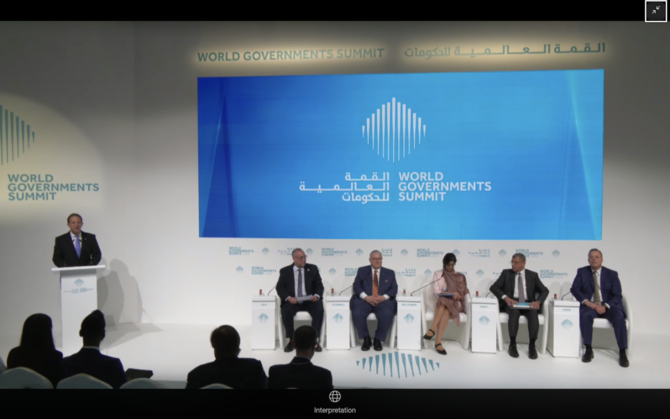

DUBAI: Space, the final frontier, is becoming a busy place, with many more countries developing their own agencies and programs, and private companies breaking into an industry long dominated by just a handful of wealthy nations.
The explosion of interest and investment in the space sector has opened a world of possibilities for scientific discovery, the development of medicines, and perhaps most exciting of all, human exploration of the solar system.
“First it will be the moon, then that will be a stepping stone onto Mars,” Kevin O’Connell, CEO of the US firm Space Economy Rising, told an audience at the World Governments Summit in Dubai on Tuesday.
However, as soon as humans begin establishing bases on the moon, staking their claim to territories, and exploiting resources in the lunar soil, all manner of commercial regulations and diplomatic arrangements will be needed.
O’Connell noted that transparency and dialogue on the issue of the moon’s settlement and exploration would be critical to allowing continued investment in the field and to avoid potential conflicts in future.
He said: “We have to find a way to authorize activities in order not to hinder investments. This time around we have the chance to think ahead of problems and not wait until they happen.”
Sherif Sedky, CEO of the Egyptian Space Agency, pointed out the need for countries to update existing treaties and establish new rules to accommodate an increasingly crowded space, as more moon missions were scheduled.
He told WGS delegates: “The moon is a natural extension of Earth. Therefore, there ought to be a lot of governance and control on how to access the moon without discrimination.

Aarti Holla-Maini, the UN director of outer space affairs, said the same mistakes made on Earth should not be repeated on the moon. “This is a fascinating time for us to go back to the moon, but we have a massive challenge,” she said. (Supplied)
“All nations ought to have a chance, whether they are first world or developing nations. We need to guarantee equal access and no appropriation of the moon.”
Sedky said the issue would require genuine cooperation and new approaches.
“Things have been operating the same way for the past 60 years, but now that more nations have joined space committees, we will be forced to modernize and update laws and regulations,” he added.
Aarti Holla-Maini, the UN director of outer space affairs, said the same mistakes made on Earth should not be repeated on the moon. “This is a fascinating time for us to go back to the moon, but we have a massive challenge.
“We have a clean sheet there, unpolluted. We cannot do on the moon what we did to Earth and its orbits. We have learned the hard way and now we have the chance to be ahead of the game.
“We also need dialogue. Our biggest mistake will be to fail to establish regulations and allow countries to do whatever they please while others play catch up. This will surely make way for conflict,” she added.
Beyond the diplomatic hurdles to the peaceful and equitable exploration of space, private companies were also keen to see robust regulations put in place so that investors could pour money into projects with confidence.
FASTFACT
• As of 2022, the global space sector had attracted private equity investments of $272bn into 1,791 companies since 2013.
It is a booming marketplace. As of the end of 2022, the global space sector had attracted private equity investments of around $272 billion into 1,791 unique companies since 2013, according to Deloitte.
Former astronaut Ron Garan is the CEO of ispace, a US company helping governments launch their own space agencies and access the required technology, infrastructure, and know-how.
Speaking at the WGS, he said: “If we expand our ecosystem and acquire new commercial and human spheres of influence then we will basically create a new continent and that will be a major cause for humanity.
“We need to create infrastructure on the moon for significant human presence there.”
However, Garan pointed out that current regulatory and diplomatic ambiguity was causing barriers to investment.
“We need to do everything we can to create stability to attract long-term investments as governments have their economical limits.
“The more we continue to negotiate things as a global community, the more investments will keep coming in,” he added.
Andrew Faiola, commercial vice president at the Tokyo-based firm Astroscale, said: “We need the right regulatory environment. In some cases, less regulation is better, but it still is important as it’ll attract innovation and funding.

Andrew Faiola, commercial vice president at Astroscale; Mike Gold, chief growth officer at Redwire Space; and Kevin O’Connell, CEO of the US firm Space Economy Rising, discussed opportunities for private companies in space exploration at the World Governments Summit on Tuesday. (Supplied)
“We are developing technical and business models that haven’t existed before. Space is hard and expensive, so to have funding is to help kick start these industries.
“In the old days, it used to take up to 10 years for a plan or for tools to show up in the market. Now it’s become a matter of two years or even two weeks. This is why we need a bottom-up approach with regulations, options, and possibilities,” Faiola added.
Mike Gold, chief growth officer at American company Redwire Space, noted that venture capital investment had stepped up significantly since 2017 and had been fueling the private space sector ever since.
He said: “There have been ups and downs in the world’s economy, but what we have witnessed is a surge of private financing, which has become an accelerator in the space economy.”
He pointed out that there was always a need to gather private funding and to bring commercial actors to the table to create an environment for innovation at every stage of the space value chain.
The growth of the space sector was expected to have a wider impact on a range of fields, industries, and technologies, with potentially huge benefits both for national economies and human well-being.
O’Connell said: “Space will have a positive impact on the biotech field. By adding the crystals found in space and producing medication there it will have more longevity, whether it be for heart or liver diseases. We are excited for the opportunities.”
But, he added, none of the applications could be fully explored until regulations had caught up. “How do you legislate these things? We are still at the cusp of figuring this all out.”


