

AI tech is in TV equivalent of monochrome but future is ‘bright’: CEO of OpenAI

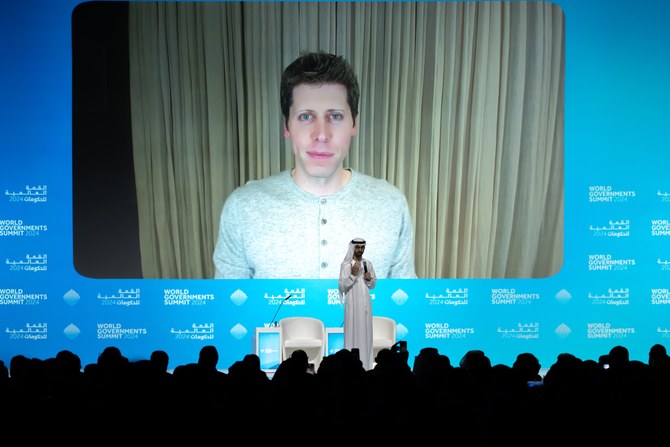
OpenAI is the developer of ChatGPT, which Altman called “one of the most transformative technologies in education we have had in recent times.” (Supplied)
Short Url
Updated 13 February 2024
Follow

AI tech is in TV equivalent of monochrome but future is ‘bright’: CEO of OpenAI

  • Discovery of new sciences, and transformation in medicine, education in next 10 years, says Sam Altman
  • Urges govts to develop global standards for study of the technology and safety measures

DUBAI: Artificial intelligence technology is currently in television’s equivalent of “black and white” but the coming decade “will be remarkable,” said Sam Altman, CEO of OpenAI, on Tuesday.

Speaking via video on the second day of the World Governments Summit underway in Dubai, Altman said the “bright future” promised by AI would transform education and medicine, and result in the development of new sciences.

He urged governments to adopt AI technology, which he said would improve the lives of citizens and modernize workplaces. There should also be efforts made to develop global standards for studying the technology and establishing safety regulations.

“What we have now would have been unimaginable in the era of the first primitive cellphones and that’s what we need to push for.”

He added: “In a few more years, (AI technologies) will be much better than it is now and, in a decade, it should be remarkable.”

OpenAI is the developer of ChatGPT, which Altman called “one of the most transformative technologies in education we have had in recent times.”

He said the core of AI was making intelligence broadly available, accessible, and inexpensive, noting that humanity still fails to realize “how limited we are.”

“Imagine a world where everyone gets a personal tutor, a great personalized medical advice, and how we can use these tools to discover new sciences and build healthy environments,” said Altman.

Asked what he would do if he was a minister of AI, Altman said he would create a “regulatory box” that would enable people to experience the new technologies before governments establish regulations.

“It’s hard to get regulatory ideas in a vacuum, so if there was a contained way to give people the future and let them experiment with it and see what went wrong or right, then put regulations around, I’d do that.”

Altman said people today were “unbelievably lucky” to be living “in the best time of human history.”

“You will use these tools that will enable you to do things people in previous generations couldn’t have imagined,” he said.

Running until Feb. 14, this year’s WGS brings together more than 25 heads of state, more than 85 international and regional organisations and global institutions, 140 governments, and distinguished global thought leaders and experts. 

Over 200 prominent speakers are addressing global future trends during more than 110 dialogues and sessions. WGS 2024 also hosts more than 4000 attendees, as well as more than 23 ministerial meetings and executive sessions attended by more than 300 ministers. 


Saudi unemployment eases to 3.4% in Q3: GASTAT  

Updated 8 sec ago
Follow

Saudi unemployment eases to 3.4% in Q3: GASTAT  

RIYADH: Saudi Arabia’s overall unemployment rate stood at 3.4 percent in the third quarter of this year, marking a 0.3 percentage point decline compared with the same period in 2024, official data showed. 

According to the General Authority for Statistics, the annual improvement came despite a 0.2 percentage point increase from the previous quarter. 

Saudi Arabia’s unemployment rate fell to a record low of 2.8 percent in the first quarter of the year before edging up to 3.2 percent in the second quarter and rising further in the third. 

The Kingdom’s strengthening labor market aligns with its Vision 2030 agenda, which aims to expand employment opportunities for citizens and support long-term economic growth. Reducing unemployment remains a central pillar of the broader socio-economic reform program. 

In its latest release, GASTAT stated: “The overall labor force participation rate (for Saudis and non-Saudis) reached 66.9 percent, showing a decrease of 0.2 percentage points compared to second quarter of 2025 and a yearly increase of 0.3 percentage points compared to the third quarter of 2024.”  

Among Saudi nationals, the rate of joblessness reached 7.5 percent in the third quarter, representing an annual decrease of 0.3 percentage points and a quarterly rise of 0.7 percentage points.  

Compared to the second quarter, the employment-to-population ratio for Saudis decreased by 0.6 percentage points to reach 45.3 percent. On a yearly basis, the ratio fell by 2.1 percentage points. 

“The labor force participation rate for Saudis in the third quarter of 2025 decreased by 0.2 percentage points compared to the second quarter, reaching 49 percent, and a decrease of 2.5 percentage points compared to the third quarter of 2024,” GASTAT said.  

Labor force participation of Saudi women stood at 33.7 percent in the third quarter, representing a 0.8 percentage point decline compared to the previous three months.  The employment-to-population ratio of Saudi women decreased by 0.9 percentage points to reach 29.7 percent.  

During the same period, the unemployment rate among Saudi women rose by 0.8 percentage points to 12.1 percent, compared with the previous quarter. 

Among Saudi men, the labor force participation rate increased by 0.3 percentage points to 64.3 percent. 

GASTAT also reported that 95.3 percent of unemployed Saudis are willing to work in the private sector. About 70.6 percent of unemployed Saudi women and 86.7 percent of unemployed Saudi men said they were open to working eight hours or more per day. 

The survey found that 61 percent of unemployed Saudi women and 42.7 percent of unemployed Saudi men were willing to commute for at least one hour to reach their workplaces. 

Among job seekers, the most common active search method was directly applying to employers, used by 73.3 percent of respondents in the third quarter. About 59.4 percent used the National Employment Platform, known as Jadarat, while 50.5 percent searched for jobs by posting or updating CVs on social media platforms.