PARIS: Past and future UN climate talk hosts the United Arab Emirates, Azerbaijan and Brazil said Tuesday they are forming a “troika” to push for an international agreement to limit global warming to 1.5 degrees Celsius.
The UAE hosted last year’s COP28 conference in Dubai, while Azerbaijan will host this year’s summit followed by Brazil in 2025.
The three countries were mandated by 198 signatories to the Dubai agreement to work together on a roadmap to limit global warming to 1.5 degrees Celsius, a key climate goal that has been seriously threatened by global greenhouse gas emissions.
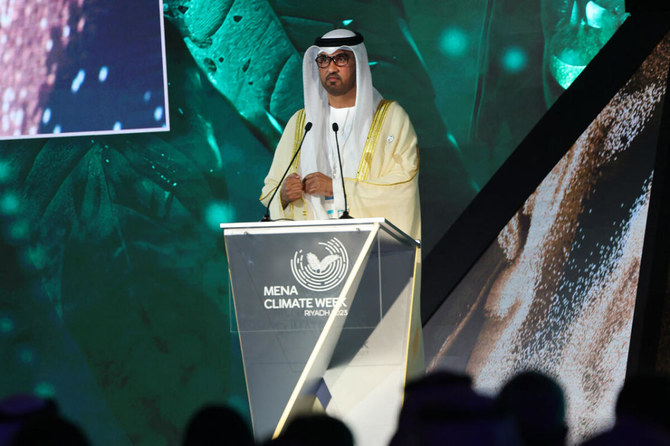
“The Troika helps ensure we have the collaboration and continuity required to keep the North Star of 1.5°C in sight — from Baku to Belem and beyond,” COP28 president Sultan Al Jaber said in a statement.
Taking into account current climate pledges, the world is still on track to warm between 2.5 and 2.9 degrees Celsius over this century, according to UN estimates.
The 1.5-degree Celsius limit will probably be reached between 2030 and 2035, according to the Intergovernmental Panel on Climate Change (IPCC).
According to the final agreement reached at COP28, the troika partnership should “significantly enhance international cooperation and the international enabling environment to stimulate ambition in the next round of nationally determined contributions.”
This is “with a view to scaling up action and implementation during this critical decade and keeping the 1.5°C limit within reach,” according to the agreement.
At COP28, the world agreed to “transition away” from fossil fuels, but there was no progress on unblocking financial flows to developing countries, a major sticking point in negotiations.
This issue is set to be a central theme of COP29 in Baku, where a new target is expected to be set for the financial support provided by developed countries for climate change.
According to the Organization for Economic Co-operation and Development, rich countries are about two years late in meeting their initial pledge of $100 billion in annual climate funding by 2022.
The UN’s high-level expert group on climate finance said in 2022 that developing nations (excluding China) need to spend some $2.4 trillion a year on clean energy and climate resilience by 2030 — four times current levels.
“We are committed to leveraging our strength as a bridge builder between the developed and developing world as host of COP29, to accelerate efforts to keep 1.5 in reach,” said COP29 president-designate Mukhtar Babayev.
“Key to that will be establishing a new climate finance goal that reflects the scale and urgency of the climate challenge.”

COP hosts UAE, Azerbaijan, Brazil announce climate ‘troika’
https://arab.news/6htwr
COP hosts UAE, Azerbaijan, Brazil announce climate ‘troika’
Epstein files reveal links to cash, women, power in Africa
- Documents attest to Epstein’sclose ties with Karim Wade, son of former Senegalese president Abdoulaye Wade
- They also reveal his ties to Nina Keita, niece of Ivorian president Alassane Ouattara
PARIS: Jeffrey Epstein built close ties with powerful figures in Senegal and Ivory Coast, files released by the US government last month show, detailing the late sex offender’s influence network across Africa.
Emails, scheduled meetings, investment projects, and loans reviewed by AFP attest to the disgraced New York financier’s close relationship with Karim Wade, son of former Senegalese president Abdoulaye Wade.
They also reveal his ties to Nina Keita, niece of Ivorian president Alassane Ouattara.
Wade and Epstein met in 2010 through Emirati businessman Sultan Ahmed bin Sulayem, who recently resigned as CEO of port giant DP World after mounting pressure over his close friendship with Epstein.
The pair quickly struck up a rapport.
“Thanks for coming. I think there are many things to consider... I feel confident that we will have fun,” Epstein wrote to Wade on November 15, 2010 after their first meeting in Paris.
“Have a safe trip back to your paradise Island,” Wade replied.
While Wade’s exchanges show no link to Epstein-related sex trafficking crimes, they do reveal conversations on potential business ventures in various sectors, such as finance and energy.
Nicknamed the “Minister of Heaven and Earth” for the multiple portfolios he held including international cooperation, energy, and air transport, Wade was a powerful figure in Senegal until April 2012, when his father’s bid for a third term sparked deadly riots.
Epstein saw him as “one of the most important players in africa” and invited him to meet close contacts such as Ehud Barak, then Israel’s defense minister.
He also put him in touch with Chinese businessman Desmond Shum to discuss “offshore banking.”
The US Department of Justice documents show Shum and Wade met in Beijing on May 9, 2011.
That same month, Wade planned an African tour through Senegal, Mali, and Gabon for Epstein.
‘You will not suffer’
Epstein and Wade’s relationship became even more apparent after the latter’s fortunes reversed when his father left office in 2012.
That autumn, Epstein proposed that his “friend” — under the Dakar authorities’ scrutiny over his assets — use his house in Florida.
“You and your family are welcome to use my house in palm beach, staff is there, pool etc. you will not suffer,” Epstein wrote.
“Txs a lot Brother for the advise,” Wade replied a few weeks later to another email, in which Epstein urged him to “stay mentally strong.”
Numerous files suggest Epstein became financially involved on Karim Wade’s behalf after his arrest in 2013 and his 2015 sentencing to six years in prison for corruption.
Karim Wade’s lawyer, Mohamed Seydou Diagne, sent two invoices in May 2014 and July 2015 of $500,000 to one of Epstein’s companies.
Contacted by AFP on Monday, Diagne said he “did not consider it useful to comment.”
Other archives suggest that Epstein covered at least $50,000 in fees for the US lobbying firm Nelson Mullins, hired by Wade’s entourage to secure his release.
Epstein regularly exchanged emails with Robert Crowe, a partner at the firm who kept him informed of their efforts in the US and Senegal.
In a June 16, 2016 email thread where Epstein and Crowe discussed whether then Senegalese president Macky Sall would pardon Wade, Crowe writes: “He has told my friends high up at State that he was going to do it. They have been putting pressure on him!“
Karim Wade was released from prison eight days later, on June 24, and went into exile in Qatar, which he credited for efforts toward his release.
Jeffrey Epstein was told by Sultan Ahmed bin Sulayem and Nina Keita.
‘A very interesting person!’
The DOJ documents show Nina Keita was close to both Epstein and Karim Wade and that she acted as a regular intermediary while Wade was in prison.
Keita also helped put Epstein in contact with her uncle, president of Ivory Coast since May 2011, and his team.
“He thought you were a very interesting person! ... they were all very happy to have you here,” she wrote on January 20, 2012, after the financier’s visit to Abidjan.
She had booked him the “ministerial suite” of the luxury Hotel Ivoire for that trip.
Ahead of the visit, Epstein had said he hoped to see “very pretty girls there, as well as interesting places.”
“You will!” Keita replied.
Emails show Keita, a former model, at least once sent photos and the phone number of a young woman to Epstein.
He then met this woman at the Ritz hotel in Paris on August 31, 2011.
“ask sadia to send pictures of her sister. i prefer under 25,” Epstein wrote to Keita after the meeting.
Now the deputy general director of Ivorian petroleum stocks company GESTOCI, Keita also appears in a February 2019 will in which Epstein requested that debts owed to him by a number of people be canceled upon his death.
AFP received no response to its requests for comment from both Keita and the Ivorian presidency, or from Karim Wade, who was contacted through his entourage.
The mere mention of a person’s name in the Epstein files does not in itself imply wrongdoing.


