

Pakistan’s election watchdog demands probe after denial of vote count access in 135 constituencies

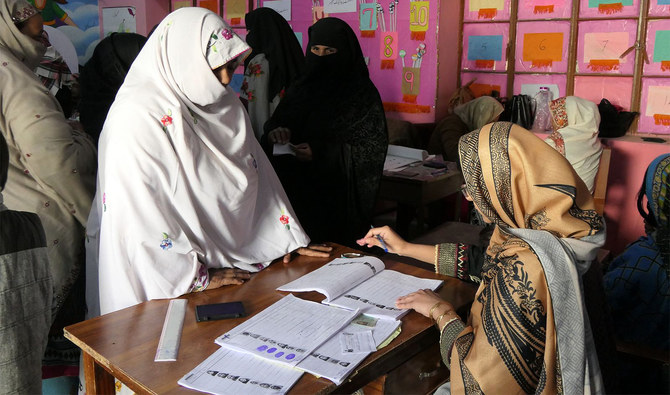
A woman casts vote in Quetta, Pakistan, on February 8, 2024. (AN photo by Saadullah Akhtar)
Short Url
Updated 13 February 2024
Follow

Pakistan’s election watchdog demands probe after denial of vote count access in 135 constituencies

  • FAFEN blames the Returning Officers for undermining ECP’s efforts to maximize electoral transparency
  • It says the ROs stopped one of more candidates from participating in tabulation proceedings in 65 areas

ISLAMABAD: A prominent Pakistani election monitoring network said on Monday its observers were not allowed to witness the vote tabulation process in 135 National Assembly constituencies by the Returning Officers (ROs) while seeking an investigation into this violation of the relevant election law.

The Free and Fair Election Network (FAFEN) has been monitoring electoral contests in the country since its formation in 2006. It is allowed to observe the consolidation of voting results under Section 238 of the Election Act, 2017, which opens up space for accredited monitoring organizations to determine the extent of transparency of an electoral contest.

Section 92 of the same law also requires the ROs to prepare and announce the Provisional Consolidated Statement of the Results of the Count (Form-47) in the presence of contesting candidates, their election agents and authorized observers.

Similarly, Section 95(1) requires the Returning Officer to conduct the consolidation of the results in the presence of the contesting candidates and their election agents. Section 95(9) requires the Returning Officers to provide copies of Form-48 (Consolidated Statement of the Results of the Count Furnished by the Presiding Officers) and Form-49 (Final Consolidated Result).

“The Returning Officers (ROs) in 135 of 260 National Assembly constituencies did not adhere to these provisions, undermining the ECP’s efforts to maximize electoral transparency, which was generally maintained during the voting and counting processes at the polling stations,” FAFEN said in its statement.

“The Returning Officers did not allow FAFEN observers in 135 constituencies to observe the tabulation process –– 80 in Punjab, 23 in Sindh, 18 in Khyber Pakhtunkhwa, 11 in Balochistan and all three in Islamabad Capital Territory (ICT),” it added.

FAFEN noted that out of these 135 constituencies, Pakistan Tehreek-e-Insaf (PTI)-backed independents won 46, Pakistan Muslim League-Nawaz (PML-N) 43 and Pakistan Peoples Party Parliamentarians (PPPP) 28 seats.

It also informed that the ROs in 65 constituencies prohibited one or more candidates and their election agents from participating in the tabulation proceedings.

“The ECP [Election Commission of Pakistan] must probe the non-compliance of Returning Officers of its instructions to ensure electoral transparency and to determine responsibility as per Section 55 of the Elections Act, 2017, which empower the Election Commission to take action against erring election officials, public servants and persons in the service of Pakistan,” FAFEN added.

Pakistan’s election regulatory body has rejected rigging allegations raised by various political parties amid voting result delays which raised suspicion of election manipulation.

Caretaker Prime Minister also described the February 8 polls as largely fair, though he maintained he was not ruling out some incidents of election irregularities which could be addressed by ECP’s tribunals.



Pakistan pitches digital finance reforms to foreign fintech investors

Updated 4 sec ago
Follow

Pakistan pitches digital finance reforms to foreign fintech investors

  • Khurram Schehzad highlights progress on digital banking and plans for regulating blockchain and virtual assets
  • Visiting delegation welcomes policy clarity, sees scope for long-term investment and partnerships in Pakistan

KARACHI: Pakistan on Saturday pitched its digital finance and fintech reforms to foreign investors as part of a broader effort to attract capital after macroeconomic stabilization, with a senior official highlighting progress on digital banking, payments infrastructure and regulatory overhaul.

The outreach came as Islamabad seeks to sustain reform momentum following a period of economic stress, positioning technology-led financial inclusion as a pillar of its recovery and growth strategy while courting international investors.

Khurram Schehzad, adviser to the finance minister, briefed a delegation of international fintech investors on Pakistan’s reform agenda and digital growth plans at a meeting in federal capital, according to a statement from the finance ministry.

“Consistent policy implementation and structural reforms have strengthened macroeconomic fundamentals and improved Pakistan’s investment outlook,” he said, highlighting the “renewed global confidence” in the economy.

Officials said the discussions focused on the government’s Digital Pakistan Vision, including efforts to expand digital payments, build public digital infrastructure and digitize government transactions to widen financial inclusion and formalize the economy.

Schehzad cited the role of Raast, Pakistan’s instant payment system, which enables real-time, low-cost and interoperable digital payments nationwide, as well as regulatory reforms introduced by the State Bank of Pakistan to modernize retail digital banking.

Under the new framework, easypaisa Digital Bank has been operational for nearly a year, while Mashreq Digital Bank has also begun operations, with several other digital banks moving toward launch, the statement said.

The adviser also outlined Pakistan’s plans to develop a regulatory framework for blockchain, Web3.0 and virtual assets, saying authorities were engaging with global platforms to support innovation while ensuring compliance and investor protection.

The investor delegation was led by John Sfakianakis, chairman of Fintech Solutions Holding, alongside the company’s chief executive Kirill Smolin, and was facilitated by local technology firm Tech Avenue.

The investors welcomed the “clarity of reforms and policy direction,” saying Pakistan’s combination of macroeconomic stabilization, digital infrastructure and emerging technologies offered opportunities for long-term investment and strategic partnerships, the finance ministry said.