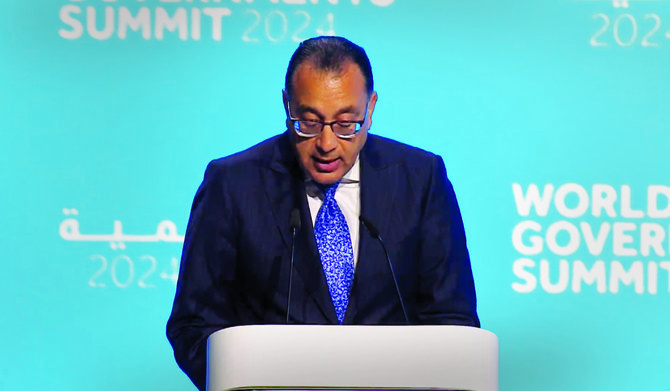

DUBAI: Egypt is responding to recent global economic turmoil by encouraging private sector investment, exploring new technologies, prioritizing the green transition, and shaking up its governance model, Egyptian Prime Minister Mostafa Madbouly has said.
The Arab world’s most populous country, home to more than 110 million people, has been almost uniquely vulnerable to the economic headwinds of the COVID-19 pandemic, the war in Ukraine, the Israel-Hamas conflict, and the pressures of climate change.
These combined blows have struck a nation already facing a foreign exchange crisis, historic inflation, sluggish non-oil exports and foreign direct investment, constrained private sector activity and job-creation, and rising government debt.
For Madbouly, the solution lies in the promotion of “sustainable governance” and policy approaches that are “visionary and innovative.”
WGS 2024 INNUMBERS
120
Government delegations attending summit.
“In Egypt we have been encouraging people to invest in the private sector, which can help create more jobs,” Madbouly, who has held the office of prime minister since 2018, told an audience at the World Government Summit in Dubai on Monday.
“Our new plans and their implementation has helped us push through the past four years till now,” he added, saying Egypt aims to achieve sustainable growth by 2030 by investing in its population — almost 30 percent of whom live below the national poverty line.
“We are educating our citizens and we have centered our policies on human dignity. Our plans so far have been recognized and received rather well by the UN.”
The World Bank and the International Monetary Fund expect Egypt to face continued economic strain through 2024 before beginning to see improvement over the medium term — as long it sticks with current stabilization and structural reforms.
These reforms include implementing the IMF-brokered State Ownership Policy, fostering greater competition, strengthening governance and the rule of law, and improving the overall business environment to unleash the private sector’s full potential.
Egypt also aims to stabilize its economy by raising productivity and by diversifying its investments into different sectors, from high-tech industries like artificial intelligence to modern agricultural techniques, creating 7-8 million jobs in the process.
“Our focus on the growth of infrastructure and our political reforms will be attracting local foreign investments alike,” said Madbouly, who was previously Egypt’s minister of housing, utilities and urban communities.
One area the Egyptian government seems especially keen to develop is green energy.
Having hosted the UN Climate Change Conference, COP27, at the Red Sea resort of Sharm El-Sheikh in 2022, Egypt is looking to lead the way in the adoption of green hydrogen and to reduce its reliance on fossil fuels.
“We aim to cooperate and facilitate the establishment and production of green energy, especially green hydrogen, which we are hoping to become a regional central hub for by 2026 and a global hub by 2030,” Madbouly said.
Of course, Egypt is not alone in having to adjust to difficult economic realities, which are forcing governments across the developing world to break with old structural orthodoxies and embrace new approaches to governance.
“According to the World Bank, the problem with high interest rates will cause problems for developing nations,” said Madbouly.
“This is a result of political tensions that manifests into lack of cooperation between governments, which will end up causing a strain on some nations’ local currencies.”
He added: “That alone ought to motivate governments to think entirely differently in order to address these present problems.”
Madbouly urged governments in a similar predicament to Egypt to “develop sustainable governance and start to approach matters in visionary and innovative ways.”