


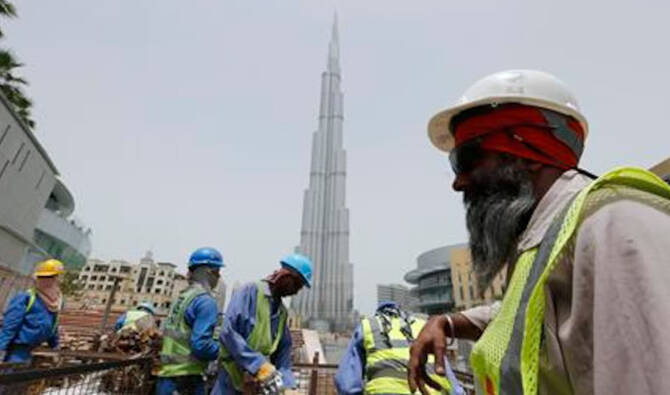

ISLAMABAD: Pakistan should shift its economic strategy in the Middle East from exporting labor to winning contracts for construction, engineering, health care, information technology and other services, a government-backed think tank said on Wednesday, arguing the approach could generate billions of dollars in additional foreign exchange.
The recommendation comes as Gulf countries, led by Saudi Arabia, invest heavily in mega-projects under Vision 2030 while reconstruction efforts gather pace in countries including Syria, Gaza and Lebanon. Pakistan has long relied on the Gulf as a destination for migrant workers and remittances but has secured only a limited share of the wider commercial opportunities emerging across the region.
In a new policy paper, the Pakistan Institute of Development Economics (PIDE) proposed establishing a “Middle East Recovery Mission” under the Special Investment Facilitation Council (SIFC) to coordinate labor certification, exports, investment, industrial cooperation and support for overseas workers. The institute said the initiative would rely on existing government institutions rather than creating a new bureaucracy.
“We send workers; others get projects. We provide manpower; others provide systems,” the report said.
It estimated that projects and reconstruction across the Gulf and wider Middle East could exceed $1.5 trillion this decade but said Pakistan continued to earn primarily through workers’ remittances rather than higher-value contracts, supply chains and professional services.
“Pakistan does not need another strategy, council or consultant. It needs an operating model that converts relationships into contracts, skills into higher incomes and remittances into productive investment,” the PIDE paper added.
According to the report, Pakistan exported $3.79 billion worth of goods to Gulf Cooperation Council countries in the last fiscal year while importing about $17.9 billion. More than 762,000 Pakistanis went abroad for work in 2025, it said, with around 61 percent classified as unskilled.
The study argued that Pakistan’s challenge was not a lack of skilled workers or commercial potential but its inability to organize and market those capabilities to compete for regional projects.
Under the proposed framework, workers would be certified and linked to banking and insurance services before deployment overseas, while Pakistani companies would receive support to compete for contracts in sectors including construction, logistics, health care, information technology and facilities management. The report also recommends expanding exports of products such as pharmaceuticals, surgical instruments, food and construction materials to Gulf markets.
PIDE estimated the strategy could generate $2 billion to $4 billion in additional external inflows annually within three years, rising to more than $5 billion by the fifth year through a combination of higher-skilled remittances, exports, contract revenues and defense-industrial cooperation. It said the figures were indicative policy targets rather than forecasts and should be independently verified before being incorporated into government planning.
The institute called on Prime Minister Shehbaz Sharif to designate the SIFC as the coordinating body for the proposed initiative, with a 90-day implementation plan and clearly assigned responsibilities across government agencies.


