

Pakistani premier defends delay in the release of election results, denies vote was unfair

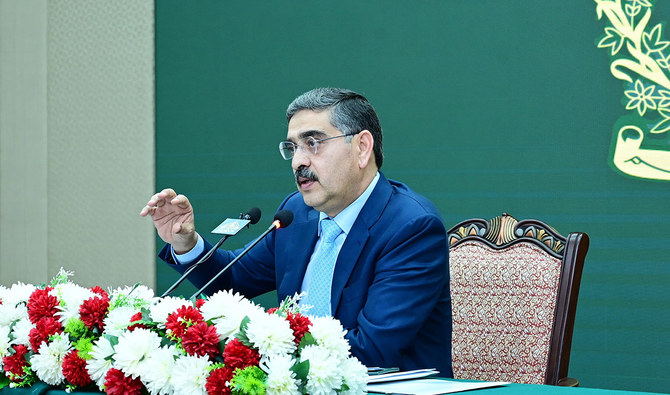
Pakistan’s caretaker prime minister Anwaar-ul-Haq Kakar speaks during a press conference in Islamabad, Pakistan on February 12, 2024. (PMO)
Short Url
Updated 12 February 2024
Follow

Pakistani premier defends delay in the release of election results, denies vote was unfair

  • Anwaar-ul-Haq Kakar said previous election results had been announced after a delay of 66 hours when Imran Khan won power in 2018
  • He insisted a “level playing field” was available to all political parties, including Khan’s Pakistan Tehreek-e-Insaf that won most of the seats

ISLAMABAD: Pakistan’s caretaker prime minister on Monday defended the widely criticized delay in the announcement of the results of last week’s election, saying authorities took only 36 hours to count over 60 million votes while also grappling with militant attacks.

Anwaar-ul-Haq Kakar said that the previous election results had been announced after a delay of 66 hours when Imran Khan won power in 2018. He insisted that a “level playing field” was available to all political parties, including Khan, the imprisoned former prime minister whose party, Pakistan Tehreek-e-Insaf, won most of the seats — but only because its candidates ran as independents.

Thursday’s vote was held to choose a new parliament but was overshadowed by allegations of vote-rigging, an unprecedented mobile phone shutdown, and the exclusion of Khan and his party from the vote.

Kakar said at a news conference that the mobile phone service was suspended on election day for security reasons following a pair of militant attacks that killed 30 people in southwestern Baluchistan province a day before the vote. He said that security forces last week killed a key militant from the Daesh group who was behind the two elections-related attacks.

He said he could afford a delay in the announcement of the election results “but not the terrorism or the terrorist attacks.”

Kakar said the elections were largely held in a peaceful, free and fair manner, and the much-awaited process to install a new government could begin within the next eight to nine days, when the newly elected National Assembly is expected to convene.

He said the parliament will elect the speaker, deputy speaker and the new prime minister.

Kakar said people were allowed to hold peaceful protests but warned that action would be taken if rallies turned violent.

On Monday, thousands of supporters of Khan and members of other political parties blocked key highways and started a daylong strike in the volatile southwest to protest alleged vote-rigging. Separately, several nationalist and Islamist political parties in Baluchistan blocked two highways leading to Iranian and Afghan border crossings and disrupting trade and movement of people.

While election winners were celebrating, PTI and other parties refused to accept their defeat in dozens of constituencies. Dozens of Khan’s supporters were briefly detained in the eastern city of Lahore over the weekend while protesting alleged election irregularities.

Jan Achakzai, a government spokesman in Baluchistan, urged protesters to “show grace” by accepting defeat and moving away from the highways.

Khan could not run in the election because of the criminal convictions against him that he says are politically motivated. His candidates won 93 out of 265 National Assembly seats — not enough to form a government.

The Pakistan Muslim League-N party led by three-time premier and ex-felon Nawaz Sharif secured 75. Sharif is currently in talks with allies to form a coalition government.

The Pakistan People’s Party, or PPP, led by Bilawal Bhutto-Zardari, came in third with 54 seats. One result has been withheld and another vote was postponed because of a candidate’s death. The campaign to kick Khan out of office in 2022 was led by the PML-N and the PPP.

The two parties were in talks to form a coalition government.

Pakistan’s military has always cast itself as the ultimate arbiter of who becomes prime minister, and Sharif was marked out as the powerful security establishment’s preferred candidate because of his smooth return to the country last October.

Sharif spent four years in exile to avoid serving prison sentences but his convictions were overturned within weeks of his arrival in Pakistan.


US freezes immigrant visa processing for 75 countries, including Pakistan

Updated 9 sec ago
Follow

US freezes immigrant visa processing for 75 countries, including Pakistan

  • Immigrant visas to be suspended from Jan 21, tourist visas unaffected
  • Move targets “public charge” concerns as Trump revives hard-line immigration rules

ISLAMABA: The United States will pause immigrant visa issuances for nationals of 75 countries, including Pakistan, from January 21, the State Department said on Thursday, as President Donald Trump presses ahead with a hard-line immigration agenda centered on financial self-sufficiency.

In an update published on its website, the State Department said it was conducting a comprehensive review of immigration policies to ensure that migrants from what it described as “high-risk” countries do not rely on public welfare in the United States or become a “public charge.”

“The State Department will pause immigrant visa processing from 75 countries whose migrants take welfare from the American people at unacceptable rates. The freeze will remain active until the US can ensure that new immigrants will not extract wealth from the American people,” the department said.

The pause applies specifically to immigrant visas, which are issued to people seeking permanent residence in the United States. The department said applicants from affected countries may still submit applications and attend interviews, but no immigrant visas will be issued during the suspension.

According to the State Department, the affected countries include Pakistan, Afghanistan, Bangladesh, Iran, Iraq, Egypt, Nigeria, Russia, Somalia, Brazil, Thailand and dozens of others across Asia, Africa, the Middle East, Europe and Latin America.

The department said tourist and other non-immigrant visas are not affected, and that no previously issued immigrant visas have been revoked. Dual nationals applying with a valid passport from a country not on the list are exempt from the pause.

The State Department did not indicate how long the visa pause would remain in effect, saying it would continue until its review of screening and vetting procedures is completed.

The announcement underscores the breadth of the Trump administration’s renewed immigration crackdown. Since returning to office last year, Trump has revived and expanded enforcement of the “public charge” provision of US immigration law, which allows authorities to deny entry to applicants deemed likely to rely on public benefits.

During his previous term, Trump imposed sweeping travel restrictions on several Muslim-majority countries, a policy widely referred to as a “Muslim ban,” which was challenged in courts before a revised version was upheld by the Supreme Court and later rescinded under former president Joe Biden.

The visa freeze also comes amid an intensifying domestic enforcement push. US Immigration and Customs Enforcement (ICE) has expanded operations nationwide, drawing scrutiny over its tactics. Last week, an ICE agent shot and killed Renee Good, a US citizen, during a federal operation in Minneapolis, sparking protests and renewed debate over immigration enforcement under the Trump administration.