

Ex-PM Sharif is not party’s candidate for premier, close aide says after Pakistan election 

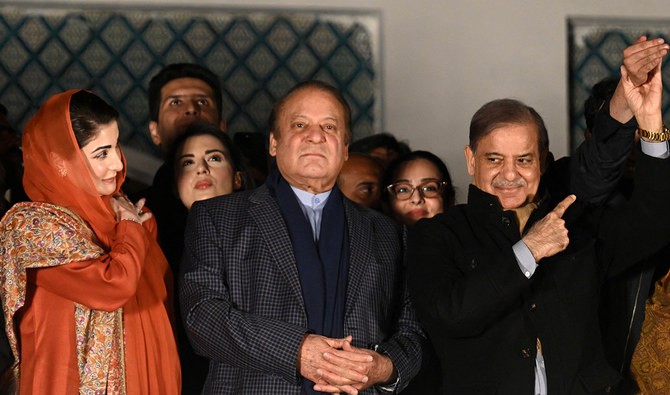
Pakistan's former Prime Minister Nawaz Sharif (C) and leader of the Pakistan Muslim League (PML) party, along with his younger brother and former prime minister Shehbaz Sharif (R) and his daughter Maryam Nawaz (L) attend a gathering with supporters in Lahore on February 9, 2024, a day after Pakistan's national elections. (AFP/File)
Short Url
Updated 12 February 2024
Follow

Ex-PM Sharif is not party’s candidate for premier, close aide says after Pakistan election 

  • Khawaja Asif, a senior party figure, says Sharif’s younger brother, Shehbaz Sharif, will be their nominee for the prime minister’s office
  • Coalition between Sharif’s party, former FM Bilawal Bhutto-Zardari-led group seems most likely outcome after Thursday’s indecisive vote

ISLAMABAD: A close aide of Pakistan Muslim League-Nawaz (PML-N) supremo Nawaz Sharif, who was seen as the main prime ministerial hopeful, said on Monday the three-time former prime minister would not be his party’s candidate for the PM’s office following Thursday’s national election.

Sharif, who returned to country months ago after having spent years in self-exile, was seen as the favorite candidate for the PM’s office and was widely believed to be backed by the country’s powerful army. Though he denies this and the army says it does not interfere in politics.

The three-time former premier called on allied parties to form a coalition government a day after his PML-N party failed to secure a simple majority in Feb. 8 national election, prompting many people to believe he would once again be taking the PM’s office.

But a senior figure in the PML-N denied on Monday that Sharif would be his party’s candidate for the top slot.

“No Mian [Nawaz Sharif] sahib is not...Mian Shehbaz sahib will be [the prime ministerial candidate],” PML-N leader Khawaja Asif told a reporter in televised comments, when asked who would be his party’s nominee for the prime minister’s post.

Thursday’s vote in Pakistan failed to present a clear winner, with independent candidates, most loyal to ex-PM Imran Khan, winning the highest 101 seats in National Assembly, the lower house of parliament, according to official results.

The PML-N stood at the second position, followed by the Pakistan Peoples Party (PPP) with 54 seats. The rest of the seats went to smaller parties, except for two seats out of which results were withheld on one and election was postponed on the other.

This means the PML-N will have to forge an alliance to form a government in the capital Islamabad and a coalition between the PML-N and former foreign minister Bilawal Bhutto-Zardari-led PPP, who formed the Shehbaz-led government after ousting Khan in April 2022, seems a most likely outcome.

Asked about the nominee for the Punjab chief minister’s post, Asif said his party had “almost made a decision” about who to nominate for the CM’s office, arguably the most influential position after the prime minister’s slot.

Analysts say the South Asian country of more than 241 million faces weeks of political uncertainty ahead following the indecisive election, with several results challenged in courts and rival parties negotiating possible alliances.

The election came at a time when the country is deeply in debt and a new government will be facing the daunting task of negotiating a fresh bailout program with the International Monetary Fund (IMF) after its current $3 billion standby agreement expires in March.

Inflation is galloping at nearly 30 percent, the rupee has been in freefall for three years — losing nearly 50 percent of its value since 2021 — and a balance of payments deficit has frozen imports, severely hampering industrial growth.


UN says 270,000 Afghans have returned from Iran, Pakistan this year

Updated 4 sec ago
Follow

UN says 270,000 Afghans have returned from Iran, Pakistan this year

  • UNHCR says 110,000 Afghans returned from Iran while 160,000 returned from Pakistan since start of 2026
  • Return numbers seem to have risen since Gulf war erupted on Feb. 28, says UNHCR official in Afghanistan

GENEVA: Some 270,000 Afghans have returned to their country from Pakistan and Iran so far this year, the UN said Tuesday, warning that the escalating Middle East war risked pushing the numbers higher.

UNHCR, the United Nations’ refugee agency, said that 110,000 Afghans had returned from Iran and another 160,000 had returned from Pakistan since the start of 2026.

And the numbers seem to have risen since the Middle East erupted on February 28, with the United States and Israel unleashing a barrage of strikes on Iran, and Tehran responding with drone and missile strikes on Israeli and US interests across the region.

Since then, there have been some 1,700 returns from Iran to Afghanistan each day, Arafat Jamal, UNHCR’s representative in Afghanistan, told reporters in Geneva.

Speaking from Islam Qala, on the Afghan-Iranian border, he said the situation there was “deceptively calm.”

“Returns are orderly but freighted with tension and apprehension,” he said, adding that with the hostilities elsewhere escalating, “I do fear there is more to come.”

“We are preparing for massive returns.”

He pointed out that Afghanistan was “facing the ramifications of what is happening with Iran,” while clashes have erupted along the Afghan border with Pakistan.

The new Middle East war, he warned, was “layering itself on top of an existing war on another frontier,” Jamal said.

UNHCR highlighted that the latest crises came after returns to Afghanistan had already been “exceptionally high” in recent years.

More than five million Afghans had returned from neighboring countries in the past two years, including 1.9 million returning from Iran last year alone.

Jamal warned that “many Afghan families are now facing cycles of displacement: first forced to flee Afghanistan, later displaced again inside Iran due to conflict, and now returning once more to Afghanistan.”

“And upon return in Afghanistan, the triply-displaced enter a spiral of precarity and uncertainty.”
Returns from Pakistan had meanwhile stabilized in recent weeks, as the main crossing point at Torkham remained closed due to the tensions there, Jamal said.

But he warned that “movements could increase sharply once the border reopens.”

UNHCR and the UN children’s agency UNICEF said Tuesday they were working to strengthen their capacity to operate at the borders and within Afghanistan.

But “given the scale of returns and the financial constraints facing humanitarian operations, additional support will be needed if arrivals increase,” UNHCR said, without specifying the amount needed.