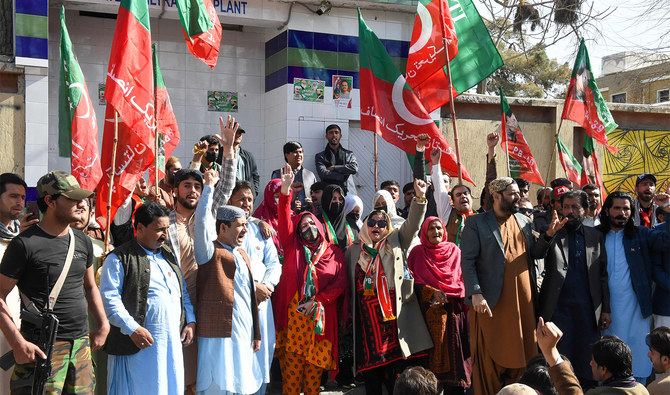

PESHAWAR: Supporters of former prime minister Imran Khan’s Pakistan Tehreek-e-Insaf (PTI) and other political parties on Monday blocked highways in Pakistan’s northwestern and southwestern provinces to protest what they said was manipulation of results of Feb. 8 national elections.
Thursday’s vote to choose a new parliament was overshadowed by allegations of vote-rigging, a nationwide shutdown of mobile phone networks, and more than 50 incidents of violence that killed at least 16 people across the South Asian country.
While the election failed to present a clear winner, independent candidates, most loyal to Khan, won the highest 101 parliamentary seats, according to official results. However, Khan’s PTI and other parties protested for a second day on Monday the results in dozens of constituencies.
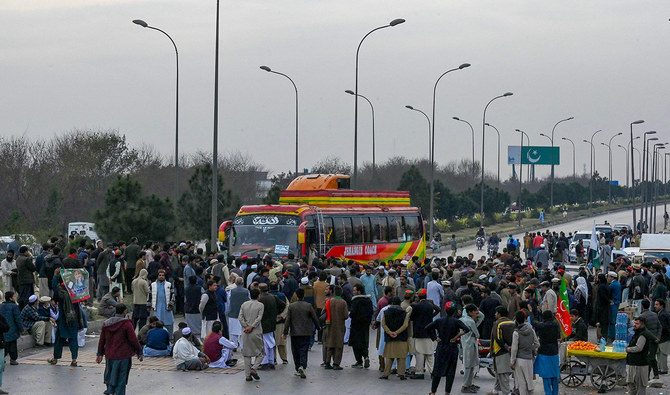
In the northwestern city of Peshawar, Khan supporters blocked the Peshawar-Islamabad motorway for more than two hours on Monday and demanded the Election Commission of Pakistan (ECP) issue “fair results.”
“The mandate given to Pakistan Tehreek-e-Insaf by the people has been robbed which should be returned,” Irfan Saleem, the PTI deputy information secretary in the Khyber Pakhtunkhwa (KP) province, told Arab News on Monday.
“We want the public’s right, who have given the vote to the Pakistan Tehreek-e-Insaf backed candidates. These votes should be counted as they were polled.”
Saleem alleged election officials issued fake Form 45 and Form 47 which were “not acceptable” to them. Form 47 is the official declaration of the results of a constituency released by a returning officer, while Form 45 contains details of the breakdown of votes received by each candidate at a polling station.
The PTI, which ruled KP for two consecutive tenures from 2013 till 2023, backed independent candidates in Thursday’s polls after it lost its election symbol. These independents swept polls in the province and won 38 out of 44 parliamentary seats and 90 out of 112 provincial seats.
However, the party said last week its victory was turned into defeat on nearly two dozen parliamentary seats, including three in Islamabad, four in Sindh and the rest in Punjab.
Ikram Khattana, a member of Khan’s party, said they wanted election results in accordance with Form 45 given to their candidates.
“We demand that the candidates who won according to the Form 45 shall be given their rights,” Shazia Aziz, a member of PTI women’s wing, told Arab News in Peshawar.
Reached for comment, Sohail Ahmad, a spokesperson for the ECP’s KP office, declined to comment on the protests, but said there was a legal way to be followed in case of queries about or objections over the tabulation of election results.
“The ECP was helping resolve issues at every level and some issues have already been resolved at the retuning officer-level and if they were not, they (protesters and candidates) may come to the ECP,” he said.
Separately on Monday, multiple nationalist and religious parties in the southwestern Balochistan province blocked two highways leading to Iranian and Afghan border crossings and disrupted trade and movement of people.
Jan Achakzai, a Balochistan government spokesman, urged protesters to “show grace” by accepting defeat and moving away from the highways.
In Thursday’s vote, the Pakistan Muslim League-Nawaz party of three-time premier Nawaz Sharif secured 75 seats, while the Bilawal Bhutto-Zardari-led Pakistan Peoples Party came in third with 54 seats.
The two parties were currently in talks to form a coalition government.