

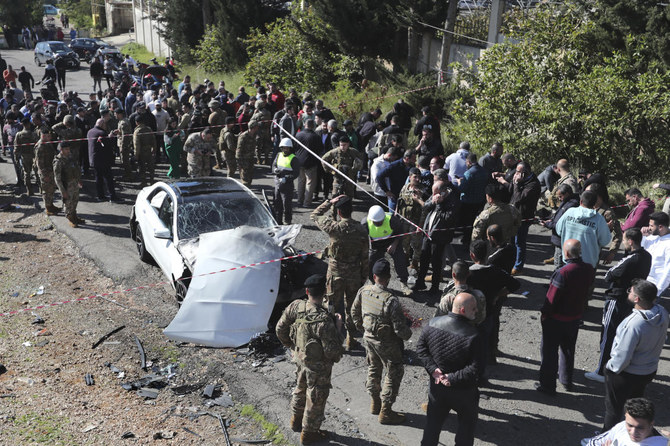

BEIRUT: The Israeli army expanded operations against Hezbollah and its allies deep into Lebanese territory on Saturday.
Israeli drone strikes hit a car and motorcycle south of Beirut, killing a Syrian and a Lebanese national, and wounding a Palestinian.
Wajih Khalil Fares, a vegetable vendor from the town of Aitaroun, was killed while attempting to rescue the victims of the car strike.
It is the first time that the coastal area of Jadra, hundreds of kilometers away from the Litani Line, has been targeted since hostilities broke out between Hezbollah and Israel last year.
Israel’s campaign reached the southern suburb of Beirut in early January when a drone hit a local Hamas headquarters, killing deputy leader Saleh Al-Arouri.
The Israeli campaign on the southern Lebanese border on day 126 also included an airstrike carried out by a drone near a house in the town of Khiam, injuring three Syrian workers.
The Israeli army intensified its air and artillery operations against homes in border towns, targeting Hanine and the outskirts of the predominantly Christian town of Rmeish, as well as Kounine in the Bint Jbeil district and Markaba.
Hezbollah targeted Israel’s Branit military barracks with missiles.
The Israeli escalation came amid a visit to Beirut by Iranian Foreign Minister Hossein Amir-Abdollahian, who met officials including Hezbollah chief Hassan Nasrallah, Palestinian faction representatives and Parliament Speaker Nabih Berri.
He said: “Developments in the Gaza Strip are heading toward a political solution, while Israeli Prime Minister Benjamin Netanyahu still sees the solution in war to save himself.”
After meeting caretaker Prime Minister Najib Mikati, Amir-Abdollahian reiterated “Iran’s firm backing for Lebanon’s stability and security.”
He said: “Certain groups attempted to cause a dispute between the government and the people of Lebanon and the resistance, but they failed.”
Amir-Abdollahian highlighted Iran’s support for “the resistance in Palestine, as it has done in the past. However, during the past four months, it has also tried to stop Israeli attacks on Gaza and prevent the expansion of the war in the region.”
He added: “The Palestinians are the true owners of Palestine and they must make decisions regarding Palestine and its future. We are aware that they have political plans and initiatives for the post-war period.”
He urged the need for “everyone to try to find a political solution to end Israeli attacks and war crimes against the Palestinians as soon as possible.”
Mikati described the situation in the region as “changing and complex,” highlighting the importance of continuing endeavors to achieve an urgent ceasefire in Gaza.
He added: “We look forward to peace and stability in the region, and efforts must be made to end the war on Gaza and prevent the war from spreading further in the region.”
During the meeting with Nasrallah, Amir-Abdollahian said: “The Palestinian resistance has acted wisely and strongly. In every political initiative, the role of the Palestinian people and the consensus of Palestinian leaders and groups must be considered as the fundamental pillar.”
Nasrallah said: “The Israeli army is facing a strategic crisis and has not achieved any of its objectives in the field. The resistance has become an important factor in regional equations, and the victory of the Palestinian people and the resistance is inevitable.”
The Iranian foreign minister met a Palestinian delegation that included the chief of the Islamic Jihad Movement, Ziad Nakhla; Hamas official Osama Hamdan; and the second in command of the Popular Front for the Liberation of Palestine, Jamil Mezher.


