

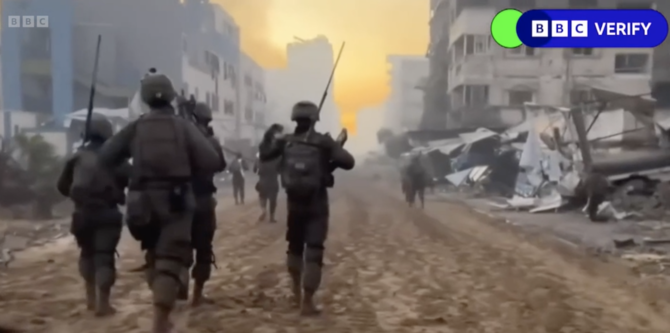

DUBAI: Humiliating videos of Gazan detainees filmed and shared online by Israeli soldiers could be a breach of international law, legal experts said.
BBC Verify said it analyzed hundreds of videos uploaded since November by Israeli troops deployed in Gaza. Most show scenes of fighting or soldiers inside homes abandoned by the residents. One shows soldiers dressed in dinosaur costumes while launching weapons. In another, troops are seen setting up a pizza restaurant inside an empty Palestinian home.
However, the BBC team said they found eight videos showing detainees stripped, bound and blindfolded. The rules of international law state that prisoners must not be exposed to unnecessary humiliation or public curiosity.
All the videos in question were posted by men who are or were serving soldiers and they did not attempt to conceal their identities.
Mark Ellis, a leading UN advisor to international criminal tribunals, said the footage might violate the recognized international rules governing the treatment of prisoners of war.
The Israeli army told the BBC it had terminated the service of one of the reservists identified by the broadcaster, and said the videos do not represent the military’s values.
The BBC team traced one image of a Palestinian detainee, which has been circulating on social media in the past week, to the YouTube channel of Israeli soldier Yossi Gamzoo Letova.
A video he posted on Dec. 24 shows the detainee seen in the image sitting on a chair, stripped and bleeding, with his hands bound while he is interrogated.
The Israel Defense Forces said that “the photo was taken during a field questioning” and “the suspect was not injured.”
It added: “A reservist photographed and published the picture, contrary to IDF orders and values. It was recently decided to terminate his reserve service.”
Letova uploaded another video to YouTube showing hundreds of Palestinian detainees assembled in a sports field. Most were stripped to their underwear. Some were blindfolded and kneeling on the ground. Both videos were removed from Letova’s YouTube page after the BBC contacted the Israeli army.
A YouTube spokesperson said the platform has removed tens of thousands of harmful videos and shut down thousands of channels during the conflict in Gaza, and teams are working around the clock to monitor the platform for inappropriate content related to the war.
Israeli soldiers have also been sharing videos on TikTok. Two videos posted on the platform by a soldier identified as Ilya Bank featured pictures of blindfolded detainees and images of soldiers posing with guns. Both were removed after the BBC contacted the Israeli army and TikTok.
The BBC reported six other videos to TikTok and the platform confirmed that all of them violated its community guidelines, which clearly state that content “that seeks to degrade victims of violent tragedies” would not be tolerated. The videos were taken down.
Ellis said it is important that prisoners of war are not subjected to degradation or humiliation.
“The idea of walking people through in their underwear and filming that and sending it out certainly would violate that,” he said.
Prof. Asa Kasher, the lead author of the Israeli army’s Code of Ethics, said taking and sharing pictures of half-naked prisoners violated that code.
While there might be military reasons to strip a detainee to check for weapons, he said he could see no reason for “taking such a picture and sharing it with the public” other than to humiliate prisoners.
Michael Mansfield, a human rights lawyer, said the footage should be investigated and assessed by a UN court.
“There is a very severe restriction on how you deal with people who are detained, who are prisoners of war, in a time of war or conflict, which this plainly is, and that provision is really one in which you are intended to treat prisoners with respect,” he told the BBC.


