


WASHINGTON: A special counsel report released Thursday found evidence that President Joe Biden willfully retained and shared highly classified information when he was a private citizen, including about military and foreign policy in Afghanistan, but concluded that criminal charges were not warranted.
The report from special counsel Robert Hur resolves a criminal investigation that had shadowed Biden’s presidency for the last year. But its bitingly critical assessment of his handling of sensitive government records and unflattering characterizations of his memory will spark fresh questions about his competency and age that cut at voters’ most deep-seated concerns about his candidacy for re-election.
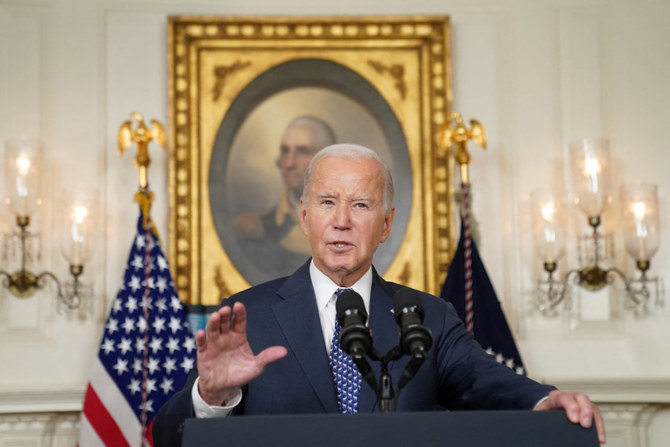
In remarks at the White House Thursday evening, Biden denied that he improperly shared classified information and angrily lashed out at Hur for questioning his mental acuity, particularly his recollection of the timing of his late son Beau’s death from cancer.
The searing findings will almost certainly blunt his efforts to draw contrast with Donald Trump, Biden’s likely opponent in November’s presidential election, over a criminal indictment charging the former president with illegally hoarding classified records at his Mar-a-Lago estate in Florida and refusing to return them to the government. Despite abundant differences between the cases, Trump immediately seized on the special counsel report to portray himself as a victim of a “two-tiered system of justice.”
Yet even as Hur found evidence that Biden willfully held onto and shared with a ghostwriter highly classified information, the special counsel devoted much of his report to explaining why he did not believe the evidence met the standard for criminal charges, including a high probability that the Justice Department would not be able to prove Biden’s intent beyond a reasonable doubt, citing among other things an advanced age that they said made him forgetful and the possibility of “innocent explanations” for the records that they could not refute.
“I did not share classified information,” Biden insisted. “I did not share it with my ghostwriter.” He added he wasn’t aware how the boxes containing classified documents ended up in his garage.
And in response to Hur’s portrayal of him, Biden insisted to reporters that “My memory is fine,” and said he believes he remains the most qualified person to serve as president.
“How in the hell dare he raise that?” Biden asked, about Hur’s comments regarding his son’s death, saying he didn’t believe it was any of Hur’s business.
Biden’s lawyers blasted the report for what they said were inaccuracies and gratuitous swipes at the president. In a statement, Biden said he was “pleased” Hur had “reached the conclusion I believed all along they would reach — that there would be no charges brought in this case and the matter is now closed.”
He pointedly noted that he had sat for five hours of in-person interviews in the immediate aftermath of Hamas’s October attack on Israel, when “I was in the middle of handling an international crisis.”
“I just believed that’s what I owed the American people so they could know no charges would be brought and the matter closed,” Biden said.
The investigation into Biden is separate from special counsel Jack Smith’s inquiry into the handling of classified documents by Trump after Trump left the White House. Smith’s team has charged Trump with illegally retaining top secret records at his Mar-a-Lago home and then obstructing government efforts to get them back. Trump has said he did nothing wrong.
Hur, in his report, said there were “several material distinctions” between the Trump and Biden cases, noting that Trump refused to return classified documents to the government and allegedly obstructed the investigation, while Biden willfully handed them over.
Hur, a former US Attorney in the Trump administration, was appointed by Attorney General Merrick Garland as special counsel in January 2023 following an initial discovery by Biden staff of classified records in Washington office space. Subsequent property searches by the FBI, all coordinated voluntarily by Biden staff, that turned up additional sensitive documents from his time as vice president and senator.
Hur’s report said many of the documents recovered at the Penn Biden Center in Washington, in parts of Biden’s Delaware home and in his Senate papers at the University of Delaware were retained by “mistake.”
Biden could not have been prosecuted as a sitting president, but Hur’s report states that he would not recommend charges against Biden regardless.
“We would reach the same conclusion even if Department of Justice policy did not foreclose criminal charges against a sitting president,” the report said.
But investigators did find evidence of willful retention and disclosure of a subset of records found in Biden’s Wilmington, Delaware house, including in a garage, office and basement den. The files pertain to a troop surge in Afghanistan during the Obama administration that Biden had vigorously opposed. He kept records that documented his position, including a classified letter to Obama during the 2009 Thanksgiving holiday.
Documents found in a box in Biden’s Delaware garage have classification markings up to the Top Secret/Sensitive Compartmented Information Level and “other materials of great significance to him and that he appears to have personally used and accessed.” Hur, though, wrote that there was a ”shortage of evidence” to prove that Biden placed the documents in the box and knew they were there.
Some of the classified information related to Afghanistan was shared with a ghostwriter with whom he published memoirs in 2007 and 2017. As part of the probe, investigators reviewed a recording of a February 2017 conversation between Biden and his ghostwriter in which Biden can be heard saying that he had “just found all the classified stuff downstairs.”
Prosecutors believe Biden’s comment, made at a time he was renting a home in Virginia, referred to the same documents FBI agents later found in his Delaware house. Though Biden sometimes skipped over presumptively classified material while reading notebook entries to his ghostwriter, the report says, at other times he read aloud classified entries “verbatim.”
The report said there was some evidence to suggest that Biden knew he could not keep classified handwritten notes at home after leaving office, citing his deep familiarity “with the measures taken to safeguard classified information and the need for those measures to prevent harm to national security.” Yet, prosecutors say, he kept notebooks containing classified information in unlocked drawers at home.
“He had strong motivations to do so and to ignore the rules for properly handing the classified information in his notebooks,” the report said. “He consulted the notebooks liberally during hours of discussions with his ghostwriter and viewed them as highly private and valued possessions with which he was unwilling to part.”
While the report removes legal jeopardy for the president, it is nonetheless an embarrassment for Biden, who placed competency and experience at the core of his rationale to voters to send him to the Oval Office. It says that Biden was known to remove and keep classified material from his briefing books for future use and that his staff struggled and sometimes failed to get those records back.
Even so, Hur took pains to note the multiple reasons why prosecutors did not believe they could prove a criminal case beyond a reasonable doubt.
Those include Biden’s “limited memory” both during his 2017 recorded conversations with the ghostwriter and in an interview with investigators last year in which, prosecutors say, he could not immediately remember the years in which he served as vice president. Hur said it was possible Biden could have found those records at his Virginia home in 2017 and then forgotten about them soon after.
“Given Mr. Biden’s limited precision and recall during his interviews with his ghostwriter and with our office, jurors may hesitate to place too much evidentiary weight on a single eight-word utterance to his ghostwriter about finding classified documents in Virginia, in the absence of other, more direct evidence,” the report says
“We have also considered that, at trial, Mr. Biden would likely present himself to a jury, as he did during our interview of him, as a sympathetic, well-meaning, elderly man with a poor memory,” investigators wrote.
In addition, prosecutors say, Biden could have plausibly believed that the notebooks were his personal property and belonged to him, even if they contained classified information.
In an interview with prosecutors, the report said, Biden was emphatic with investigators that the notebooks were “my property” and that “every president before me has done the exact same thing.”
Special counsels are required under Justice Department regulations to submit confidential reports to the attorney general at the conclusion of their work. Such reports are then typically made public. The dual appointments in the Biden and Trump cases were seen as a way to insulate the Justice Department from claims of bias and conflict by placing the probes in the hands of specially named prosecutors.
Garland has worked assiduously to challenge Republican claims of a politicized Justice Department. He has named special counsels to investigate not only the president but also his son, Hunter, in a separate tax-and-gun prosecution that has resulted in criminal charges.
But in this case, Biden’s personal and White House lawyers strongly objected to the characterizations of Biden in the report and to the fact that so much derogatory information was released about an uncharged subject like the president.
Biden’s personal attorney Bob Bauer accused the special counsel of violating “well-established’ norms and “trashing” the president.
“The special counsel could not refrain from investigative excess, perhaps unsurprising given the intense pressures of the current political environment. Whatever the impact of those pressures on the final report, it flouts department regulations and norms,” he said in a statement.
But a public outcome was basically sealed once Garland appointed a special counsel.
Regulations require special counsels to produce confidential reports to the attorney general at the conclusion of their work. Those documents are then generally made public, even if they contain unflattering assessments of people not criminally charged.


