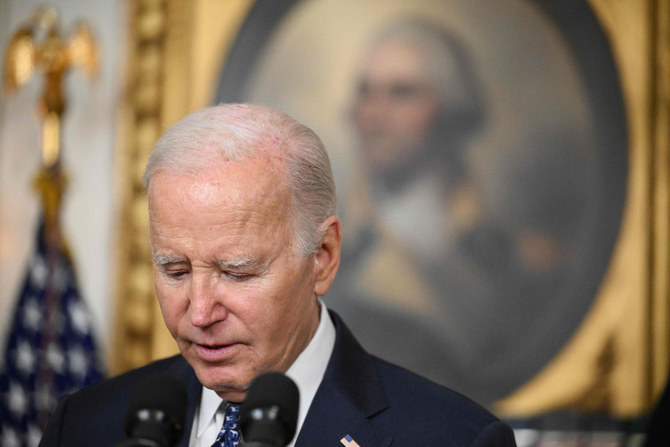

WASHINGTON: A long-awaited report cleared President Joe Biden of any wrongdoing in his mishandling of classified documents Thursday but dropped a political bombshell by painting the Democrat as a “well-meaning, elderly man with a poor memory.”
The report removed a legal cloud hanging over Biden as he seeks re-election in a contest expected to be against Donald Trump — who is facing a criminal trial for removing large amounts of secret documents after he lost the White House, then refusing to cooperate with investigators.
However, in a shock for the Biden campaign, special counsel Robert Hur said his probe had found a president with such reduced mental capacities that he could not remember the dates of his vice presidency under Barack Obama and the death of his son Beau to cancer in 2015.
Speaker Mike Johnson and other top Republican leaders of the House of Representatives called the report “deeply disturbing” and showed Biden was “unfit” for the presidency.
“A man too incapable of being held accountable for mishandling classified information is certainly unfit for the Oval Office,” they said in a statement.
The 81-year-old Biden, speaking at a Democratic Party meeting, said he was “pleased to see they reached the conclusion... that no charges should be brought.”
He said the “exhaustive” investigation found he had cooperated “completely,” in contrast with Trump who refused to return top secret documents and “obstructed justice.”
The president noted that he had granted five hours of interviews to the special counsel on October 8th and 9th, right as he was handling the start of the Israel-Hamas crisis.
He did not address the remarks about his memory that were included in the report.
Hur was appointed by Biden’s attorney general, Merrick Garland, last year after classified material was found at Biden’s home in Wilmington, Delaware, and in a former office.
The 388-page report said Biden had “willfully retained and disclosed classified materials” in the period after he left the vice presidency — well before he defeated Trump in 2020 to become president.
Hur — previously nominated by Trump to be the lead prosecutor for the state of Maryland — said documents about military and foreign policy in Afghanistan and other matters were recovered by FBI agents.
However, “We conclude the evidence is not sufficient to convict, and we decline to recommend prosecution of Mr.Biden for his retention of the classified Afghanistan documents,” Hur said.
Hur added, however, unusually pointed remarks about Biden’s mental capacities.
He wrote that a jury would not want to convict Biden, who came across to investigators as a “sympathetic, well-meaning elderly man with a poor memory.”
“It would be difficult to convince a jury that they should convict him — by then a former president well into his eighties — of a serious felony that requires a mental state of willfulness,” the special counsel said.
White House special counsel Richard Sauber and Biden’s personal lawyer Bob Bauer attacked the comments as neither “accurate or appropriate.”
“The report uses highly prejudicial language to describe a commonplace occurrence among witnesses: a lack of recall of years-old events,” they said in a letter to Hur. “Such comments have no place in a Department of Justice report.”
Hur did note clear differences in the Biden and Trump classified documents scandals — in particular that “after being given multiple chances to return classified documents and avoid prosecution, Mr.Trump allegedly did the opposite.
“In contrast, Mr.Biden turned in classified documents to the National Archives and the Department of Justice, consented to the search of multiple locations including his homes, sat for a voluntary interview. and in other ways cooperated with the investigation.”
Trump, 77, pleaded not guilty in June to charges of unlawfully retaining national defense information, conspiracy to obstruct justice and making false statements.
In a statement Friday, Trump said he was the victim of a “TWO-TIERED SYSTEM OF JUSTICE AND UNCONSTITUTIONAL SELECTIVE PROSECUTION!“
Trump was indicted by another special counsel, Jack Smith, and accused of endangering national security by holding on to top secret nuclear and defense information after leaving the White House.
Trump allegedly kept the files — which included records from the Pentagon, CIA and National Security Agency — unsecured at his Mar-a-Lago home in Florida and thwarted official efforts to retrieve them.
He is scheduled to go on trial in Florida in May.