BARCELONA, Spain: The EU on Thursday announced $225.9 million (210 million euros) to help Mauritania crack down on people smugglers and deter migrant boats from taking off, as the number of people attempting the dangerous Atlantic crossing from West Africa to Europe rises sharply.
Mauritania, during a meeting with European officials in its coastal capital of Nouakchott, also noted that it was itself increasingly struggling to cope with the growing number of migrants and refugees entering its borders as security in the Sahel region declines.
European Union Commission President Ursula von der Leyen announced the extra funding for migration, but also for humanitarian aid and job creation, as she met with Mauritanian President Mohamed Ould Ghazouani and Spanish Prime Minister Pedro Sánchez.
“Insecurity and the lack of economic opportunity in the region are pushing many people to migrate,” Von der Leyen told journalists as she stood next to Ghazouani and Sánchez in a live-streamed statement. “This causes many to fall into the traps of cynical smugglers and puts their lives in danger.”
While Mauritania’s leader renewed his commitment to working with Spain and the EU to stop migrant departures he also highlighted the cost his country bore.
“Mauritania is paying a heavy price in the management of migratory flows,” Ghazouani said, adding that his nation already hosts 150,000 refugees from neighboring Mali and increasingly is not just a transit country but a destination for migrants.
One of the most stable countries in the Sahel, Mauritania has been hailed as a key partner in the fight against terrorism, and Von der Leyen announced an additional 22 million euros for a new anti-terrorism battalion in Mauritania that will patrol the border with restive Mali.
“We are witnessing the fall of democratic governments, rise of terrorist attacks, a spike in refugees and internally displaced people, and the worsening of an already acute food security crisis,” Sánchez said. “I am well aware that Mauritania is at the front line of all the consequences.”
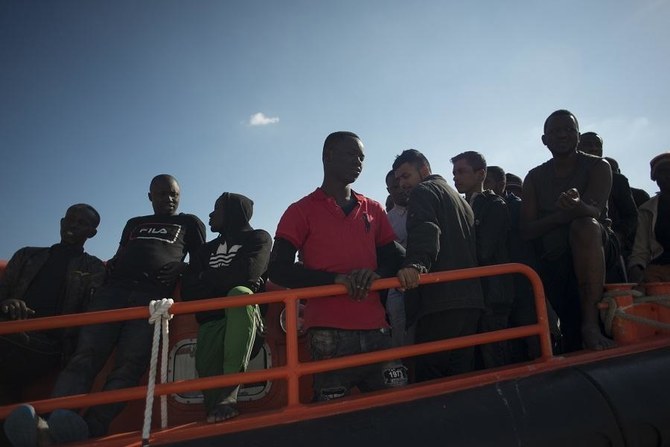
Spain’s Canary Islands have increasingly become a stepping stone for migrants and refugees trying to reach continental Europe from West Africa. In January alone, some 7,270 migrants landed on the archipelago, about as many as in the first six months of 2023.
The Atlantic route to Europe is one of the deadliest in the world, Von der Leyen said. Indeed, it is not uncommon for entire boats to vanish in the Atlantic with a few sometimes reappearing months later on the other side of the ocean with no survivors.
The Canary Islands had already been struggling with a record number of arrivals last year with nearly 40,000 people arriving on its shores on boats mainly from Senegal. This year, departures from Mauritania, which had appeared to be under control for most of last year, have surged again.
Despite the presence of both Spanish and Mauritanian patrols of the coast, the majority of this year’s migrant arrivals to the Canaries have departed from the impoverished nation. While many of those arriving are citizens from Mali and Senegal, a growing number of young Mauritanians are also boarding boats.
Besides announcing more funds for migration and security, the two European leaders announced a series of financing and development projects for green hydrogen production in Mauritania as part of an EU energy transition initiative.


![]()

EU announces $225.9 million in aid to help Mauritania curb migration
Short Url
https://arab.news/5qt2u
EU announces $225.9 million in aid to help Mauritania curb migration
- European Union Commission President Ursula von der Leyen announced the extra funding for migration, but also for humanitarian aid and job creation
- “Insecurity and the lack of economic opportunity in the region are pushing many people to migrate,” Von der Leyen told journalists


Latest updates


Recommended


© 2026 SAUDI RESEARCH & PUBLISHING COMPANY, All Rights Reserved And subject to Terms of Use Agreement.