NIR’OZ, Israel: Argentina’s President Javier Milei on Thursday likened Hamas’s attacks on southern Israel to the Holocaust, after touring a kibbutz targeted in the October 7 raids.
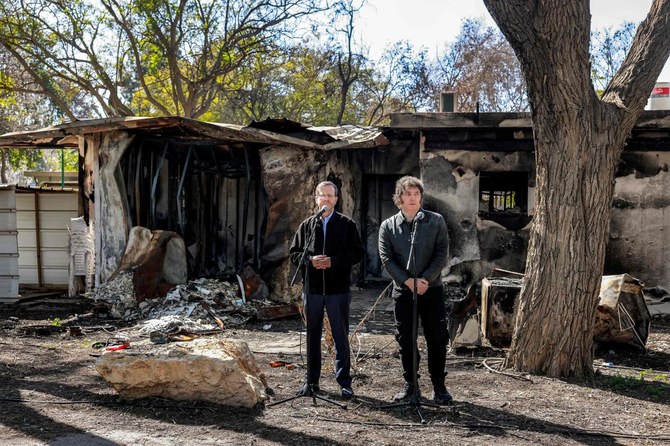
Milei joined Israel’s President Isaac Herzog on a visit to Nir Oz near the border with Gaza, where residents were killed or taken hostage by the Palestinian militant group.
They were accompanied by former hostage Ofelia Roitman, an elderly Argentinian national who moved to Israel in 1985, making her first visit back to the farming community since she was released.
Milei, who was elected in November and is on his first official state visit as president, has appeared visibly emotional during his time in Israel, and said Thursday’s tour was “very moving.”
He again gave his backing to Israel’s fight-back against Hamas, calling the Palestinian Islamists a “terrorist group” who had committed “a crime against humanity.”
“The free world can’t remain indifferent in this case, as we see clear examples of terrorism and anti-Semitism and what I would describe as 21st century Nazism,” he said.
“When we hear about the methods that were used this time, it reminds us of the atrocities of the Holocaust,” he added, according to remarks translated from Spanish by Herzog’s office.
Many traumatized Israelis have likened the attacks, which left 1,160 dead according to an AFP tally based on official Israeli statistics, to the horrors of the Holocaust.
A total of 132 of the 250 hostages taken are still in Gaza, but 29 are presumed dead, Israel has said.
But the head of Jerusalem’s Yad Vashem memorial center, has described comparisons as “simplistic... even if there are similarities in the genocidal intentions, sadism and barbarism of Hamas.”
“The crimes that took place on October 7 are on the same level as Nazi crimes, but they are not the Shoah,” Dani Dayan told AFP last year, using another term for the Holocaust.
Milei, who was raised in a Catholic family but has studied Jewish scripture, placed a wreath near the eternal flame at the Hall of Remembrance at Yad Vashem on Wednesday.
He arrived in Israel on Tuesday on a four-day visit and immediately announced plans to move the Argentinian embassy to Jerusalem.
Only a handful of countries have their embassy to Israel in Jerusalem, rather than Tel Aviv, and any international recognition of the city’s status as a capital is deeply controversial.
Hamas, which runs Gaza, said in response that Jerusalem remains “occupied Palestinian land.”


![]()

Argentina’s Milei likens Hamas attack on Israel to the Holocaust
Short Url
https://arab.news/msxcm
Argentina’s Milei likens Hamas attack on Israel to the Holocaust
- Milei joined Israel’s President Isaac Herzog on a visit to Nir Oz near the border with Gaza
- Milei has appeared visibly emotional during his time in Israel and said Thursday’s tour was “very moving”


Latest updates




© 2026 SAUDI RESEARCH & PUBLISHING COMPANY, All Rights Reserved And subject to Terms of Use Agreement.