

Argentina’s Milei to visit Israel, denounces Hamas

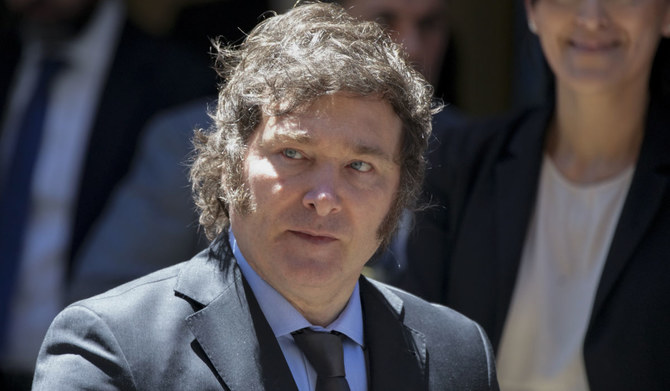
Argentine President Javier Milei leaves the Holocaust museum after attending and event marking the International Day in Memory of the Victims of the Holocaust in Buenos Aires, Argentina, Friday, Jan. 26, 2024. (AP)
Short Url
Updated 27 January 2024
Follow

Argentina’s Milei to visit Israel, denounces Hamas

  • Milei has presented himself politically as an ally to Israel, open to moving Argentina’s embassy from Tel Aviv to Jerusalem

BUENOS AIRES: Argentina’s new President Javier Milei, who has recently embraced Orthodox Judaism, said Friday he would visit Israel as he condemned Hamas’ actions in an address to the Jewish community in Buenos Aires.
“In the coming weeks, I will be traveling to the Holy Land,” Milei said in a speech at the Holocaust Museum in Argentina’s capital, evoking a “new chapter in the brotherhood of our two nations.”
He condemned as “atrocious and unforgivable,” the October 7 attack by Islamist group Hamas on Israel which resulted in the deaths of some 1,140 people, most of them civilians according to an AFP tally based on official figures.
Israel has vowed to crush the militant group and launched a military offensive that the health ministry in Hamas-run Gaza says has killed at least 26,083 people, about 70 percent of them women and children.
Milei was speaking on the eve of International Holocaust Memorial Day, and on the same day the International Court of Justice in The Hague ruled that Israel must prevent genocide in its retaliatory war with Hamas and allow aid into Gaza.
He urged the liberation of 11 Argentines among the more than 100 hostages still held in Gaza after being captured during the Hamas attack.
Self-described anarcho-capitalist Milei was raised in a Catholic family but has spoken of his more recent study of the Torah, the book of Jewish scripture.
Right after his November election, he visited the tomb of a revered rabbi in New York, a popular spiritual pilgrimage destination for some Jews.
Argentina’s Jewish community, at 250,000, is one of the largest in Latin America.
Milei has presented himself politically as an ally to Israel, open to moving Argentina’s embassy from Tel Aviv to Jerusalem.
Prior to his election, Milei had referred to Argentine-born Pope Francis as “the evil one,” “nefarious,” and an “imbecile” who “promotes communism.”
The two seemed to reconcile when Francis called to congratulate Milei on his win and the new president invited the pope on a visit.
His Israel visit could coincide with a trip to Rome, where he is to attend a ceremony to canonize an Argentine nun. The Clarin newspaper has said the pope would receive Milei on February 12.


Ethiopia accuses Eritrea of arming rebels in escalating war of words

Updated 5 sec ago
Follow

Ethiopia accuses Eritrea of arming rebels in escalating war of words

  • The charge by Ethiopia’s federal police escalates a feud between Ethiopia and Eritrea
  • The two countries fought a three-year border war that broke out in 1998

ADDIS ABABA: Ethiopian police said they had seized thousands of rounds of ammunition sent by Eritrea to rebels in Ethiopia’s Amhara region, an allegation Eritrea dismissed as a falsehood intended to justify starting a war.
The charge by Ethiopia’s federal police escalates a feud between Ethiopia and Eritrea, longstanding foes who reached a peace deal in 2018 that has since given way to renewed threats and acrimony.
The police said in a statement late on Wednesday they had seized 56,000 rounds of ⁠ammunition and arrested two suspects this week in the Amhara region, where Fano rebels have waged an insurgency since 2023.
“The preliminary investigation conducted on the two suspects who were caught red-handed has confirmed that the ammunition was sent by the Shabiya government,” the statement said, using a term for Eritrea’s ruling party.
Eritrea’s Information Minister Yemane Gebremeskel told Reuters that Ethiopian Prime ⁠Minister Abiy Ahmed’s Prosperity Party (PP) was looking for a pretext to attack.
“The PP regime is floating false flags to justify the war that it has been itching to unleash for two long years,” he said.
In an interview earlier this week with state-run media, Eritrean President Isaias Afwerki said the Prosperity Party had declared war on his country. He said Eritrea did not want war, but added: “We know how to defend our nation.”
The two countries fought a three-year border war that broke out in 1998, five years after Eritrea won its independence from Ethiopia. They ⁠signed a historic agreement to normalize relations in 2018 that won Ethiopia’s Abiy the Nobel Peace Prize the following year. Eritrean troops then fought in support of Ethiopia’s army during a 2020-22 civil war in Ethiopia’s northern Tigray region.
But relations soured after Asmara was frozen out of the peace deal that ended that conflict. Since then, Eritrea has bristled at repeated public declarations by Abiy that landlocked Ethiopia has a right to sea access — comments many in Eritrea, which lies on the Red Sea, view as an implicit threat of military action.
Abiy has said Ethiopia does not seek conflict with Eritrea and wants to address the issue of sea access through dialogue.