Diriyah signs agreements worth over $700m at PIF forum

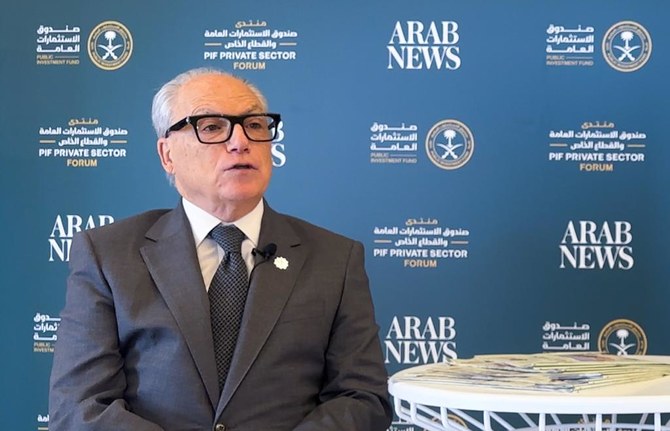
Jerry Inzerillo, Group CEO of the Diriyah Gate Development Authority, during an interview with Arab News. Photo by Huda Bashatah
Short Url
Updated 08 February 2024
Follow

Diriyah signs agreements worth over $700m at PIF forum

RIYADH: Riyadh will witness a surge in the entertainment, leisure and tourism sectors, with Diriyah Co. aiming to break ground on 11 new assets by the end of 2024.

In the first step toward this endeavor, the company signed two agreements on the sidelines of the Public Investment Fund’s Private Sector Forum. 

Speaking to Arab News, Jerry Inzerillo, Group CEO of the Diriyah Gate Development Authority, outlined that the firm’s agreement worth SR700 million ($186 million) with Saudi Constructioneers Ltd., known as Saudi Co., entails the development of the Ritz-Carlton residences.

The second deal, worth SR2 billion, was inked with Al-Ayuni Investment and Contracting Co. for infrastructure development. 

Inzerillo affirmed that this is a testament to the fact that the company is “moving very, very fast along” and will open assets, announce and break ground every year “until we pull off the most spectacular EXPO the world has seen in 2030.”

The executive said that among the 11 upcoming initiatives in 2024 is the King Salman Boulevard, which he deemed Saudi Arabia’s version of Paris’ Champs-Elysees. It will be revealed this December.

“This will have a new contemporary art museum, one of the most beautiful museums in the world. Our version of the Sydney Opera House, the new King Salman Mosque. It will take a while to build it but we will show that blueprint in December of this year,” he said. 

In December of each year, the company holds its “Bashayer” event to announce its upcoming initiatives. The last meeting saw the unveiling of the Diriyah Art Futures museum, which the executive noted will “have its first exhibit shortly.”

Since then, the company has opened 9 km of parks in order to “fulfill His Royal Highness (the crown prince’s) vision of having all Saudis outside enjoying the weather, bicycling, horseback riding, skateboarding, walking, jogging, even picnicking with families. So we did nine km of parks. We’ve planted 6 million trees and bushes and shrubs in the wadi, all with smart city technology and we opened up our community center,” said Inzerillo. 

He added: “We opened up our sales center for the residences, and we already put 106 of our new Ritz-Carlton villas on sale, which sold very well. We introduced our new Wadi Spa residential community in what is for our district. We finished nine of the 27-hole golf course, the Greg Norman Golf Course, so we did a lot in one year. Wait to see what we do by this December.”

Outlining the importance of the private sector in bringing giga-projects like Diriyah to fruition, Inzerillo recapped that while the government will fund these projects “to get them going,” the commercial opportunities available through these projects around the Kingdom are “quite substantial.”

Thus, this year, the company intends to allocate more than $3 billion in contracts, predominantly focusing on the infrastructure and design engineering fields, as mentioned during his participation in a panel discussion at the forum.

Furthermore, he noted that several significant projects would be listed on the Saudi Stock Exchange, Tadawul, “at some particular point,” adding that Diriyah has mainly garnered “very good private sector support” from Saudi and Gulf countries. 

“Assets that have high commercial returns, hotels, restaurants, retail, residential, we’re seeing great interest from the private sector,” he said. 


Gulf-EU value chain integration signals shift toward long-term economic partnership: GCC secretary general

Updated 03 February 2026
Follow

Gulf-EU value chain integration signals shift toward long-term economic partnership: GCC secretary general

RIYADH: Value chains between the Gulf and Europe are poised to become deeper and more resilient as economic ties shift beyond traditional trade toward long-term industrial and investment integration, according to the secretary general of the Gulf Cooperation Council.

Speaking on the sidelines of the World Governments Summit 2026 in Dubai, Jasem Al-Budaiwi said Gulf-European economic relations are shifting from simple commodity trade toward the joint development of sustainable value chains, reflecting a more strategic and lasting partnership.

His remarks were made during a dialogue session titled “The next investment and trade race,” held with Luigi Di Maio, the EU’s special representative for external affairs.

Al-Budaiwi said relations between the GCC and the EU are among the bloc’s most established partnerships, built on decades of institutional collaboration that began with the signing of the 1988 cooperation agreement.

He noted that the deal laid a solid foundation for political and economic dialogue and opened broad avenues for collaboration in trade, investment, and energy, as well as development and education.

The secretary general added that the partnership has undergone a qualitative shift in recent years, particularly following the adoption of the joint action program for the 2022–2027 period and the convening of the Gulf–European summit in Brussels.

Subsequent ministerial meetings, he said, have focused on implementing agreed outcomes, enhancing trade and investment cooperation, improving market access, and supporting supply chains and sustainable development.

According to Al-Budaiwi, merchandise trade between the two sides has reached around $197 billion, positioning the EU as one of the GCC’s most important trading partners.

He also pointed to the continued growth of European foreign direct investment into Gulf countries, which he said reflects the depth of economic interdependence and rising confidence in the Gulf business environment.

Looking ahead, Al-Budaiwi emphasized that the economic transformation across GCC states, driven by ambitious national visions, is creating broad opportunities for expanded cooperation with Europe. 

He highlighted clean energy, green hydrogen, and digital transformation, as well as artificial intelligence, smart infrastructure, and cybersecurity, as priority areas for future partnership.

He added that the success of Gulf-European cooperation should not be measured solely by trade volumes or investment flows, but by its ability to evolve into an integrated model based on trust, risk-sharing, and the joint creation of economic value, contributing to stability and growth in the global economy.

GCC–EU plans to build shared value chains look well-timed as trade policy volatility rises.

In recent weeks, Washington’s renewed push over Greenland has been tied to tariff threats against European countries, prompting the EU to keep a €93 billion ($109.7 billion) retaliation package on standby. 

At the same time, tighter US sanctions on Iran are increasing compliance risks for energy and shipping-related finance. Meanwhile, the World Trade Organization and UNCTAD warn that higher tariffs and ongoing uncertainty could weaken trade and investment across both regions in 2026.