
RIYADH: Self-driving taxis may soon be a reality in Saudi Arabia as TASARU Mobility has secured deals to introduce automated vehicles to the Kingdom.
In its significant agreement since launching in October, the Public Investment Fund subsidiary has signed three strategic deals to introduce “the technology of the future” into the Kingdom, aiming to enhance the efficiency of the mobility sector, according to its CEO.
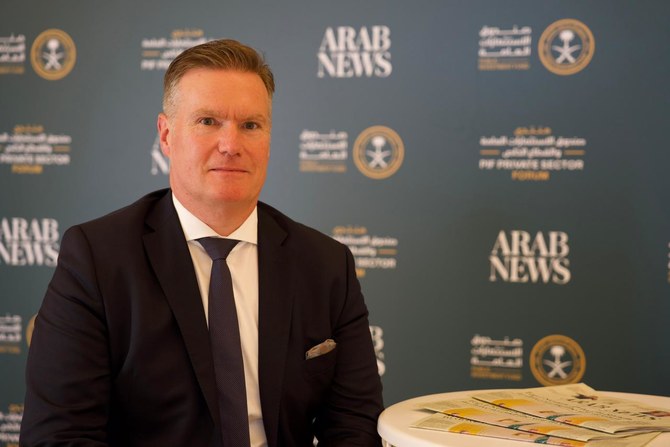
TASARU also signed a binding agreement to invest in the Croatian mobility solutions company P3, intending to introduce its robo-taxi technology to Saudi Arabia, Michael Mueller told Arab News on the sidelines of the PIF Private Sector Forum in Riyadh.
“TASARU is planning to invest in three main pillars. Pillar number one is the automotive and supplier business. So, we try to localize essential suppliers necessary to build up the OEMs (original equipment manufacturer) and also the ecosystem to have strong partners on our side. This is very essential for the automotive arm. The second pillar is everything around mobility, and the third pillar is next-generation technology,” the CEO added.
Mueller said: “We are very proud to partner with P3, a Croatian company and a remote holding that develops robo-taxis for the future. Here, we aim to bring this technology to Saudi Arabia, as it is already embedded in the Vision 2030 to have a say in this industry and this technology.”
Through this agreement, the company aims to introduce a fully integrated autonomous vehicle system to giga and mega cities aspiring to implement self-driving taxis, with the CEO emphasizing the country’s ambition to be a “frontrunner” in this field.
The development of a robust automotive and mobility sector in the Kingdom brings various benefits, including economic diversification, high-value job creation, and broader societal advantages such as reduced carbon emissions and less congested cities, he noted.
Marko Pejkovic, CEO of P3, said in a statement: “We are very happy to bring on board such a strong investor, which is backed by one of the world’s largest sovereign wealth funds — Saudi Arabia’s Public Investment Fund.
“Through intense discussions and meetings, we understood that the two teams share the same ambition: to create radically better mobility in our cities. The team from TASARU is the perfect long-term partner to support achieving this bold vision.”
Furthermore, TASARU has finalized the signing of a binding agreement for the acquisition of a strategic stake in the Benteler Group subsidiary, Holon, said Mueller, adding that this agreement is “very much connected to the first.”
The company acquired a stake in Holon to support the development and industrialization of the company's autonomous, fully electrified shuttle.
TASARU’s acquisition is planned in several tranches, starting in the first quarter of 2024, subject to the necessary regulatory approvals.
The prototype of the autonomous shuttle, addressing “last mile transportation” issues, was available for visitors at the PIF forum to experience firsthand during the event.
Looking at the transportation challenges faced by the Kingdom’s capital, Mueller told Arab News: “I think together this will solve a lot of those that we see. And the autonomous mover might be at least more or less a piece of the puzzle to solve it.”
The company aims for a localized production facility to produce this technology in the Kingdom through this investment.
“So that’s the starting point. And of course, the sky’s the limit. So then that might be interesting also for the private sector, for bigger companies that have big campuses; they have a lot of interest from universities,” said the executive.
“It’s not just public transportation in individual cities. Companies are also interested because those are interested. So everybody is finally focused on integrating such movers into the ecosystem. That also might be a solution to have these kinds of transportation systems up and running to bring people from A to B and B to C,” he added.
Moving to the company’s third investment pillar, which encompasses the technology of the future, TASARU signed another binding agreement to invest in the American tech company Recogni Inc.
The automotive and mobility sector over the last years has witnessed a shortage of rare earths and semiconductors, Mueller said. Therefore, the company’s investment serves to aid in “developing the next generation of chips that might solve a lot of problems and reduce the energy that is finally necessary to run these chips.”
This agreement also interconnects with the company’s first two, as “it’s investing in the future that might be needed in autonomous vehicles because you need a lot of AI and intelligence to run these cars. And so for that, we did a strategic investment into the further development of this company.”
Recogni introduced its first low-power AI computing product, Recogni Scorpio, in December 2022. Scorpio is the world’s first 1000 TFLOPS, Peta-Op, class inference solution for autonomous mobility.
According to a release, Scorpio’s performance validates Recogni’s vision and ability to break barriers in AI computing with “scalable performance generation over generation.”
When asked about localization, TASARU CEO told Arab News said: “Something we always have in mind is to have at a later stage a production facility here with this investment. We just want to get more or less our first foot into the door to develop something like this together and to bring also this technology to Saudi Arabia.”