Former Malaysian leader Najib Razak seeks full royal pardon, disappointed at commutation of sentence

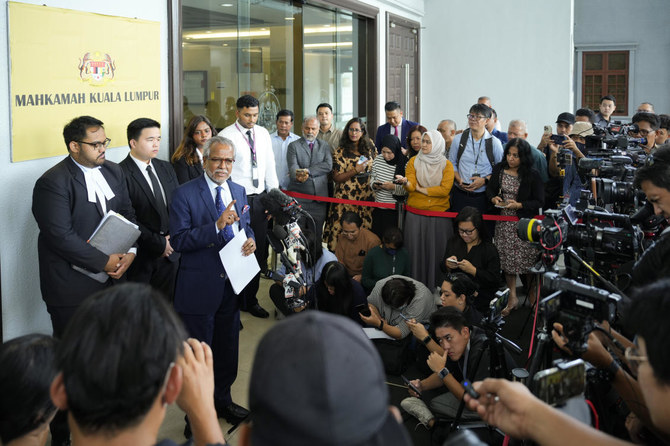
Shafee Abdullah, lawyer for former Prime Minister Najib Razak, speaks on the Pardons Board’s decision last week to commute Najib’s 12-year jail sentence in Kuala Lumpur on Feb. 7, 2024. (AP)
Short Url
Updated 07 February 2024
Follow

Former Malaysian leader Najib Razak seeks full royal pardon, disappointed at commutation of sentence

  • Decision last week by the Pardons Board to cut in half Najib Razak’s jail term sparked outrage among many Malaysians

KUALA LUMPUR: Malaysia’s ex-Prime Minister Najib Razak is disappointed he wasn’t given a full royal pardon of his 12-year prison sentence for graft, and may file a new appeal to the new monarch, his lawyer said Wednesday.
The decision last week by the Pardons Board to cut in half Najib’s jail term sparked outrage among many Malaysians, who slammed it as a mockery of the justice system and a blow to Prime Minister Anwar Ibrahim’s anti-corruption campaign. While the board isn’t required to explain its decision, it triggered calls for transparency in such high-profile cases.
Najib, 70, has been serving less than two years of his sentence linked to the theft of billions of dollars from the 1MDB state fund that has sparked investigations in the US and other countries. He is Malaysia’s first leader to be imprisoned after leaving office and still faces a major trial linked to 1MDB.
1MDB was a development fund that Najib set up shortly after taking power in 2009. Investigators allege at least $4.5 billion was stolen from the fund and laundered by Najib’s associates through layers of bank accounts in the US and other countries and financed Hollywood films and extravagant purchases that included hotels, a luxury yacht, art and jewelry. More than $700 million landed in Najib’s bank accounts.
His lawyer, Shafee Abdullah, said Najib was disappointed because he felt he wasn’t given a fair trial. He also questioned if there was interference in the Pardons’ Board process, chaired by the former king, Sultan Abdullah Sultan Ahmad Shah.
Shafee alleged that Sultan Abdullah was initially looking at granting Najib a full pardon during the board’s meeting on Jan. 29. But the king asked members of the board to vote and the result was a commutation of the sentence and fine, he said.
“We are seriously thinking about another petition for pardon, a full pardon,” Shafee told a news conference. “The reason we want to put in another request is that we don’t think the Pardons Board operated the way the constitution expected them to operate. The king merely hears advice but he must then decide on his own.”
Anwar has said the pardon was the prerogative of Sultan Abdullah, who ended his five-year reign under Malaysia’s unique rotating monarch system just a day after the board’s meeting. Abdullah is from Najib’s home state of Pahang. Sultan Ibrahim Iskandar, the powerful ruler of southern Johor state, took the throne on Jan. 31 for a five-year term.
Najib was found guilty in 2020 on seven charges of corruption for illegally receiving $9.4 million from SRC International, a former unit of 1MDB. His wife, Rosmah Mansor, was also sentenced in 2022 to 10 years in prison and a record fine of 970 million ringgit for corruption involving a solar energy project and is out on bail pending an appeal.


Winter storm packing snow and strong winds to descend on Great Lakes, Northeast

Updated 5 sec ago
Follow

Winter storm packing snow and strong winds to descend on Great Lakes, Northeast

  • The fierce winds on Lake Erie sent water surging toward the basin’s eastern end near Buffalo, New York, while lowering water on the western side in Michigan to expose normally submerged lakebed — even the wreck of a car and a snowmobile

NEW YORK: A wild winter storm was expected to bring strong winds, heavy snow and frigid temperatures to the Great Lakes and Northeast on Tuesday, a day after a bomb cyclone barreled across the northern US and left tens of thousands of customers without power.
The storm that hit parts of the Plains and Great Lakes on Monday brought sharply colder air, strong winds and a mix of snow, ice and rain, leading to treacherous travel. Forecasters said it intensified quickly enough to meet the criteria of a bomb cyclone, a system that strengthens rapidly as pressure drops.
Nationwide, more than 127,000 customers were without power Tuesday morning, more than a third of them in Michigan, according to Poweroutage.us.

BACKGROUND

The storm that hit parts of the Plains and Great Lakes on Monday brought sharply colder air, strong winds and a mix of snow, ice and rain, leading to treacherous travel.

As the storm moved into Canada, the National Weather Service predicted more inclement weather conditions for the Eastern US, including quick bursts of heavy snow and gusty winds known as snow squalls. Blustery winds were expected to add to the arctic chill, with low temperatures dipping below freezing as far south as the Florida panhandle, the agency said.
New York Gov. Kathy Hochul warned that whiteout conditions were expected Tuesday in parts of the state, including the Syracuse metro area.
“If you’re in an impacted area, please avoid all unnecessary travel,” she said in a post on the social platform X.
Snow piled up quickly in Michigan’s Upper Peninsula on Monday, where as much as 2 feet (60 centimeters) fell in some areas, according to the National Weather Service. Meteorologist Ryan Metzger said additional snow was expected in the coming days, although totals would be far lighter.
Waves on Lake Superior that were expected to reach 20 feet (6 meters) on Monday sent all but one cargo ship into harbors for shelter, according to MarineTraffic.com.
The fierce winds on Lake Erie sent water surging toward the basin’s eastern end near Buffalo, New York, while lowering water on the western side in Michigan to expose normally submerged lakebed — even the wreck of a car and a snowmobile.
Kevin Aldrich, 33, a maintenance worker from Monroe, Michigan, said he has never seen the lake recede so much and was surprised on Monday to spot remnants of piers dating back to the 1830s. He posted photos on social media of wooden pilings sticking up several feet from the muck.
“Where those are at would typically be probably 12 feet deep,” he said. “We can usually drive our boat over them.”
Dangerous wind chills plunged as low as minus 30 F (minus 34 C) across parts of North Dakota and Minnesota on Monday. And in northeast West Virginia, rare, nearly hurricane-force winds were recorded on a mountain near Dolly Sods, according to the National Weather Service.
In Iowa, after blizzard conditions eased by Monday morning, high winds continued blowing snow across roadways, keeping more than 200 miles (320 kilometers) of Interstate 35 closed. State troopers reported dozens of crashes during the storm, including one that killed a person.
On the West Coast, the National Weather Service warned that moderate to strong Santa Ana winds were expected in parts of Southern California through Tuesday, raising concerns about downed trees in areas where recent storms had saturated the soil. Two more storms were forecast later this week, with rain on New Year’s Day potentially soaking the Rose Parade in Pasadena for the first time in about two decades.