


Saudi crown prince meets with Blinken in Riyadh/node/2454496/saudi-arabia
Saudi crown prince meets with Blinken in Riyadh
1 / 2
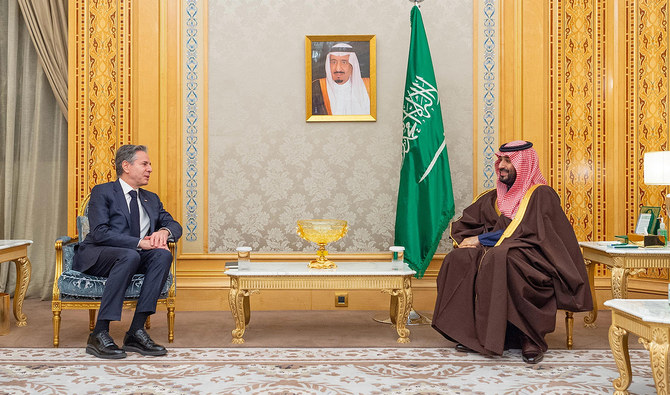
US Secretary of State Antony Blinken meets Saudi Crown Prince Mohammed bin Salman, in Riyadh, Saudi Arabia, February 5, 2024. (Saudi Press Agency/Handout via REUTERS)
2 / 2
US Secretary of State Antony Blinken disembarks from the plane upon arriving at King Khalid International Airport in the Saudi capital Riyadh on February 5, 2024. (AFP)
Blinken is later expected to visit Israel, Egypt and Qatar
Will meet with senior Saudi officials and discuss Gaza war
Updated 05 February 2024
Arab News
RIYADH: Saudi Arabia’s Crown Prince Mohammed bin Salman met with US Secretary of State Antony Blinken in Riyadh on Monday, Saudi Press Agency reported.
Blinken arrived in Riyadh earlier on in the day, on the first stop of his fifth regional tour since the beginning of the Israel-Gaza war. Blinken is later expected to visit Israel, Egypt and Qatar.
Saudi Foreign Minister Prince Faisal bin Farhan and the Kindom’s ambassdor to the US Princess Reema bint Bandar attended the meeting.
Ahead of the trip, Blinken stressed the need for “urgently addressing humanitarian needs in Gaza,” after aid groups have repeatedly sounded the alarm over the devastating impact nearly four months of war have had on the besieged territory.
The health ministry in Hamas-run Gaza said at least 27,478 people have been killed in the territory in nearly four months of war between Palestinian militants and Israel.
A ministry statement said 66,835 people have been wounded since fighting erupted on Oct. 7.
Red Sea Global unveils scientific model for regenerative tourism worldwide
The report details the model’s rollout at “The Red Sea” and “AMAALA” destinations, backed by studies covering 8 marine habitats
Updated 5 sec ago
Arab News
TABUK: Red Sea Global (RSG) has unveiled a science-based model aimed at achieving a 30% net positive conservation benefit across its tourism destinations by 2040.
The framework is now available for global adoption, according to a statement released by RSG.
Owned by Saudi Arabia’s Public Investment Fund (PIF), Red Sea Global is the multi-project developer behind ambitious regenerative tourism destinations like “The Red Sea” and “AMAALA.”
As a cornerstone of the Kingdom’s Vision 2030, the company aims to diversify the national economy while setting new global benchmarks for sustainable, nature-positive development.
CEO John Pagano stated that openly sharing this detailed approach will help elevate the global tourism sector and secure a healthier environment for future generations.
Map showing the boundaries of the Red Sea Zone. (Graphic from the RSG report)
The cornerstone of this initiative is the proprietary SIIG Model, a four-step framework:
• Survey: Establish biodiversity baselines and monitor long-term changes.
• Identify: Assess risks to priority habitats and species.
• Intervene: Execute evidence-based actions, such as regulating fishing and enhancing natural habitats.
• Gain: Measure and verify biodiversity improvements.
The report details the model’s rollout at “The Red Sea” and “AMAALA” destinations, backed by extensive 2022–2023 environmental baseline studies covering eight marine habitats and priority species groups during 2022 and 2023.
A major intervention is the 5,015-square-kilometer Fishery Management Area in Al-Wajh Lagoon. The plan reserves 38% of the area for priority conservation—protecting 62% of local coral reefs—while allocating 61% for sustainable fishing.
According to scientific modeling, eliminating fishing in high-protection zones could increase reef fish populations by 113%, sharks and rays by 72%, and marine mammals by 24%. These measures are expected to boost coral resilience, support ecosystem recovery, and protect vulnerable species like sea turtles and seabirds.
Ihab Kindi, RSG’s Red Sea Destination Executive Director, called the data-driven model a practical roadmap for large-scale marine recovery. The complete methodology is available in the new report, “The SIIG Model: A Roadmap Toward Achieving Measurable Conservation Gains.”