



KARACHI: With just days left before thousands of polling booths open for millions of voters, analysts say dynastic politics in Pakistan’s southern Sindh province is a “reality,” especially in a country where democratic practices lack, even within political parties.
In Pakistan, political power and influence are often concentrated in the hands of specific families over multiple generations. Successive governments over the years have featured members of a few select families hold positions of power or influence.
Pakistan’s political landscape has long been dominated by well-established families, including the Sharif clan of three-time prime minister Nawaz Sharif, a wealthy industrialist family from Punjab, and the Bhutto dynasty of feudal aristocrats that has ruled the southern Sindh province for decades, given the country two prime ministers and whose scion, Bilawal Bhutto-Zardari, has now set his sights on the PM’s office.
The Pakistan Peoples Party (PPP), a major political party which has been elected to power three consecutive times in Sindh since 2008, has nominated 191 candidates for the upcoming national and provincial assembly elections in the province. A large number of the candidates are from 12 prominent political families in Sindh.
“I think dynastic politics is true for much of South Asia,” Shahzeb Jillani, a journalist and political analyst, told Arab News. “It’s true in Pakistan as well. It seems to be more true in Sindh because you have one party running the province for last 15 years.”
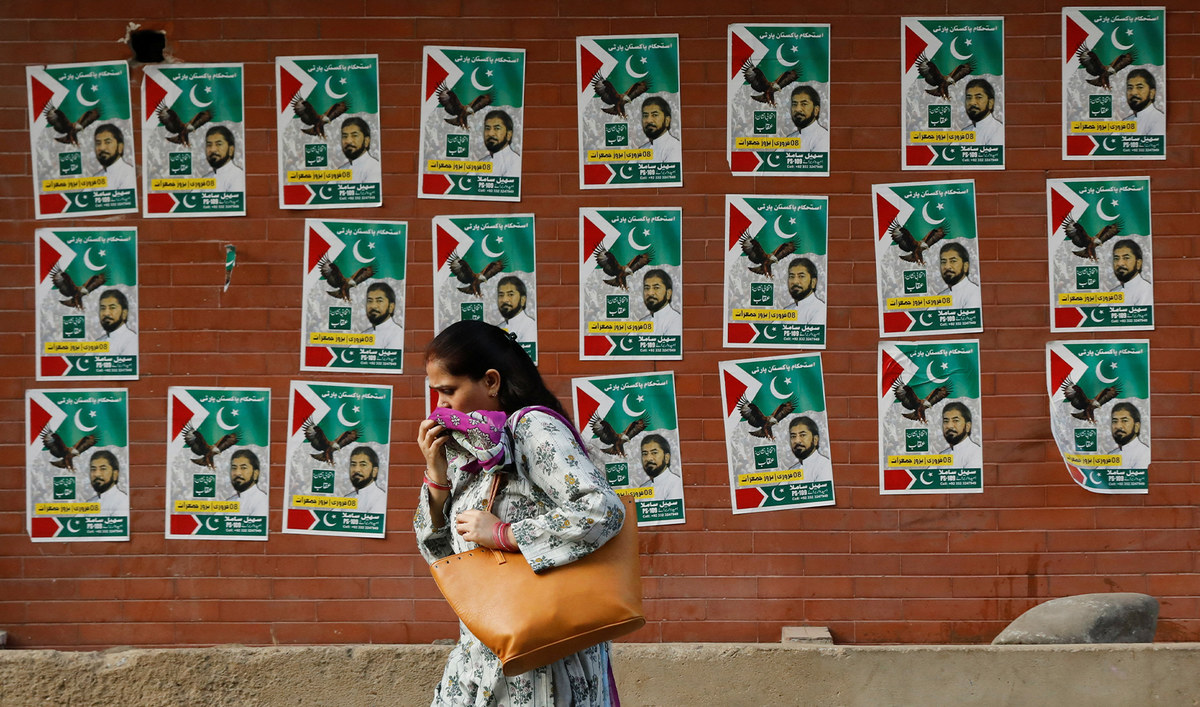
A woman walks past a wall with the campaign posters of political party, ahead of general elections, in Karachi, Pakistan on February 2, 2024. (REUTERS)
Former Pakistani president and PPP co-chairman Asif Ali Zardari has been nominated as the party’s candidate from Sindh’s NA-207 constituency in Shaheed Benazirabad. His son and PPP chairman, Bhutto-Zardari, is contesting the polls from the NA-194 seat in Larkana and NA-196 in Kambar-Shahdadkot.
Zardari’s sister Dr. Azra Fazal Pehchuho has been nominated to contest from the PPP’s platform for the provincial assembly constituency of PS-36 in Shaheed Benazirabad. Another sister of the former president, Faryal Talpur, is contesting polls from the PS-10 constituency in Larkana.
Meanwhile Syed Khursheed Shah, a former leader of the opposition in Pakistan’s National Assembly, is contesting from NA-201 in Sukkur, with his son Syed Farrukh Shah, running for the provincial constituency PS-24.
Shah’s son-in-law, Syed Owais Shah, is contesting polls from PS-23 in Sindh’s Sukkur district.
Jillani said Zardari is known for promoting younger people in politics but from the same family as he believes in “lineage.”
“And he believes in continuity as well,” Jillani noted. “And he believes that their [candidates of dynastic families] interests are so deeply intertwined with the party, that they will not ditch.”
Taj Haider, a senior PPP leader, defended the party’s choice of candidates who belong to the same families. He said these candidates not only enjoy public support but also stood with the party during tough times.
“They can win, the one who has people with him, will get the party tickets,” Haider told Arab News.
Journalist and author Fazil Jamili said dynastic politics in Pakistan and Sindh are thriving due to lack of democratic practices within political parties themselves.
“Whether you call it unfortunate or anti-democratic, this is a reality,” Jamili told Arab News. “Dynastic politics hinders common workers from obtaining party tickets.”
Jamili said when only a few families dominate electoral politics, it leaves less room for grassroots supporters of political parties who are “more connected and can better serve” the masses.
“Consequently, it makes people dependent on the rich or the elite, who may not understand people’s problems as someone from among them might,” Jamili noted.
However, he said political families dominating electoral politics are not confined to Sindh or the PPP. Rather, he said the Pakistan Muslim League-Nawaz (PML-N), a major political party led by former premier Nawaz Sharif, also favored dynastic families.
Candidates from other Sindh-based parties, such as Pir Sadruddin Shah Rashidi, leader of the Pakistan Muslim League-Functional (PML-F), is contesting from Khairpur for a National Assembly seat.
Rashidi is a candidate of the anti-PPP alliance, the Grand Democratic Alliance (GDA), while his son Pir Syed Ismail Shah and nephew, Muhammad Rashid, are contesting for provincial assembly seats in the province as well.
Similarly, prominent politicians Ghulam Murtaza Jatoi and his brother, Masroor Jatoi, are also contesting the upcoming polls. Former Sindh chief minister Arbab Ghulam Rahim is contesting from the GDA’s platform while his nephew, Arbab Lutfullah, is contesting for a provincial assembly seat on the PPP’s ticket.
Jillani agreed that political parties rely on “electables“— a popular term for politicians with significant clout that helps them win electoral contests— due to the lack of democratic culture in the country.
“We haven’t been allowed to function as a democracy over the last 75 years,” he said. “We had dictatorships, we had interference. And that has allowed families to become more deeply entrenched.”


