Pakistani information literacy organization launches collaborative fact-checking tool for newsrooms

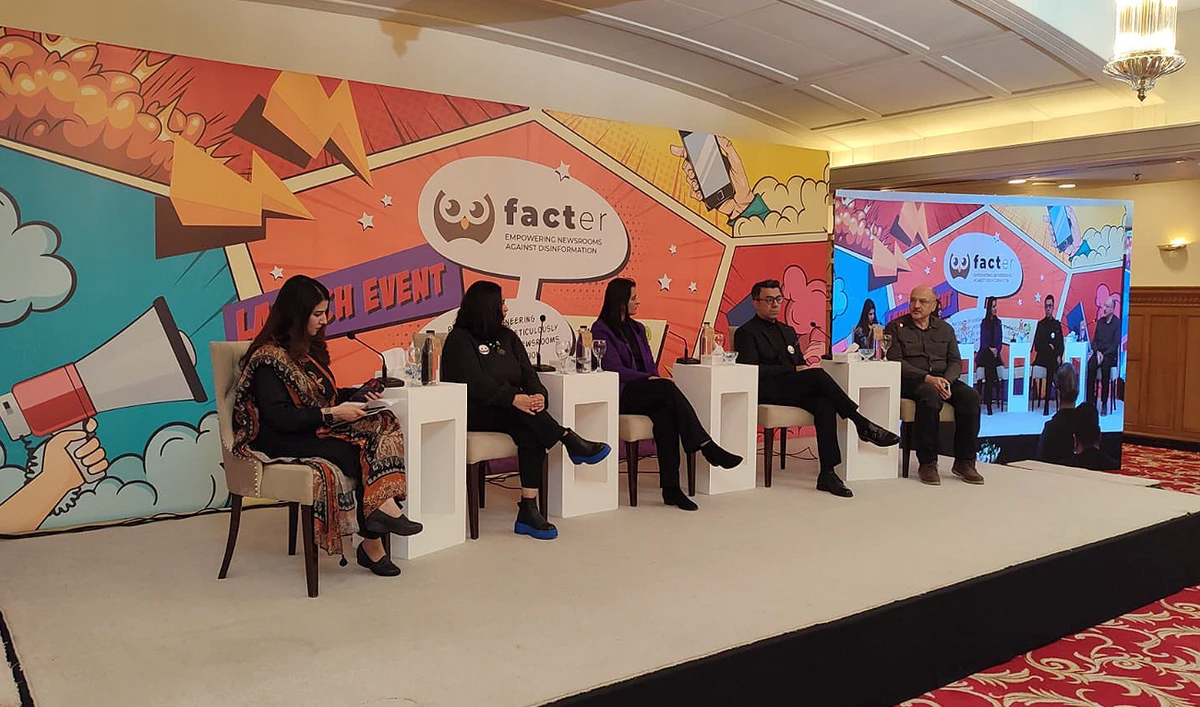
Veteran Pakistani journalist Haroon Rashid (right) speaks during the launching of a new fact-checking initiative, "Facter," by Media Matters for Democracy (MMfD), a Pakistani information literacy organization, in Islamabad on February 2, 2024. (Photo courtesy: X/@mmfd_Pak)
Short Url
Updated 03 February 2024
Follow

Pakistani information literacy organization launches collaborative fact-checking tool for newsrooms

  • Digital rights activists have already warned of the dangers of misinformation as Pakistan heads to polls on Feb. 8
  • The tool, ‘Facter,’ leverages technology to aggregate verified content from different news sources, its own team

ISLAMABAD: Media Matters for Democracy (MMfD), a Pakistani information literacy organization, on Friday launched a collaborative fact-checking tool, called ‘Facter,’ to support newsrooms in countering misinformation and delivering accurate information, the organization said.

Facter, which functions both as a tool and a platform, leverages technology to aggregate verified content from various news sources and its own monitoring and fact-checking team.

Its launch came days ahead of national elections in Pakistan that is facing overlapping political, economic and security challenges and digital rights activists and groups have warned of the dangers of misinformation, fake news and hate speech marring polls in a country that has a burgeoning young population, with millions using Facebook, X, Instagram, TikTok and other social media platforms.

“Facter is designed to empower credible newsrooms against disinformation. In the age of digital misinformation, our primary challenge is sustainability, both for fact-checking operations and newsrooms,” Asad Baig, the MMfD founder, said at the Facter launch in Islamabad.

Trends Monitor, MMfD’s technical toolkit for digital investigations, is employed to monitor social media platforms for mis- and disinformation, according to Baig. The analyzed content is categorized as suspected information, misinformation, misleading information, or verified information.

He said the fact-checking tool was already being adopted by more than 10 mainstream newsrooms, and his organization aimed to leverage these collaborations to effectively combat disinformation.

Key features of the tool include a constantly updated list of fact-checks and related news content published by leading credible newsrooms, according to Baig.

It also aligns with MMfD’s long-term goal of enabling newsrooms to enhance web traffic and digital revenue through the publication of verified, credible information.

“We have successfully piloted similar partnerships with news organizations and are looking to expand with Facter,” he said.
Pakistan, Malaysia discuss halal food, energy and tourism to boost cooperation

Updated 47 min 44 sec ago
Follow

Pakistan, Malaysia discuss halal food, energy and tourism to boost cooperation

  • Bilateral trade between both countries stands at about $1.4 billion a year
  • In Oct., both countries announced a new $200 million halal meat trade quota

ISLAMABAD: Pakistan and Malaysian officials have held talks on halal food, green energy and tourism sectors as part of renewed efforts to expand ties between the two Muslim-majority nations, the Pakistani High Commission in Malaysia on Monday.

The discussions took place during a meeting between Pakistan’s High Commissioner to Malaysia, Syed Ahsan Raza Shah and Tun Pehin Sri Dr. Wan Junaidi Tuanku Jaafar, governor of Malaysia’s Sarawak state.

Bilateral trade between the two countries stands at about $1.4 billion a year, according to official data from both governments. In Oct., both countries announced a new $200 million halal meat trade quota.

“Constructive talks on Pakistan-Malaysia ties in halal [food], palm oil, green energy, rice, labor, tourism, culture & sustainable development,” the Pakistani High Commission in Malaysia said on X.

Malaysia’s exports to Pakistan are led by palm oil and other vegetable fats, followed by machinery, rubber products and organic chemicals. Pakistan’s main exports to Malaysia include rice, textiles, seafood and minerals.

The two countries have also traded under the Malaysia-Pakistan Closer Economic Partnership Agreement since 2008, which provides preferential market access for goods and services.

Pakistan has been rapidly growing its green energy, halal food, and tourism sectors. Its halal food industry is attracting global buyers with Shariah-compliant products, while tourism is leveraging the country’s natural beauty, heritage sites and cultural attractions to draw international visitors.