

Educational institutions in Pakistan’s capital to close from Feb. 6-9 for polls

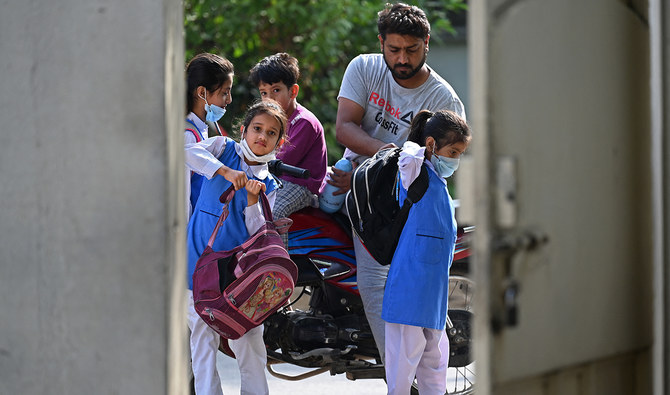
A man drops his children to a school in Islamabad on June 7, 2021. (AFP/File)
Short Url
Updated 01 February 2024
Follow

Educational institutions in Pakistan’s capital to close from Feb. 6-9 for polls

  • Authorities in Punjab, Khyber Pakhtunkhwa have also announced educational institutions will be closed from Feb. 6-9 for polls 
  • Over 120 million Pakistanis are expected to head to polling booths nationwide on Feb. 8 for elections to national and provincial seats

ISLAMABAD: Schools, colleges and universities in Pakistan’s capital will be closed from Feb. 6-9 for the upcoming national elections, the city’s deputy commissioner said on Thursday, as the South Asian country heads toward polls scheduled for Feb. 8 amid a challenging security situation.

Pakistani authorities in the northwestern Khyber Pakhtunkhwa (KP) and Punjab provinces have previously announced that educational institutions will be closed from Feb. 6-9. Schools, colleges and universities in Pakistan are closed days before polling opens nationwide as several educational institutions are designated as polling stations where citizens cast their votes.

“Education institutes are off in Islamabad from 6th to 9th Feb, 2024,” District Magistrate Irfan Nawaz Memon wrote on social media platform X. 


According to a circular shared by the education ministry seen by Arab News, schools in the capital will reopen on Feb. 10. 

A day earlier, Caretaker Chief Minister Mohsin Naqvi announced that educational institutions in Punjab will remain closed from Feb. 6-9 due to elections. The same was announced by KP’s education department on Thursday. 

Over 120 million people are expected to cast their votes on Feb. 8 when polling booths open for voters nationwide. However, an uptick in attacks in Pakistan’s KP and Balochistan provinces bordering Afghanistan have prompted fears elections could be marred by violence. 

On Jan. 22, panic spread through the Pakistani capital after parents received messages from schools urging them to pick their children a few hours after they had dropped them due to security reasons. 

However, Islamabad Police hours later clarified that the security situation in the capital was “under control,” urging citizens not to pay heed to rumors and avoid spreading baseless speculation. 

Pakistan’s election regulator on Thursday held a high-level meeting with senior intelligence officials, following which it reiterated its resolve to hold elections on Feb. 8 despite the ongoing pre-poll violence. 


Pakistan, China to sign multiple MoUs at major agriculture investment conference today

Updated 11 sec ago
Follow

Pakistan, China to sign multiple MoUs at major agriculture investment conference today

  • Hundreds of Chinese and Pakistani firms to attend Islamabad event
  • Conference seen as part of expanding CPEC ties into agriculture, trade

KARACHI: Islamabad and Beijing are set to sign multiple memorandums of understanding (MoUs) to boost agricultural investment and cooperation at a major conference taking place in the capital tomorrow, Monday, with hundreds of Chinese and Pakistani companies expected to participate.

The conference is being billed by Pakistan’s Ministry of National Food Security and Research as a platform for deepening bilateral agricultural ties and supporting broader economic engagement between the two countries.

“Multiple memorandums of understanding will be signed at the Pakistan–China Agricultural Conference,” the Ministry of National Food Security said in a statement. “115 Chinese and 165 Pakistani companies will participate.”

The conference reflects a growing emphasis on expanding Pakistan-China economic cooperation beyond the transport and energy foundations of the flagship China-Pakistan Economic Corridor (CPEC) into agriculture, industry and technology.

Under its first phase launched in 2015, CPEC, a core component of China’s Belt and Road Initiative, focused primarily on transportation infrastructure, energy generation and connectivity projects linking western China to the Arabian Sea via Pakistan. That phase included motorways, power plants and the development of the Gwadar Port in the country's southwest, aimed at helping Pakistan address chronic power shortages and enhance transport connectivity.

In recent years, both governments have formally moved toward a “CPEC 2.0” phase aimed at diversifying the corridor’s impact into areas such as special economic zones, innovation, digital cooperation and agriculture. Second-phase discussions have highlighted Pakistan’s goal of modernizing its agricultural sector, attracting Chinese technology and investment, and boosting export potential, with high-level talks taking place between planning officials and investors in Beijing.

Agri-sector cooperation has also seen practical collaboration, with joint initiatives examining technology transfer, export protocols and value-chain development, including partnerships in livestock, mechanization and horticulture.

Organizers say the Islamabad conference will bring together government policymakers, private sector investors, industry associations and multinational agribusiness firms from both nations. Discussions will center on investment opportunities, technology adoption, export expansion and building linkages with global buyers within the framework of Pakistan-China economic cooperation.