BURSA, Turkiye: Abdulalim Muaini lies in bed looking at pictures of his children and wife who died next to him in the earthquake one year ago, contemplating how it shattered the new life they had built in southern Turkiye after having fled war in Syria.
The deadliest disaster in Turkiye’s modern history, the magnitude 7.8 tremor levelled towns and city swathes in the country’s southeast and neighboring Syria. It killed more than 50,000 people in Turkiye, some 5,900 in Syria, and left millions homeless.
Muaini, now 34 and unable to walk, was rescued from the rubble of his collapsed apartment in Hatay nearly three days after the quake struck in the dead of night. It was too late for his wife Esra, who had been trapped there alongside him, and for his 10-year old son Muhsin and daughter Basira, 7.
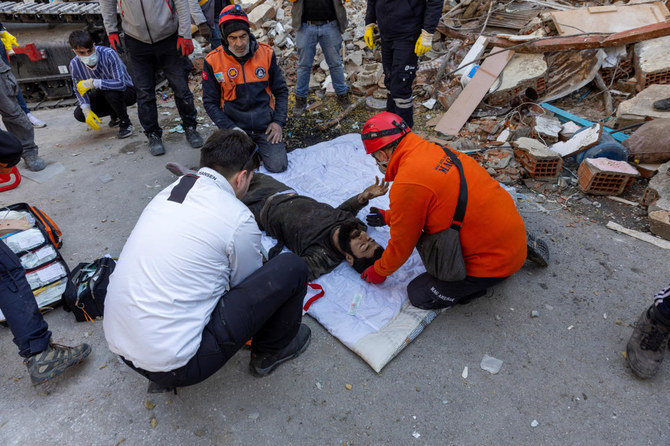
They were able to talk to each other for some 12 hours before the children and then mother died, he said. A photo of Muaini, peering out from under the rubble and gesturing weakly at his rescuers, with the body of his wife beside him, was published around the world. “I miss spending time with my family so much,” Muaini said, reflecting on the first anniversary of the Feb. 6 earthquake.
One of his legs was amputated and the other was paralyzed below the knee due to the crush of concrete and brick in his home in Hatay — which was the hardest-hit province in a disaster zone the size of Netherlands and Belgium combined.
He moved from the south to Bursa in the northwest where he lives with his mother, sister and her three children, getting physiotherapy and dreaming of a prosthetic leg so he can get back to work, pay off bills and, perhaps later, return to his homeland of Syria.
“My two brothers returned to Hatay because they couldn’t find a job here. They’re now working at construction projects (and) that’s also probably what I will do,” Muaini said. “First I need to have a prosthesis. Then I can go back to Hatay and look for a job,” he told Reuters in his sister’s three-room apartment in a Bursa neighborhood with lots of Syrian shops and Arabic signboards.
With his wife and son in 2016, he fled war-gripped northwest Syria, where he had sold computers, for Turkiye, where he earned a living selling fruit and vegetables. Turkiye has accepted millions of Syrian refugees from the nearly 13-year war.
In Bursa, rent is five times higher than in Hatay, and Muaini says he relies on his brother to help pay for that and food. Medical bills are piling up and include covering bladder surgery related to earthquake injuries.
Merve Akyuz, a physical medicine and rehabilitation physician at Bursa City Hospital, says that while the newly-started physiotherapy for the paralyzed leg offers a beacon of hope for Muaini, it will take time to walk again.
“After physiotherapy and prosthesis, he can continue his daily life... But a long treatment process awaits us,” she said. Muaini, who needs help to get out of bed and most other tasks, said all he can do for now is read Qur'an, pray and chat with friends and relatives. Asked whether he regretted coming to Turkiye, he said:
“No, it’s fate... I don’t know what happened to my home in Aleppo. But maybe I can go back one day when the war completely ends.”


![]()
![]()

A year on, Turkiye earthquake survivor counts losses of life and limb

Short Url
https://arab.news/5xdw6
A year on, Turkiye earthquake survivor counts losses of life and limb
- Muaini, now 34 and unable to walk, was rescued from the rubble of his collapsed apartment in Hatay nearly three days after the quake struck
- One of his legs was amputated and the other was paralyzed below the knee


Latest updates


© 2026 SAUDI RESEARCH & PUBLISHING COMPANY, All Rights Reserved And subject to Terms of Use Agreement.