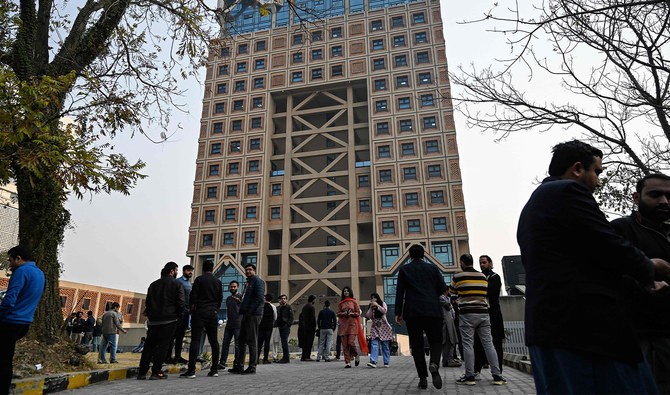
ISLAMABAD: A magnitude 6.4 earthquake rattled much of Pakistan and parts of neighboring Afghanistan on Thursday, sending panicked residents fleeing from homes and offices and frightening people in remote villages, Pakistani officials and the U.S. Geological Survey said.
The epicenter of the quake was in the Hindu Kuch mountain range in Afghanistan, according to the Pakistan Meteorological Department.
The epicenter was 45 kilometers (27.9 miles) from Jurm village in northeastern Afghanistan and was centered at a depth of 206 kilometers (128 miles), the U.S.G.S. said.
There were no immediate reports of damage in either country.
The temblor was felt in Pakistan's capital, Islamabad, and in the major cities of Lahore, Peshawar and Muzaffarabad in the Pakistan-administered, disputed Himalayan region of Kashmir, which is divided between Pakistan and India and claimed by both in its entirety.
Sahiba Bibi, a woman who lives on the outskirts of Islamabad, said she was preparing for prayers when she suddenly felt the ground shaking.
“We quickly came out of our home and we saw some other people also standing outside their houses,” she said.
Residents in the northwestern city of Peshawar also said they went out of their homes and offices after feeling the earthquake.
“I knew that it should not be less than magnitude 6 when I felt the earthquake as we have felt strong earthquakes in the past,” said Mohammad Khan, 65, in Peshawar, the capital of Khyber Pakhtunkhwa province bordering Afghanistan.
Bilal Faizi, a spokesman for Pakistan’s emergency services in the northwest, told The Associated Press that police and rescue officials were ordered to alert the emergency services about any damage caused by the earthquake.
“So far, there has been no reported damage from the earthquake, though the earthquake was so strong that it terrified many people who came out of their offices and houses in Peshawar and elsewhere in Khyber Pakhtunkhwa province,” he said.
Authorities in Pakistan-administered Kashmir said the earthquake caused no damage, but some panicked people came out of their homes and offices protectively.
Pakistan and the region, which sits along an active continental plate boundary, are often hit by earthquakes.
A magnitude 7.6 quake in 2005 killed thousands of people in Pakistan and Kashmir.


![]()

Magnitude 6.4 earthquake rattles much of Pakistan, parts of Afghanistan
Short Url
https://arab.news/9z73y
Magnitude 6.4 earthquake rattles much of Pakistan, parts of Afghanistan
- Quake's epicenter was in the Hindu Kush mountain range in Afghanistan
- There were no immediate reports of damage in either Afghanistan or Pakistan
Latest updates



© 2026 SAUDI RESEARCH & PUBLISHING COMPANY, All Rights Reserved And subject to Terms of Use Agreement.