

India seeks to foster international cooperation at energy week next month

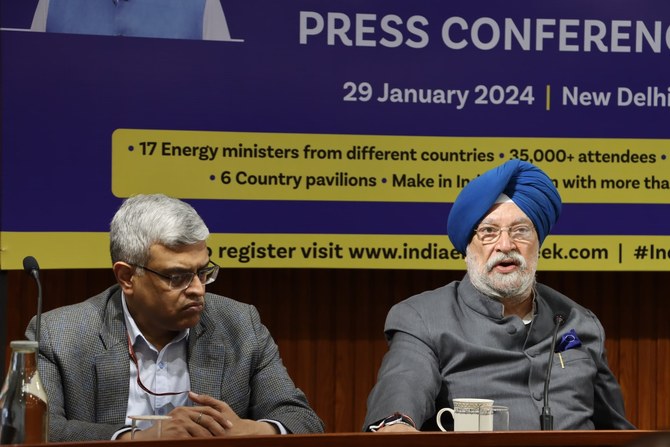
Indian Oil Minister Hardeep Singh Puri, right, speaks during a press conference in New Delhi on Jan. 29, 2024. (Ministry of Petroleum and Natural Gas)
Short Url
Updated 29 January 2024
Follow

India seeks to foster international cooperation at energy week next month

  • Saudi Arabia is an ‘important part’ of India Energy Week, minister says
  • Expert sees IEW as opportunity for closer Saudi-Indian energy cooperation

New Delhi: India is seeking to foster international cooperation to achieve its energy transition goals, the country’s oil minister said on Monday ahead of the 2024 India Energy Week. 

The South Asian country is set to welcome 17 ministers and more than 4,000 delegates from over 100 countries for the second edition of IEW, which will take place from Feb. 6 to 9 in the western state of Goa. 

During a press conference in New Delhi, Indian Oil Minister Hardeep Singh Puri expressed confidence in India’s energy outlook and described IEW as a “golden opportunity” for progress related to energy to be showcased and as a “platform for further development and growth.”

India aims to install 50 gigawatts of clean energy by the end of the decade and to reach net-zero emissions by 2070. The world’s most populous nation is still mostly powered by fossil fuels, with coal generating about 70 percent of India’s electricity and renewable energy contributing around 10 percent. 

The growth of IEW in its second year, which now has 30 percent more exhibitors than in 2023, is a “testament to India’s strong economic credentials and commitment to energy innovation,” Puri said. 

Saudi Arabia, which last year signed a number of agreements on energy cooperation with India, is also expected to take part at IEW next month. 

“Saudi Arabia is an important part of India Energy Week, with Aramco being one of the main platinum sponsors of the event,” Puri said. 

Saudi and Indian officials agreed to cooperate in renewable energy and energy security just last September, which was followed by an initial agreement on electrical interconnection and co-production of green and clean hydrogen. 

The event in Goa will be an opportunity for closer energy collaboration between India and the Kingdom, experts said.

“IEW provides a platform for both India and Saudi Arabia to reinforce collaboration in renewable and green technology,” Manish Mohan, director at the Confederation of Indian Industry, told Arab News. 

“Saudi Arabia is collaborating in a major way with India, and we want to reduce our carbon footprint and take significant steps to reduce emissions.” 

Saudi-Indian collaboration will be beneficial for New Delhi, said Lakshmi Priya, a fellow at the Indian Council of World Affairs.

“Cooperation with Saudi Arabia will help India in many ways. One, it will ensure hydrocarbon energy security for the ever-growing energy needs of India. Two, it will accelerate India’s transition to renewable energy,” Priya told Arab News. 

“Collaboration in green hydrogen has immense potential to enhance our efforts in the production and usage of green hydrogen. The understanding between PM Modi and Crown Prince Mohammed bin Salman will do wonders for energy cooperation.”


At top UN court, Myanmar denies deadly Rohingya campaign amounts to genocide

Updated 57 min ago
Follow

At top UN court, Myanmar denies deadly Rohingya campaign amounts to genocide

  • The country defended itself Friday at the United Nations top court against allegations of breaching the genocide convention
  • Myanmar launched the campaign in Rakhine state in 2017 after an attack by a Rohingya insurgent group

THE HAGUE: Myanmar insisted Friday that its deadly military campaign against the Rohingya ethnic minority was a legitimate counter-terrorism operation and did not amount to genocide, as it defended itself at the top United Nations court against an allegation of breaching the genocide convention.
Myanmar launched the campaign in Rakhine state in 2017 after an attack by a Rohingya insurgent group. Security forces were accused of mass rapes, killings and torching thousands of homes as more than 700,000 Rohingya fled into neighboring Bangladesh.
“Myanmar was not obliged to remain idle and allow terrorists to have free reign of northern Rakhine state,” the country’s representative Ko Ko Hlaing told black-robed judges at the International Court of Justice.
Gambia filed genocide case in 2019
African nation Gambia brought a case at the court in 2019 alleging that Myanmar’s military actions amount to a breach of the Genocide Convention that was drawn up in the aftermath of World War II and the Holocaust.
Some 1.2 million members of the Rohingya minority are still languishing in chaotic, overcrowded camps in Bangladesh, where armed groups recruit children and girls as young as 12 are forced into prostitution. The sudden and severe foreign aid cuts imposed last year by US President Donald Trump shuttered thousands of the camps’ schools and have caused children to starve to death.
Buddhist-majority Myanmar has long considered the Rohingya Muslim minority to be “Bengalis” from Bangladesh even though their families have lived in the country for generations. Nearly all have been denied citizenship since 1982.
Myanmar denies Gambia claims of ‘genocidal intent’
As hearings opened Monday, Gambian Justice Minister Dawda Jallow said his nation filed the case after the Rohingya “endured decades of appalling persecution, and years of dehumanizing propaganda. This culminated in the savage, genocidal ‘clearance operations’ of 2016 and 2017, which were followed by continued genocidal policies meant to erase their existence in Myanmar.”
Hlaing disputed the evidence Gambia cited in its case, including the findings of an international fact-finding mission set up by the UN’s Human Rights Council.
“Myanmar’s position is that the Gambia has failed to meet its burden of proof,” he said. “This case will be decided on the basis of proven facts, not unsubstantiated allegations. Emotional anguish and blurry factual pictures are not a substitute for rigorous presentation of facts.”
Aung San Suu Kyi represented Myanmar at court in 2019. Now she’s imprisoned
Nobel Peace Prize winner Aung San Suu Kyi represented her country at jurisdiction hearings in the case in 2019, denying that Myanmar armed forces committed genocide and instead casting the mass exodus of Rohingya people from the country she led as an unfortunate result of a battle with insurgents.
The pro-democracy icon is now in prison after being convicted of what her supporters call trumped-up charges after a military takeover of power.
Myanmar contested the court’s jurisdiction, saying Gambia was not directly involved in the conflict and therefore could not initiate a case. Both countries are signatories to the genocide convention, and in 2022, judges rejected the argument, allowing the case to move forward.
Gambia rejects Myanmar’s claims that it was combating terrorism, with Jallow telling judges on Monday that “genocidal intent is the only reasonable inference that can be drawn from Myanmar’s pattern of conduct.”
In late 2024, prosecutors at another Hague-based tribunal, the International Criminal Court, requested an arrest warrant for the head of Myanmar’s military regime for crimes committed against the country’s Rohingya Muslim minority. Senior Gen. Min Aung Hlaing, who seized power from Suu Kyi in 2021, is accused of crimes against humanity for the persecution of the Rohingya. The request is still pending.