

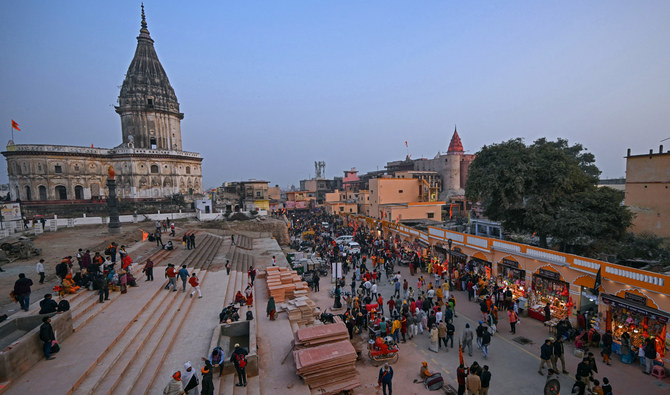
India Hindu group toughens stance on mosque-temple disputes

Hindu devotees walk towards the newly inaugurated temple of Hindu deity Ram in Ayodhya on January 23, 2024. (AFP)
Short Url
Updated 27 January 2024
Follow

India Hindu group toughens stance on mosque-temple disputes

  • The development comes after Modi led consecration of temple on site of 16th-century mosque demolished by Hindu mob
  • The fight over claims to holy sites has divided Hindu-majority India, which has the world’s third-largest Muslim population

NEW DELHI: A powerful Hindu group said several mosques in India were built over demolished Hindu temples, apparently hardening its stance in a decades-long sectarian dispute just days after a huge temple was inaugurated on the site of a razed mosque.

The comments from the Rashtriya Swayamsevak Sangh (RSS), the ideological parent of Prime Minister Narendra Modi’s Hindu-nationalist party, come after Modi and the RSS chief led Monday’s consecration of the temple on the site of a 16th-century mosque demolished by a Hindu mob in 1992.

The fight over claims to holy sites has divided Hindu-majority India, which has the world’s third-largest Muslim population, since independence from British rule in 1947.

Four days after the temple was inaugurated in the northern city of Ayodhya, a lawyer for Hindu petitioners said the Archaeological Survey of India had determined that a 17th century mosque in the Hindu holy city of Varanasi, in Modi’s parliamentary constituency, had been built over a destroyed a Hindu temple.

The Archaeological Survey did not respond to a request for comment.

Late on Friday, senior RSS leader Indresh Kumar questioned whether Varanasi’s Gyanvapi mosque and three others, including the razed one in Ayodhya on the site where many Hindus believe Lord Ram was born, were mosques at all.

“Whether we should consider them mosques or not, the people of the country and the world should think about it,” Kumar told Reuters in an interview, referring to the sites in Gyanvapi, Ayodhya, one other in Uttar Pradesh state and one in Madhya Pradesh. “They should stand with the truth, or they should stand with the wrong?“

In the group’s first reaction to the Gyanvapi findings, Kumar said, “Accept the truth. Hold dialogues and let the judiciary decide.”

Raising questions about the mosques does not mean Hindu groups comprise “an anti-mosque movement,” he said. “This is not an anti-Islam movement. This is a movement to seek the truth that should be welcomed by the world.”

‘Nothing political’

Muslim groups are disputing the assertions of Hindu groups in court.

Zufar Ahmad Faruqi, chairman of the Sunni Central Waqf Board in Uttar Pradesh, said the group “have confidence in the judiciary that it will do what is correct.

“We want to live in harmony and peacefully while protecting the monuments as they are,” he said. “Nothing political about it, we are in the court and facing it legally.”

The Modi-led opening of the Ayodhya temple fulfilled a 35-year-old pledge of his Bharatiya Janata Party ahead of a general election due by May. He is expected to win a third straight term, the longest stretch since India’s first prime minister, Jawaharlal Nehru.

The razing of the Ayodhya mosque sparked riots across India that authorities say killed at least 2,000 people, mostly Muslims. Hindu groups have for decades said that Muslim Mughal rulers built monuments and places of worship after destroying ancient Hindu structures.

Indian law bars the conversion of any place of worship and provides for the maintenance of the religious character of places of worship as they existed at the time of independence — except for the Ayodhya shrine. The Supreme Court is hearing challenges to the law.

The court this month halted plans for a survey of another centuries-old mosque in Uttar Pradesh, the country’s most populous and politically important state, to determine if it contained Hindu relics and symbols.

The RSS’s Kumar, who is also the chief patron of the group’s Muslim wing, said Islamic law requires mosques to be constructed on undisputed land, or the land should be donated by someone who has bought it or the people building the mosque should buy it.


How a Syrian refugee chef met Britain’s King Charles

Imad Alarnab, a chef and restaurant owner who fled Syria in 2015, works at one of his restaurants in central London. (AFP)
Updated 55 min 2 sec ago
Follow

How a Syrian refugee chef met Britain’s King Charles

  • Alarnab, 48, said he had asked the king to come to the popular eatery when he met him at Buckingham Palace

LONDON: Pots clanged and oil sizzled inside the London kitchen of Syrian chef Imad Alarnab, as the former refugee who fled his country’s civil war recalled hosting King Charles III.
When the chef left his war-torn homeland in 2015, he never imagined that one day he would watch as cameras flashed and wide-eyed crowds greeted the monarch arriving at his Soho restaurant last year.
Alarnab, 48, said he had asked the king to come to the popular eatery when he met him at Buckingham Palace before an event honoring humanitarian work in 2023.
“I told him ‘I would love for you to visit our restaurant one day’ and he said: ‘I would love to’... I was over the Moon to be honest.”
The chef has come a long way since he arrived in London after an arduous journey from Damascus with virtually no money in his pocket.
Fearing for his life, he had escaped Syria after his family was uprooted again and again by fighting.
His culinary empire — restaurants, cafes, and juice bars peppered across the Syrian capital — had been destroyed by bombing in just six days in 2013.
Alarnab spent three months crisscrossing Europe in the back of lorries, aboard trains, on foot and even on a bicycle before he reached the UK.
“When I left, I left with nothing,” he told AFP, as waiters whirled past carrying steaming plates of traditional Syrian fare.
Starving and exhausted, he spent the last of his money on a train ticket to Doncaster where his sister lived.
“Love letter from Syria”
To make a living, Alarnab initially picked up any odd jobs, such as washing and selling cars, saving enough to bring his wife and three daughters over after seven months.
His love of cooking never left him though. In France, while he was sleeping on the steps of a church, Alarnab had often cooked for hundreds of other refugees.
“I always dreamed of going back to cooking,” he said.
So it wasn’t long before he found himself back in the kitchen, cooking up a storm across London with his sold-out supper clubs, bustling pop-up cafes, and crowded lunchtime falafel bars.
Alarnab’s friends gave him the initial boost for his first pop-up in 2017, and profits from his new catering business then covered the costs of later events.
He now runs two restaurants in the city — one in Soho’s buzzing Kingly Court and another nestled in a corner of the vibrant Somerset House arts center.
“I was looking for a city to love when I found London,” Alarnab said, adding it had offered him “space to innovate” and add his own modern twist to classic Syrian dishes.
Far from home, Alarnab said his word-of-mouth success had grown into a “love letter from Syria to the world” that needs no translation.
“You don’t really need to speak Arabic or Syrian to know that this is the best falafel ever,” he said, pointing to a row of colorful plates.
“There is hope”
For Alarnab, spices frying, dough rising and cheese melting inside a kitchen offered an unlikely escape from the real world.
“All my problems, I leave them outside the kitchen and walk in fresh.”
When he fled Syria, Alarnab thought going back to Damascus was forever off the table.
Yet he returned for the first time in October, almost a year to the day after longtime leader Bashar Assad was toppled in a lightning rebel offensive — ending almost 14 years of brutal civil war.
He walked the familiar streets of his old home, where his late mother taught him to cook many years ago.
“To return to Damascus and for her not to be there, that was extremely difficult.”
Torn between the two cities, Alarnab said he longed to one day rebuild his home in Damascus.
“I wish I could go back and live there. But at the same time, I feel like London is now a part of me. I don’t know if I could ever go back and just be in Syria,” he said.
Although Syrians still bear the scars of war, Alarnab said he had seen “hope in people’s eyes which was missing when I left in 2015.”
“The road ahead is still very long, and yes this is only the beginning — but there is hope.”