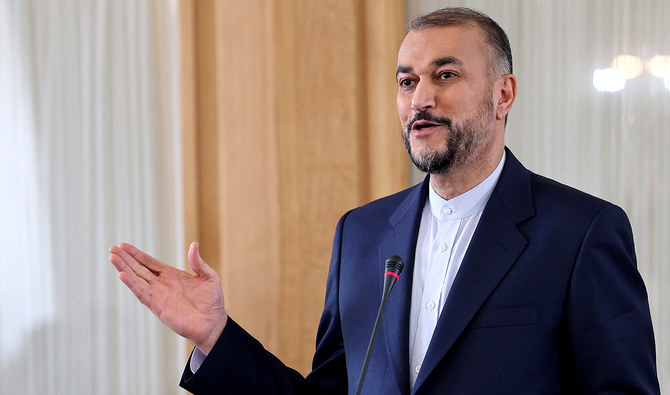
ISLAMABAD: Iranian Foreign Minister Hossein Amir Abdollahian is due to arrive in Pakistan on Sunday night, Pakistan’s foreign ministry said, a day after gunmen killed nine Pakistanis in southeast Iran amid strained ties between the two neighbors.
The deceased Pakistanis, who had been working as laborers, were killed in Iran’s restive southeastern border area of Saravan, according to relatives of the victims.
The attack in Saravan came a day after Pakistani and Iranian ambassadors returned to their posts after being recalled when both countries exchanged missile strikes last week at what they said were militant targets.
The strikes were the highest-profile cross-border intrusions in recent years, however, both countries quickly moved to de-escalate tensions following a telephonic conversation between their foreign ministers.
During the visit, FM Abdollahian would meet his Pakistani counterpart Jalil Abbas Jilani and other Pakistani officials to address the issues of mutual concern, according to the Pakistani foreign ministry.
“He [Iranian foreign minister] will arrive in Islamabad later tonight on a visit to Pakistan,” Mumtaz Zahra Baloch, a Pakistani foreign ministry spokesperson, told Arab News on Sunday.
Baloch said FM Abdollahian was visiting Pakistan upon the invitation of his Pakistani counterpart, which was extended during a telephonic conversation between the two figures held last week.
Asked about the significance of the visit, Naghmana Hashmi, a former Pakistani diplomat, said it was important with regard to the recent developments and their possible impact on the diplomatic relations between the two countries.
In the last few decades, she noted, both countries had seen a rise in militancy, which needed to be addressed at the highest level.
“There have been some issues which have more to do with the overall geostrategic and geopolitical situation that has evolved, particularly in our neighborhood,” she told Arab News.
“After the recent attacks, the two governments promptly established contact, initiating a hectic diplomatic effort, as we cannot afford to have either Iran or Pakistan open another front in the region.”
Hashmi said any military action between the two neighbors would not only impact Pakistan, but also extend consequences to Iran and the broader Middle East region.
“It is important to sit down and discuss common concerns and find ways out to address them,” she added.
Syed Muhammad Ali, a Pakistani security expert, said the visit would allow both countries to timely address the issues, particularly the recent rise in militant attacks as well as the killing of Pakistani nationals in Saravan.
“Pakistan expects Iran to timely identify those responsible and bring them to justice and ensure that such terrorist attacks neither affect the bilateral relations between Pakistan and Iran nor harm major regional economic, trade and connectivity projects which will benefit both nations,” he told Arab News.

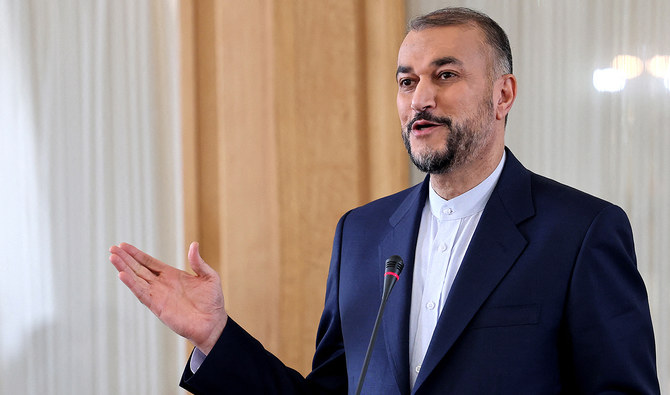
Iranian FM due in Islamabad day after gunmen kill nine Pakistanis in southeast Iran amid strained ties
https://arab.news/4bxk4
Iranian FM due in Islamabad day after gunmen kill nine Pakistanis in southeast Iran amid strained ties
- The killing of Pakistani nationals followed last week’s tit-for-tat strikes by both countries
- Analysts say the visit is timely and crucial to address the issues straining friendly relations
T20 World Cup: ICC deputy chief in Lahore for talks after Pakistan boycotts India match
- Islamabad’s boycott over Bangladesh’s exclusion has threatened the tournament’s most lucrative game
- Bangladesh Cricket Board chief has also arrived in Pakistan and is expected to participate in meetings
ISLAMABAD: International Cricket Council (ICC) Deputy Chairman Imran Khwaja arrived in Lahore on Sunday for talks with Pakistan Cricket Board (PCB) officials, the PCB said, as the sport’s governing body strives to save a high-stakes T20 World Cup clash between arch-rivals Pakistan and India.
The development follows Islamabad’s decision to boycott the Feb. 15 Pakistan-India match in Colombo, a move to protest the ICC’s exclusion of Bangladesh from the ongoing T20 World Cup.
The controversy over Pakistan’s participation erupted after the ICC replaced Bangladesh with Scotland, following Bangladesh’s decision to not play matches in India owing to security fears.
The ICC has since requested the Pakistan Cricket Board to reconsider the decision to boycott their match against India in Colombo or they will have to forfeit the marquee game of the tournament.
“ICC Deputy Chairman Imran Khwaja arrived in Lahore,” the PCB said on Sunday, adding that he was received at the airport by the PCB chairman’s adviser, Aamir Mir.
Prior to Khwaja’s arrival in Lahore, where the PCB is headquartered, Pakistan welcomed Bangladesh Cricket Board (BCB) President Aminul Islam, who was received by PCB CEO Salman Naseer.
The two visiting officials are scheduled to meet PCB Chairman Mohsin Naqvi.
“Bangladesh Cricket Board President Aminul Islam will also take part in other meetings,” the PCB said in a statement, hinting that he will be part of the meeting with ICC’s Khwaja.
The dispute stems from the ICC’s decision to replace Bangladesh with Scotland last month after Bangladesh refused to play tournament matches in India. Dhaka’s decision followed the removal of Mustafizur Rahman from the Indian Premier League (IPL). He was bought for $1 million by the IPL’s Kolkata Knight Riders, but on Jan. 3 the Board of Control for Cricket in India (BCCI) ordered Kolkata to release Mustafizur without a public explanation but amid regional tensions.
Pakistan have boycotted the 27th match of the tournament against India, due to take place at R. Premadasa Stadium in Colombo. An India-Pakistan fixture is the sport’s most lucrative asset, generating a massive share of global broadcasting and sponsorship revenue.
The PCB has remained defiant amid reports of potential sanctions. On Saturday, the board rejected claims by Indian media that it had initiated a dialogue with the ICC to find a way out of the standoff.
“I categorically reject the claim by Indian sports journalist Vikrant Gupta that PCB approached the ICC,” PCB’s Mir said in a statement. “As usual, sections of Indian media are busy circulating fiction. A little patience and time will clearly show who actually went knocking and who didn’t.”
The standoff highlights the growing friction within the sport’s governance.
Pakistan has accused India’s cricket board of influencing the ICC’s decisions.
Defense Minister Khawaja Asif this week called for the formation of a new cricket governing body, saying the ICC, currently chaired by Jay Shah, son of India’s Home Minister Amit Shah, was being held “hostage” to “Indian political interests.”
India generates the largest share of cricket’s commercial revenue and hence enjoys considerable influence over the sport. Critics argue that this financial contribution translates into decisive leverage within the ICC.
A large part of that revenue comes from the Indian Premier League (IPL), the sport’s most lucrative T20 cricket competition, which is run by the Board of Control for Cricket in India (BCCI). Between 2024 and 2027, the IPL is projected to earn $1.15 billion, nearly 39 percent of the ICC’s total annual revenue, according to international media reports.
While the Pakistani government cleared the team to participate in the rest of the tournament, Prime Minister Shehbaz Sharif maintained that the boycott of the India game was necessary to protest the “unjust” treatment of Bangladesh.