Saudi opera singer Sawsan Albahiti on performing in AlUla with Andrea Bocelli

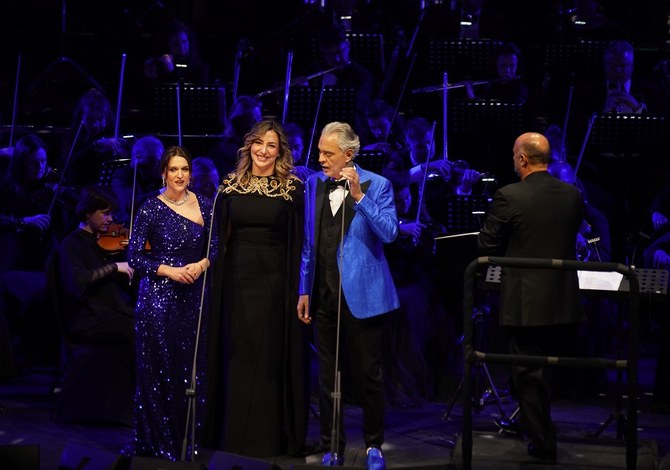
Andrea Bocelli (R), Sawsan Albahiti and Serena Gamberoni (L) on stage in AlUla on Jan. 26. (Supplied)
Short Url
Updated 28 January 2024
Follow

Saudi opera singer Sawsan Albahiti on performing in AlUla with Andrea Bocelli

DUBAI: Some dreams really do come true. When Saudi opera singer Sawsan Albahiti was still a university student in the UAE, she had a very particular dream about performing with the artist who inspired her the most — Italian tenor Andrea Bocelli.

“I don’t know why, but he was always wearing a blue suit and I was wearing black,” she tells Arab News.

On Jan. 26, Albahiti — dressed in black — sang Bocelli’s signature song “Time To Say Goodbye” (“Con te partiro” in Italian) with Bocelli (who wore a blue tuxedo) and Italian soprano Serena Gamberoni as the closing number of his concert at AlUla’s Maraya Theater. 
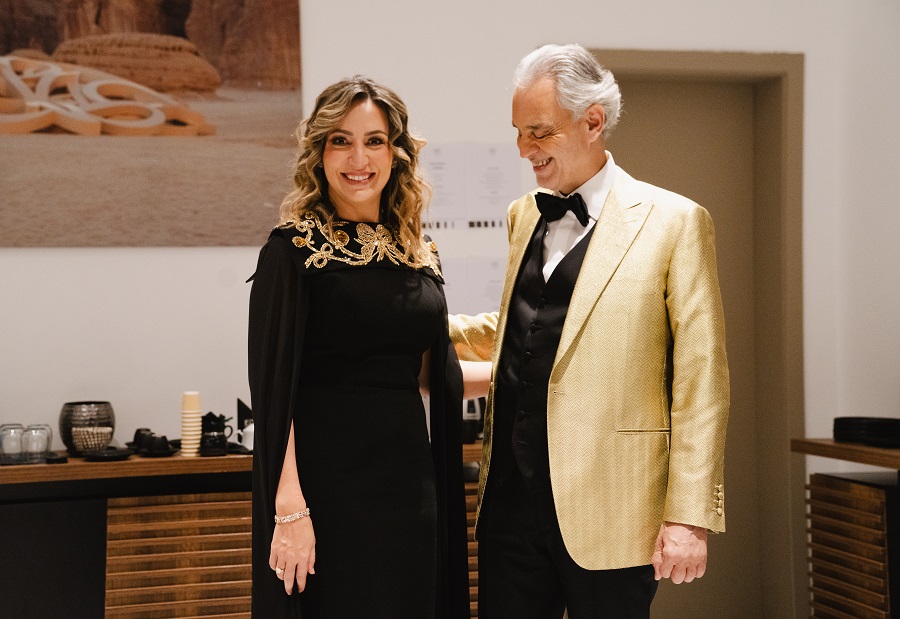


Sawsan Albahiti and Andrea Bocelli backstage at the Maraya Theater on Jan. 26. (Supplied)

“To perform with the person that inspired you to do what you always dreamed of doing is, of course, the biggest deal ever,” Albahiti says. “I remember when I was studying in the UAE, whenever I went to Dubai Mall I’d go to the dancing fountains, and they would play his song with Sarah Brightman, ‘Time To Say Goodbye.’ I’d always get goosebumps and tear up. I was always so fascinated by the beauty and the magic in his voice. He made me love this whole art. I always dreamed of performing this song with him.”

Albahiti also gave a pre-show and a solo performance at the special concert, which was organized by the Royal Commission For AlUla.

Albahiti says it was typical of Bocelli to invite a local artist up on stage to perform with him, and highlights his generosity as a performer.

“Between his singing parts, he turned to me and said in Italian, ‘Prego,’ meaning ‘You are welcome here,’” she says. “There was a massive roar and a standing ovation when we finished the song.” 

This wasn’t the first time that Albahiti has met Bocelli. Their first encounter took place in 2021, and it was an emotional one.

“He was so humble and kind,” she recalls. “I told him, ‘You are the reason why I went into opera. You inspired me.’ And he teared up. His story is a very inspiring one, full of challenges. On top of the physical disability of blindness, he also faced difficulty at the start of his career getting the recognition he deserved from producers and record labels. But he kept on going. He pursued his dream.”


Riyadh exhibition to trace the origins of Saudi modern art

Updated 07 January 2026
Follow

Riyadh exhibition to trace the origins of Saudi modern art

  • Features painting, sculpture and archival documents
  • Open from Jan. 27-April 11 at Saudi national museum

DUBAI: A new exhibition in Riyadh is focusing on the origins of Saudi Arabia’s modern art scene, examining how a generation of artists helped shape the Kingdom’s visual culture during a period of rapid change.

The “Bedayat: Beginnings of Saudi Art Movement” show reportedly traces the emergence of creative practices in Saudi Arabia from the 1960s to the 1980s, an era that laid the groundwork for today’s art ecosystem.

On view from Jan. 27 until April 11 at the National Museum of Saudi Arabia, it includes works and archival material that document the early years of modern and abstract art in the Kingdom, according to the organizers.

It will examine how artists responded to shifting social, cultural and economic realities, often working with limited infrastructure but a strong sense of purpose and experimentation.

The exhibition is the result of extensive research led by the Visual Arts Commission, which included dozens of site visits and interviews with artists and figures active during the period.

These firsthand accounts have helped to reconstruct a time when formal exhibition spaces were scarce, art education was still developing, and artists relied heavily on personal initiative to build communities and platforms for their work.

Curated by Qaswra Hafez, “Bedayat” will feature painting, sculpture, works on paper and archival documents, many of which will be shown publicly for the first time.

The works will reveal how Saudi artists engaged with international modernist movements while grounding their practice in local heritage, developing visual languages that spoke to both global influences and lived experience.

The exhibition will have three sections, beginning with the foundations of the modern art movement, and followed by a broader look at the artistic concerns of the time.

It will conclude with a focus on four key figures: Mohammed Al-Saleem, Safeya Binzagr, Mounirah Mosly and Abdulhalim Radwi.

A publication, documentary film and public program of talks and workshops will accompany the exhibition, offering further insight into a pivotal chapter of Saudi art history and the artists who helped define it.