
PARIS: Lady Gaga and French-Malian singer Aya Nakamura joined dancers, an opera diva and even a heavy metal band in an opening ceremony for the Paris Olympics that sought to proudly showcase French culture with a modern twist.
The first-ever opening ceremony held outside a stadium — on the River Seine — had to battle driving rain that cast a pallid gloom over the City of Light.
The fast-moving and multi-location ceremony masterminded by acclaimed French theater director Thomas Jolly was aimed at impressing the global TV audience as much as those who braved the weather and intense security to watch live.
“It is now. The world is watching us. Let’s open the Games in style!” French President Emmanuel Macron, who watched the ceremony in a VIP stand with other leaders, wrote on X.
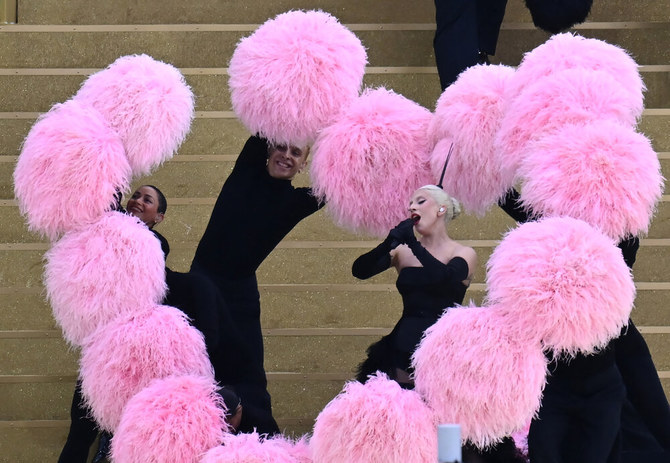
In a nod to her passion for French culture, US pop star Lady Gaga appeared from behind a fan of pom-poms held by her dancing troupe to sing “Mon truc en plumes” (“My Thing With Feathers“) an iconic French music hall hit by the legendary Zizi Jeanmaire.
“It is my supreme honor to sing for you and cheer you on,” Gaga wrote on her social media channels after the performance, saying she always “felt a very special connection with French people and singing French music.”
Franco-Malian R&B superstar Aya Nakamura, the most listened-to French-speaking singer in the world, performed a medley with two of her hits “Pookie” and “Djadja” and a classic by Charles Aznavour, “For me Formidable,” one hundred years since his birth.
Rumours she was to perform had sparked a backlash from the extreme right in France and a torrent of racist abuse on social media. But in a striking symbol, she was accompanied in her performance by musicians from France’s Republican Guard.
According to Jolly, the 12 different phases of the ceremony tell the story of a country rich in its “diversity,” “inclusive,” “not one France but several Frances,” and celebrating “the whole world united.”
He has been backed by a writing team including famed novelist Leila Slimani and screenwriter Fanny Herrero, who penned the smash-hit casting agency comedy “Dix pour cent” (“Call My Agent).
In another highlight, the star “etoile” dancer of the Paris Opera Guillaume Diop performed on a Paris rooftop.
For many French spectators, the highlight was the surprise appearance of the heavy metal group Gojira, who burst out onto platforms constructed on the Conciergerie, a key building in the French Revolution, where deposed queen Marie-Antoinette was held.
With a mannequin of headless Marie Antoinette after her guillotine execution for good measure, they belted out the revolutionary chant “Ah! Ca ira.”
In an unlikely collaboration, they were joined by the French-Swiss mezzo-soprano Marina Viotti, who makes no secret of her taste for metal as well as classical.
Jakub Jozef Orlinski, a Polish couter-tenor who is also a break-dancer, interpreted an aria from the opera “Les Indes Galantes” by Jean-Philippe Rameau combining both of his talents.
The ceremony, which was due to last several hours, had got under way with a clip of French actor Djamel Debbouze carrying the Olympic torch into the national stadium, the Stade de France, only to realize he should have gone to the river.
Helped by French football great Zinedine Zidane, he then takes the torch on un underground odyssey through Paris and hands it to a group of children who are then guided by a mysterious masked individual who is expected to eventually light the Olympic flame.