

‘Today’s gathering is a referendum’: Pakistani religious party holds power show at Karachi’s Bagh-e-Jinnah

Jamaat-e-Islami Pakistan (JIP) party supporters attend an election campaign rally in Karachi on January 28, 2024. (AFP)
Short Url
Updated 28 January 2024
Follow

‘Today’s gathering is a referendum’: Pakistani religious party holds power show at Karachi’s Bagh-e-Jinnah

  • Bagh-e-Jinnah venue has often been used by political parties as symbol of political might to help gauge public support
  • Jamaat-e-Islami Karachi chief Naeem-ur-Rehman claims his party is winning the polls, asks establishment to ‘let it win’

KARACHI: The Jamaat-e-Islami (JI), a prominent Pakistani religious party, on Sunday flexed its muscles by holding a public rally at the iconic Bagh-e-Jinnah venue in Karachi, where its leaders said the people had announced their decision in favor of the JI by attending the rally in large numbers.

Political parties have stepped up their activities to mobilize supporters, with less than two weeks before millions of Pakistanis head to the ballot box on February 8 to elect their representatives for the next five years.

The Bagh-e-Jinnah park, located adjacent to the mausoleum of Pakistan’s founder Muhammad Ali Jinnah, is a venue that has often been used by parties as a symbol of political might that can help gauge public support.

On Sunday, the JI held a public gathering at the venue and the party members recalled before the crowd how the JI had highlighted their issues, including energy tariff hikes, issuance of national identity cards and water shortage, in the recent months.

“In this powerful display, there is a sea of people surrounding us on all four sides,” JI chief Sirajul Haq said. “Today’s gathering is a referendum in favor of Jamaat-e-Islami.”
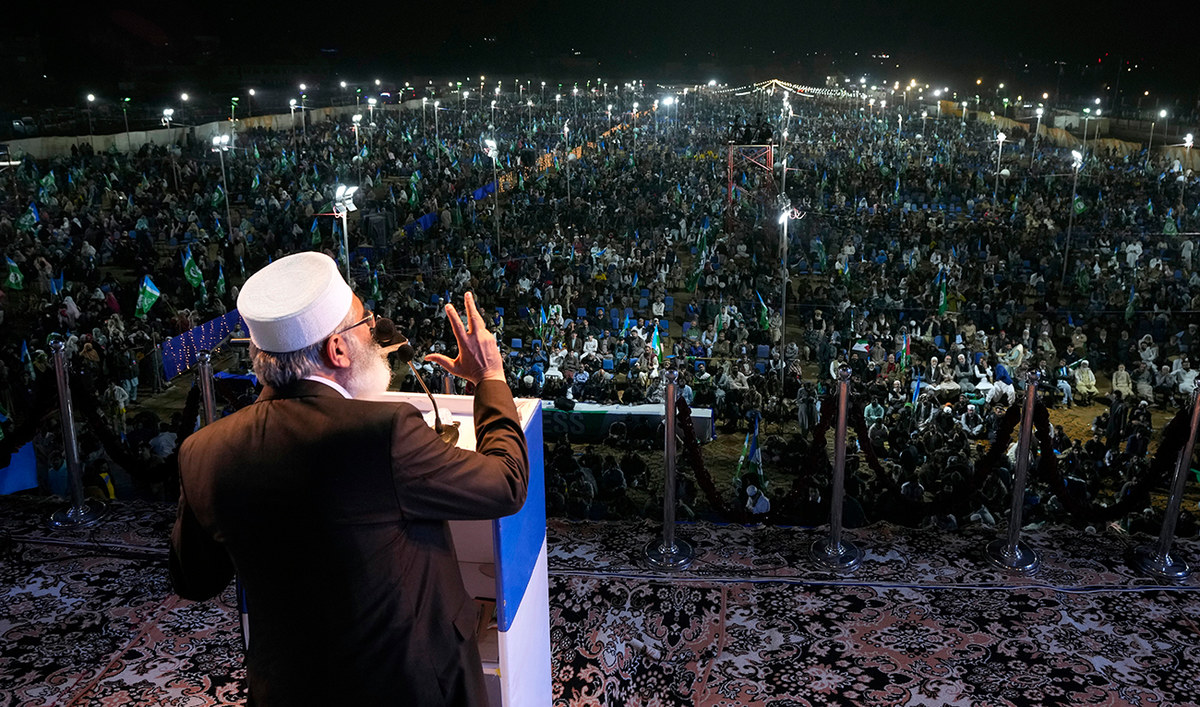


Siraj ul Haq, leader of the Pakistani religious group' Jamaat-e-Islami' addresses supporters at an election campaign rally in Karachi on January 28, 2024. (AP)

During his speech, Hafiz Naeem-ur-Rehman, who heads the JI’s Karachi chapter, claimed his party was winning the elections in Karachi and the country’s establishment should “allow” it to win.

“Today, these individuals have not been brought here, they have come of their own accord,” Rahman said. “I want to convey to the establishment that Jamaat-e-Islami is winning, and it should be allowed to win.”

In Pakistan’s context, politicians and analysts often refer to the country’s powerful military as the establishment, which has directly ruled the South Asian country on many occasions and is said to have considerable sway in the country’s politics.
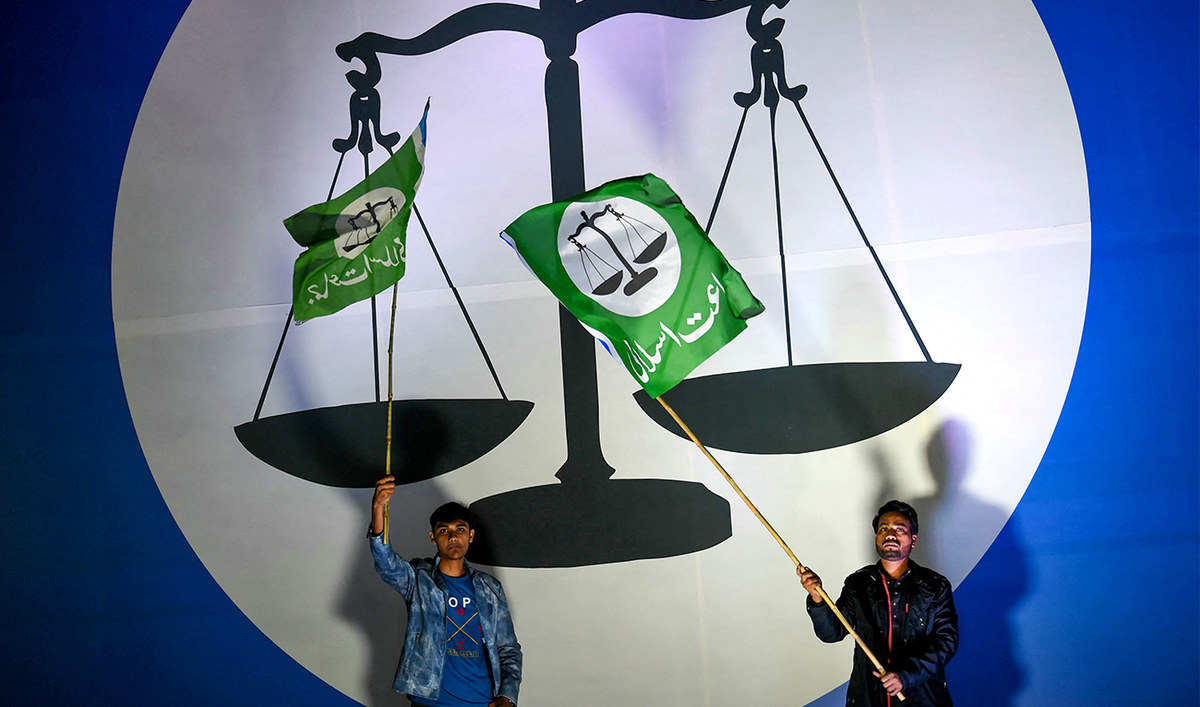


Jamaat-e-Islami Pakistan (JIP) supporters hold party flags at an election campaign rally in Karachi on January 28, 2024. (AFP)

The JI once used to be a dominant party in Karachi’s electoral politics before the Muttahida Quami Movement (MQM) dethroned it to become the most popular political party in the southern port city, which is Pakistan’s commercial hub and home to nearly 18 million people.

In 2023, the JI bounced back after several years and bagged the second-highest 86 seats in local body elections in the city, while the Pakistan Peoples Party (PPP), which has also been ruling in the province, won the polls with 93 seats.

However, the elections were marred by allegations of rigging by the JI and former prime minister Imran Khan-led Pakistan Tehreek-e-Insaf (PTI) party.
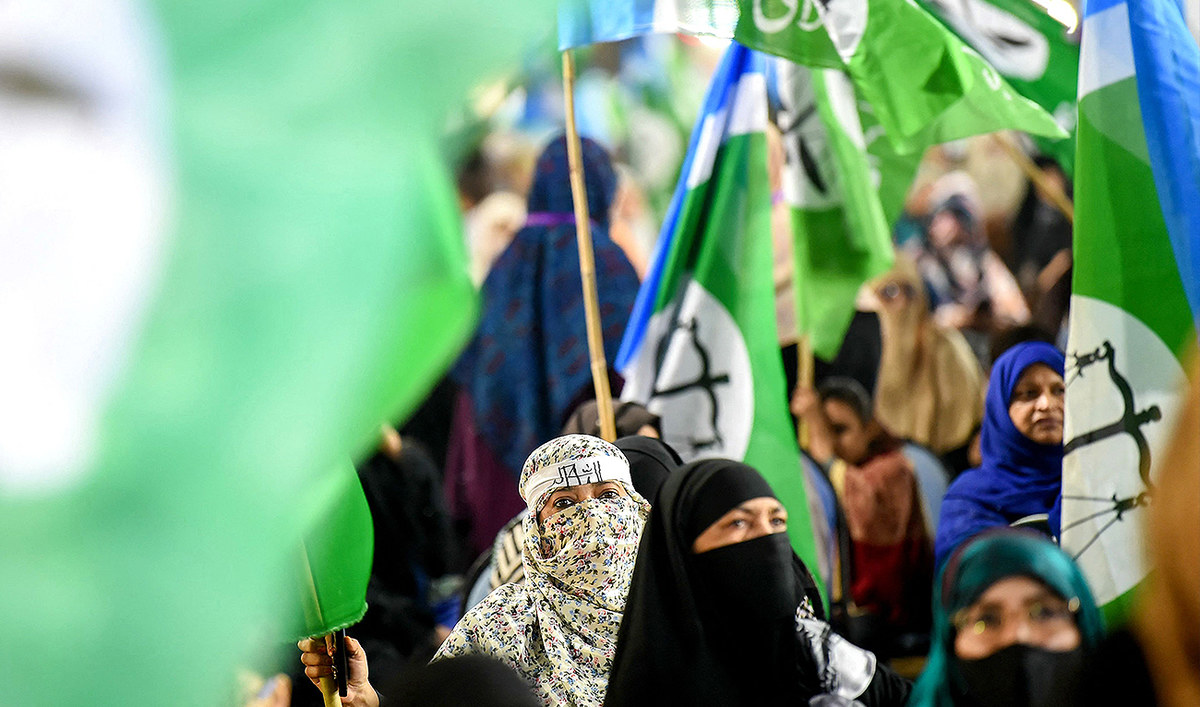


Jamaat-e-Islami Pakistan (JIP) supporters hold party flags at an election campaign rally in Karachi on January 28, 2024. (AFP)


Pakistan Navy tests surface-to-air missile in Arabian Sea, reaffirms defense resolve

Updated 5 sec ago
Follow

Pakistan Navy tests surface-to-air missile in Arabian Sea, reaffirms defense resolve

  • The test follows a brief conflict with India that involved missile, artillery and drone exchanges but no naval clashes
  • Pakistan has stepped up battle readiness more recently, with senior commanders overseeing major training exercises

ISLAMABAD: The Pakistan Navy reaffirmed its resolve to defend the country’s territorial waters on Monday after conducting a live firing test of a surface-to-air missile in the northern Arabian Sea, according to a military statement.

The missile test involved the FM-90(N) ER, a medium-range naval air-defense system designed to intercept aerial threats, and comes months after a brief but intense military conflict between Pakistan and India in which the nuclear-armed neighbors exchanged missile and artillery fire and deployed drones and fighter jets.

While the four-day confrontation did not escalate into a naval clash, the Pakistan Navy remained on high alert until a US-brokered ceasefire brought the fighting to an end.

“Pakistan Navy successfully conducted a Live Weapon Firing (LWF) of the FM-90(N) ER Surface-to-Air Missile in the North Arabian Sea,” the military’s media wing, Inter-Services Public Relations (ISPR), said in a statement.

“During the firepower demonstration, a Pakistan Navy ship effectively engaged highly manoeuvrable aerial targets, reaffirming the Navy’s war-fighting capability and combat readiness,” it added. “Commander Pakistan Fleet witnessed the live firing at sea onboard a Pakistan Navy Fleet unit.”

ISPR said the fleet commander commended officers and sailors involved in the exercise for their professionalism and operational competence, and reiterated the navy’s resolve to safeguard Pakistan’s maritime interests under all circumstances.

Pakistan has placed greater emphasis on battle readiness in recent months.

Last week, Chief of Defense Staff Field Marshal Asim Munir visited frontline garrisons of Gujranwala and Sialkot to observe a field training exercise involving tanks and drones, where he highlighted the importance of technological adaptability, saying modern warfare required agility, precision, situational awareness and rapid decision-making.